|
VOOZH | about |
|
VOOZH | about |
A One Bit Memory Cell (also known as a Basic Bistable Element) is a digital circuit that can store a single bit of information. It is a type of sequential circuit that can hold its state until a new input signal is received, causing the state to change. One Bit Memory Cells are used in digital systems as temporary storage elements and are the building blocks of more complex sequential circuits such as flip-flops, latches, and state machines.
In summary, One Bit Memory Cells (also known as Basic Bistable Elements) are digital circuits that store a single bit of information and hold its value until it is updated by new input signals. There are two types of One Bit Memory Cells: SR (Set-Reset) Flip-Flops and D (Data) Flip-Flops, and they are widely used in digital systems for various applications.
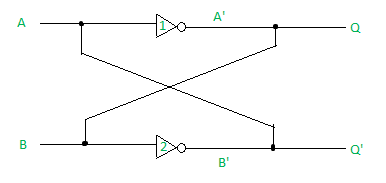
One Bit memory cell is also called Basic Bistable element. It has two cross-coupled inverters, 2 outputs Q and Q'. It is called "Bistable" as the basic bistable element circuit has two stable states logic 0 and logic 1. The following diagram shows the Basic Bistable element: 👁 Image
(A) when A=0,
(i) In inverter1, Q = A'= B= 1
(ii)In inverter2, Q' = B' = A = 0

(B) when A=1,
(i) In inverter1, Q = A'= B= 0
(ii)In inverter2, Q' = B' = A = 1
Some key points:
One-bit six transistor SRAM memory cell is volatile. Fast switching speed is its main advantage. It needs a constant power supply because of its volatility. The demand for faster and denser memory devices has seen memristors being proposed as replacements for flash memory, Static Random Access Memory (SRAM) and Random Access Memory (RAM). The most salient feature of memristors is its resistive switching ability that can retain resistance states for long periods despite without power supply. The One-bit non-volatile memory cell can be designed using transmission gates and memristor. Memristive devices have high switching speed, low energy consumption, non-volatile and small device size. The non-volatility of memristor used in designs as the information storage element provides retention ability of up to 10 years in the absence of power supply. The transmission gates used ensures that voltage is not lost through other components of the memory cell, thus improves the switching speed by providing a larger potential difference across the memristor. Other advantages of using memristors in memory devices are its long retention period, excellent endurance properties, and good scalability compared to NAND-based flash memory devices. Reference: DIGITAL ELECTRONICS - Atul P. Godse, Mrs. Deepali A. Godse IEEE XPLORE, Digital library - One-bit non-volatile memory cell using memristor and transmission gates.
Application of One bit memory cell (or Basic Bistable element)
1.Registers: A register is a gathering of the slightest bit memory cells that can store a double number. Registers are utilized in microchips, computerized signal processors, and other advanced frameworks for putting away information briefly.
2.Flip-flops: A flip-flop is a worthless memory cell that can store a parallel state. A flip-flop is utilized in computerized frameworks for synchronization, as well concerning putting away the condition of a sign.
3.Clock circuits: A clock circuit is a computerized circuit that creates an intermittent sign with a particular recurrence. The slightest bit memory cells are utilized in clock circuits to store the condition of the clock signal.
4.Counters: A counter is a computerized circuit that counts the quantity of clock cycles. The slightest bit memory cells are utilized in counters to store the count esteem.
5.Logic gets: The slightest bit memory cells can be utilized as building blocks in logic gets, for example, shift registers and multiplexers.