|
VOOZH | about |
|
VOOZH | about |
K-map is the best manual technique to solve Boolean equations but it becomes difficult to manage when number of variables exceed 5 or 6. So, a technique called Variable Entrant Map (VEM) is used to increase the effective size of k-map. It allows a smaller map to handle large number of variables. This is done by writing output in terms of input.
Now, let's see how to find SOP expression if a VEM is given.
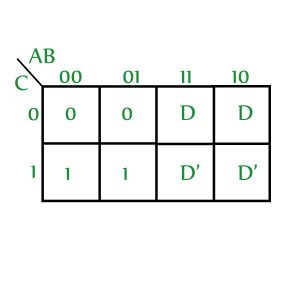
Let's apply the above procedure on a sample VEM (X is used to represent don't care):
👁 ImageStep 1:
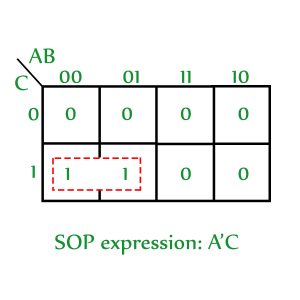
Write all the variables as 0 (D and D' are considered as two different variables), leave minterms, 0's and don't cares as it is and obtain the SOP expression. D and D' are considered distinct variables because VEM treats complemented and non-complemented forms as independent variables to help simplify the Boolean expression.
👁 ImageSOP obtained: A'C
Step 2:
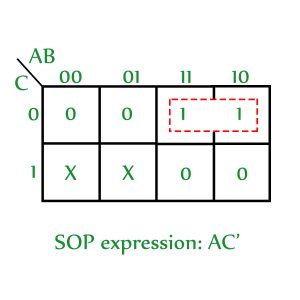
(a) Replace all occurrences of D with 1, all occurrences of D' with 0 and all 1's with don't care. Leave 0's and don't cares as it is.
👁 Image(b) Multiply the obtained SOP with the concerned variable.
SOP obtained: AC'D
Step 3:
Repeat step 2 for D' (the complement of D).
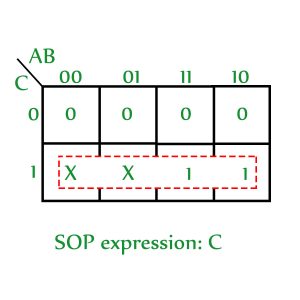
(a) Replace all occurrences of D' with 1, all occurrences of D with 0 and all 1's with don't care. Leave 0's and don't cares as it is.
👁 Image(b) Multiply the obtained SOP with the concerned variable.
SOP obtained: CD'
Step 4:
SOP of VEM is obtained by taking logical OR of all the obtained SOP expressions. Therefore, the SOP expression for the given VEM is:
A'C + AC'D + CD'
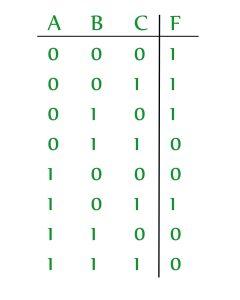
A 3-variable function can be defined as a function of 2-variables if the output is written in terms of third variable. Consider a function
F(A,B,C) = (0,1,2,5)
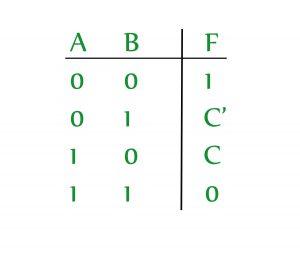
If we define F in terms of 'C', then this function can be written as:
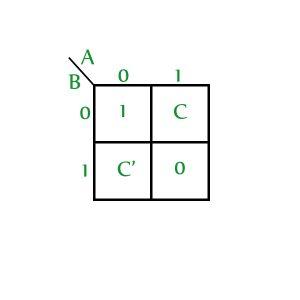
And the VEM for this is: