|
VOOZH | about |
|
VOOZH | about |
Numerical computations play an important role in solving real-life mathematical problems. Numerical methods are the procedures by applying arithmetic operations one can formulate mathematical problems to find the approximate result. In this, there is no need for algorithms, because numerical methods require the programming logic concept for the implementation. Following is the process of the numerical method,
There are different numerical methods for the solutions of the problem but the particular method depends on the situation from which the problem is taken. The following methods come under the concept of obtaining the roots of the equation.
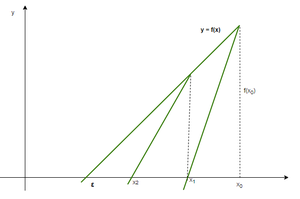
The Newton Raphson Method is one of the fastest methods among the bisection and false position methods. In this method, take one initial approximation instead of two. It is the process for the determination of a real root of an equation f(x) = 0 given just one point close to the desired root.
👁 ImageFormula for Newton raphson method: x1 = x0 - f(x0)/f'(x0)
Example: Find a root of an equation f(x) = x3 - x - 1
Solution:
Given equation x3 - x - 1 = 0
Using differentiate method the equation is,
∴ f′(x) = 3x2 - 1
Here, f(1) = -1 < 0 and f(2) = 5 > 0
∴ Root lies between 1 and 2
x0 = (1 + 2)/2 = 1.5
f(x0) = f(1.5) = 0.875
f′(x0) = f′(1.5) = 5.75
x1 = x0 - f(x0) / f′(x0)
=1.5 - 0.875/ 5.75
x1 = 1.34783
f(x1) = f(1.34783) = 0.10068
f′(x1) = f′(1.34783) = 4.44991
x2 = x1 - f(x1)/f′(x1)
= 1.34783 - 0.10068/4.44991
x2 = 1.3252
f(x2) = f(1.3252) = 0.00206
f′(x2) = f′(1.3252) = 4.26847
x3 = x2 - f(x2)/f′(x2)
=1.3252 - 0.00206/4.26847
x3 = 1.32472
f(x3) = f(1.32472) = 0
f′(x3) = f′(1.32472) = 4.26463
x4 = x3 - f(x3)/f′(x3)
=1.32472 - 0/ 4.26463
x4 = 1.32472
The Approximate root of the equation x3 - x - 1 = 0 using Newton Raphson method is 1.32472.
Advantages of Newton Raphson method
Disadvantages of Newton Raphson method
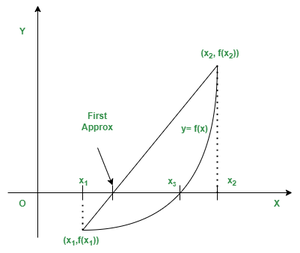
This method is the same as bisection but it is must faster than the bisection method. This is one of the oldest methods to find the real root of an equation f(x) = 0 and closely resembles with Bisection Method.
Formula for regular falsi method:
Example: Find a root of an equation f(x) = x3 - x - 1
Solution:
Given equation, x3 - x - 1 = 0
let x = 0, 1, 2
f(1) = -1 < 0 and f(2) = 5 > 0
Root lies between these two points x0 = 1 and x1 = 2
x2 = x0 - f(x0)
= x1 - x0
f(x1) - f(x0)
x2 = 1 - (-1)⋅
= 2 - 1
= 5 - (-1)
x2 = 1.16667
f(x2) = f(1.16667) = -0.5787 < 0
f(1.16667) = -0.5787 < 0 and f(2) = 5 > 0
Root lies between these two points x0 = 1.16667 and x1 = 2
x3 = x0 - f(x0)
= x1 - x0
f(x1) - f(x0)
x3 = 1.16667 - (-0.5787)
= 2 - 1.16667
= 5 - (-0.5787)
x3 = 1.25311
f(x3) = f(1.25311) = -0.28536 < 0
f(1.25311) = -0.28536 < 0 and f(2) = 5 > 0
Root lies between these two points x0 = 1.25311 and x1 = 2
x4 = x0 - f(x0)⋅
= x1 - x0
f(x1) - f(x0)
x4 = 1.25311 - (-0.28536)⋅
= 2 - 1.25311
= 5 - (-0.28536)
x4 = 1.29344
f(x4) = f(1.29344) = -0.12954 < 0
f(1.29344) = -0.12954 < 0 and f(2) = 5 > 0
Root lies between these two points x0 = 1.29344 and x1 = 2
x5 = x0 - f(x0)⋅
= x1 - x0
= f(x1) - f(x0)
x5 = 1.29344 - (-0.12954)⋅
= 2 - 1.29344
= 5 - (-0.12954)
x5 = 1.31128
f(x5) = f(1.31128) = -0.05659 < 0
f(1.31128) = -0.05659 < 0 and f(2) = 5 > 0
Root lies between these two points x0 = 1.31128 and x1 = 2
x6 = x0 - f(x0)⋅
= x1 - x0
= f(x1) - f(x0)
x6 = 1.31128 - (-0.05659)⋅
= 2 - 1.31128
= 5 - (-0.05659)
x6 = 1.31899
f(x6) = f(1.31899) = -0.0243 < 0
f(1.31899) = -0.0243 < 0 and f(2) = 5 > 0
Root lies between these two points x0 = 1.31899 and x1 = 2
x7 = x0 - f(x0)⋅
= x1 - x0
f(x1) - f(x0)
x7 = 1.31899 - (-0.0243)⋅
= 2 - 1.31899
= 5 - (-0.0243)
x7 = 1.32228
f(x7) = f(1.32228) = -0.01036 < 0
f(1.32228) = -0.01036 < 0 and f(2) = 5 > 0
Root lies between these two points x0 = 1.32228 and x1 = 2
x8 = x0 - f(x0)⋅
x1 - x0
f(x1) - f(x0)
x8 = 1.32228 - (-0.01036)⋅
= 2 - 1.32228
= 5 - (-0.01036)
x8 = 1.32368
The approximate root of the equation x3 - x - 1 = 0 using the Regula Falsi method is 1.32368.
Advantages of Regular falsi method
Disadvantages of Regular falsi method
| Sr. No. | Regular Falsi Method | Newton Raphson Method |
|---|---|---|
| 1. | The rate of convergence is superlinear. | Here, the rate of convergence is second-order or quadratic. |
| 2. | Formula is: | Formula is: x1 = x0 - f(x0)/f'(x0) |
| 3. | In this method, two initial approximations of the root are taken in which the root is expected to lie. | In this method, one initial approximation of the root is taken. |
| 4. | The computation of function per iteration is 1. | The computation of function per iteration is 2. |
| 5. | The initial approximation is less sensitive. | The initial approximation is very sensitive. |
| 6. | There is no need to find derivatives. | There is a need to find derivatives. |
| 7. | It is not applicable for finding complex, multiple, and nearly equal two roots. | It is applicable for finding complex, multiple, and nearly equal two roots. |