|
VOOZH | about |
|
VOOZH | about |
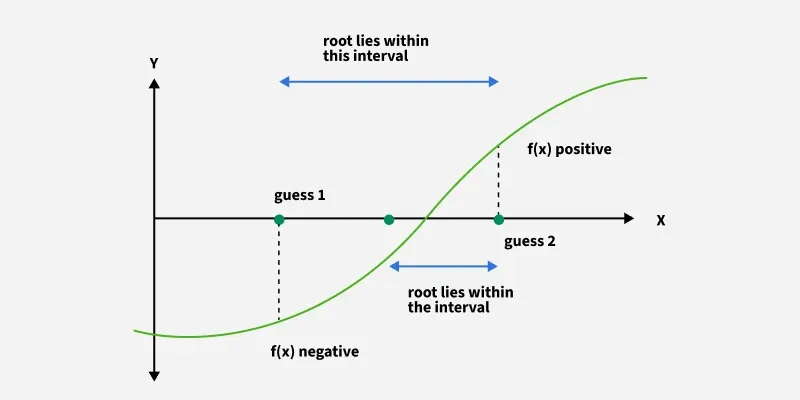
Regula Falsi Method, also known as the False Position Method, is a numerical technique used to find the roots of a non-linear equation of the form f(x)=0.
Regula Falsi Method is a numerical technique used to find the roots of a non-linear equation of the form f(x) = 0. This method is particularly useful when the function is continuous and the root is located between two points.
The Regula Falsi method uses the following formula to approximate the root:
Where,
To use Regula Falsi Method, we can use the following steps:
Step 1: Choose two initial points a and b such that function at those points have opposite sign i.e., f(a)⋅f(b) < 0.
Step 2: Calculate the point c where the linear approximation intersects the x-axis using the formula.
Step 3: Determine f(c).
- If f(c) ⋅ f(a) < 0, then the root lies between a and c. Set b = c.
- If f(c) ⋅ f(b) < 0, then the root lies between b and c. Set a = c.
Step 4: Repeat the steps until ∣f(c)∣ is less than a predefined tolerance level or the interval [a, b] is sufficiently small.
Example: the root of in the interval [1, 3].
Initial interval: a=1, b=3
f(b) =Apply the formula:
So, the first approximation of the root is c=1.75.
Repeat: Now, use c=1.75 to update the interval. Since , we continue iterating to find more accurate roots.This process would continue until f(c) is sufficiently close to 0.
Feature | Regula Falsi Method | Bisection Method | Newton-Raphson Method |
|---|---|---|---|
Initial Requirements | Requires two initial guesses a and b such that f(a).f(b)<0 | Requires two initial guesses 𝑎 and 𝑏 such that f(a).f(b)<0 | Requires one initial guess x0 |
Convergence Guarantee | Guaranteed if the function is continuous in [a, b] | Guaranteed if the function is continuous in [a, b] | Not guaranteed; depends on the choice of x0 and function behavior |
Convergence Speed | Linear, generally faster than Bisection but slower than Newton-Raphson | Linear, generally slow | Quadratic, generally very fast |
Formula | c = a− f(a)⋅(b−a)/f(b)−f(a) | c = a+b/2 | xn+1 = xn − f(xn)/ f ′(xn) |
Number of Function Evaluations | One per iteration | Two per iteration | One function and one derivative evaluation per iteration |
Derivative Requirement | Not required | Not required | Requires first derivative |
Application | Useful for non-differentiable functions | Useful for non-differentiable functions | Requires differentiable functions |
Efficiency | More efficient than Bisection, less efficient than Newton-Raphson | Least efficient of the three | Most efficient if the derivative is available and well-behaved |
Oscillatory Behavior | Can exhibit oscillatory behavior, slowing convergence | No oscillatory behavior | Can exhibit oscillatory behavior if initial guess is poor |
Handling Multiple Roots | May converge to the nearest root | Will find a root within the interval but not necessarily the nearest | May fail to find multiple roots or diverge if poorly initialized |
Problem 1 : Find the root of the equation f(x)=x3−x−2 in the interval [1,2].
Solution:
Lets assume Initial Points i.e., a=1, b=2
Now,
- f(1) = 13−1−2 = −2
- f(2) = 23−2−2 = 4
Since f(1) ⋅ f(2) < 0, the root lies between 1 and 2.
Iteration 1: c = a− [f(a)⋅(b−a)/f(b)−f(a)]
⇒ c = 1−[(−2)⋅(2−1)/4−(−2) ]
⇒ c = 1− (−2/6) = 4/3
⇒ c = 1.3333
and f(1.3333) = 1.33333 − 1.3333 − 2 = −0.1481Since f(2)⋅ f(1.3333) <0, update the interval to [4/3, 2].
Iteration 2: c = 1.3333− (−0.1481)⋅(2−1.3333)/4−(−0.1481)
⇒ c =1.3333−(−0.1481⋅0.6667/4.1481)
⇒ c = 1.3672
and f(1.3672) = 1.36723 − 1.3672 − 2 = 0.1197Since 𝑓(1.3333)⋅𝑓(1.3672)<0, update the interval to [1.3333,1.3672].
Iteration 3: c = 1.3333− (−0.1481)⋅(1.3672−1.3333)/0.1197−(−0.1481)
⇒ c =1.3513
and f(1.3513) = 1.35133 − 1.3513 − 2 = −0.0061Since 𝑓(1.3333)⋅𝑓(1.3513)<0, update the interval to [1.3513,1.3672].
Iteration 4: c = 1.3513− (−0.0061)⋅(1.3672−1.3513)/0.1197−(−0.0061)
⇒ c =1.3535
and f(1.3535) = 1.35353 − 1.3535 − 2 = 0.0003Since 𝑓(1.3513)⋅𝑓(1.3535)<0, update the interval to [1.3513,1.3535].
Iteration 5: c = 1.3513− (−0.0061)⋅(1.3535−1.3513)/0.0003−(−0.0061)
⇒ c =1.3520
and f(1.3520) = 1.35203 − 1.3520 − 2 = −0.0001Since, there are no significant changes in the value of approximate root.
Thus, the root is approximately x = 1.3522.
Problem 2: Find the root of the equation f(x) = cos(x) - x in the interval [0,1].
Solution:
Let the initial points be a = 0, b = 1
- f(0) = cos(0) − 0 = 1
- f(1) = cos(1) − 1 ≈ −0.4597
Since f(0)⋅ f(1) < 0, the root lies between 0 and 1.
Iteration 1: c = a−
⇒ c =0−
⇒ c = 1/1.4597
⇒ c =0.684
and f(0.684) = cos(0.684) − 0.684 ≈ 0.0894Since f(0)⋅f(0.684) < 0, update the interval to [0,0.684].
Iteration 2: c = 0− [1⋅(0.684−0)/0.0894−1]
⇒ c = 0.684/0.9106
⇒ c = 0.751
and f(0.751) = cos(0.751) − 0.751 ≈ −0.0189Since f(0.684)⋅f(0.751) < 0, update the interval to [0.684,0.751].
Iteration 3:
c = 0.684− (0.0894⋅(0.751−0.684))/(−0.0189−0.0894)
⇒ c = 0.739
and f(0.739) = cos(0.739) − 0.739 ≈ 0.0005Since f(0.684)⋅f(0.739)<0, update the interval to [0.684,0.739].
Iteration 4: c = 0.684− 0.0894⋅(0.739−0.684)/0.0005−0.0894
⇒ c =0.7391
and f(0.7391) = cos(0.7391) − 0.7391 ≈ 0.0000Since, there are no significant changes in the value of approximate root.
The root is approximately x = 0.7391.
Problem 1: Find the root of the equation f(x) = x2-4 in the interval [1,3] using the Regula Falsi method.
Problem 2: Solve f(x) = ex - 3x in the interval [0,1] using the Regula Falsi method.
Problem 3: Determine the root of f(x) = sin(x)−0.5x in the interval [1,2] using the Regula Falsi method.
Problem 4: Apply the Regula Falsi method to find the root of f(x) = log(x)+x−5 in the interval [1,3].
Problem 5: Use the Regula Falsi method to solve f(x) = x3+3x2−1 in the interval [0,1].
Read More,