|
VOOZH | about |
|
VOOZH | about |
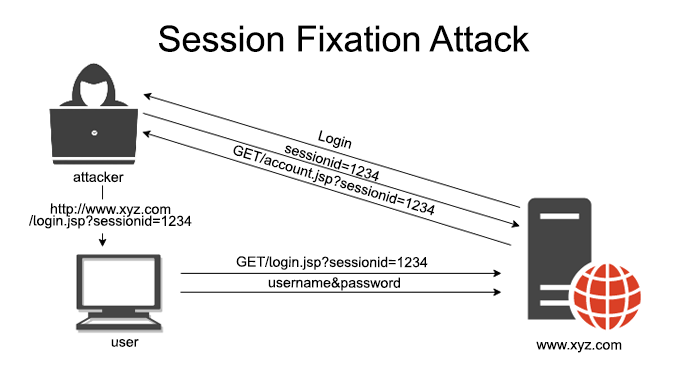
A session fixation attack is a type of remote code execution attack which is used to exploit software designed with the web-server Session Management feature. When a website is running an HTTP server, the server's session state information can be stolen and then retrieved by an attacker to take over the browser or use it for further attacks. There are many tools that can help you detect session fixation attacks in your organization in order to prevent future attacks. A Session fixation attack is also known as Session Fixation Vulnerability (SFV).
In this article, we will see a session fixation attack and why it is important to secure it against attackers. Further, this article will discuss some frameworks and tools that can help you find those vulnerabilities in your system.
For example, in a session fixation attack, the hacker provides the server with his client's session ID and is able to access any server he wants without the need for proper credentials.
This particular type of attack uses malicious scripts placed on websites to generate random ID sessions which aren't compliant with security standards. Hackers can utilize front-end validation services but are able to bypass them. One way hackers do this is by analyzing browser cookies for other people who were already on-site at one point during their visit, as well as what sites users have recently been to in order to ensure that they can provide the website with a legitimate ID session in order to get around any front end validation service put into place.
Session fixation has been a common attack vector for exploits that utilize the Java applet, which is a program that runs within the user's web browser. The hacker's script is able to detect when the user has left their browser, and can then re-establish a new session with the server.
In order to avoid this type of attack from taking place, users must always set Java security settings to 'high' to prevent this from happening. This basically means that all applications on the user's computer are required to be set up before they will be allowed to run.
Security testers can use the following methods to find or identify the Session Fixation vulnerabilities:
https://example.com/login?SESSIONID=XYZ123 # If the session is not regenerated, the site is vulnerable.There are three main techniques to force a user to use a fixed session:
https://example.com/login?SESSIONID=ABC123Note: If the web application does not regenerate the session ID after login, the attacker can simply use the same ID to access the victim’s account.
<form action="https://example.com/login" method="POST">
 <input type="hidden" name="SESSIONID" value="ABC123">
 <input type="text" name="username">
 <input type="password" name="password">
 <input type="submit" value="Login">
</form>document.cookie = "SESSIONID=ABC123; path=/; domain=example.com";HttpOnly and use the Secure flags to prevent JavaScript access.SameSite=Strict cookies to prevent cross-site session fixation attacks.Session hijacking and session fixation are two types of session-based security attacks that are different in how they leverage user sessions. In session hijacking, a malicious actor acquires an active session ID to impersonate a targeted user and gain access to restricted areas.In Session fixation is when an attacker uses different methods to make a victim session with a known or predetermined session ID that the attacker can control after the potential target logs in. Although both can lead to identity theft, unauthorized access, and data loss, they differ in their approaches, as well as their need for tailored preventative measures.
| Aspect | Session Hijacking | Session Fixation |
|---|---|---|
| Definition | An attacker steals an active session ID and uses it to impersonate the victim. | An attacker assigns a predefined session ID to the victim before login, allowing them to take over the session. |
| Attack Method | Intercepts or steals a session ID using packet sniffing, malware, or XSS. | Tricks the user into using a pre-set session ID via phishing, URL injection, or malicious scripts. |
| Session Ownership | The attacker steals an already active session. | The attacker fixes the session ID before the victim logs in. |
| When the Attack Occurs | After the victim logs in and establishes a session. | Before the victim logs in, using an attacker-controlled session ID. |
| Common Attack Techniques | Man-in-the-middle (MITM) attacks, packet sniffing, cross-site scripting (XSS), session sidejacking. | URL-based session IDs, hidden form fields, phishing emails, JavaScript injection. |
| Vulnerability Exploited | Weak session management, unencrypted session transmission, poor session expiration policies. | Weak session ID regeneration, accepting session IDs from URLs or external sources. |
| Impact | Full control over the victim’s active session, leading to data theft, financial fraud, and unauthorized actions. | Allows an attacker to seamlessly take over a victim’s session after they log in. |
| Prevention Techniques | Use HTTPS/TLS, enable secure cookie attributes (HttpOnly, Secure, SameSite=Strict), implement session timeout policies, use multi-factor authentication (MFA), and regenerate session IDs frequently. | Regenerate session IDs after login, disable session IDs in URLs, use secure cookies, implement CSRF protection, and enforce strong session expiration policies. |
There are several tools and frameworks you can use to detect Session Fixation attacks, but normally this kind of attack is detected by your security team or analysts. You need to be alert to invalid sessions and take measures to secure them against attacks. One of the most common ways is using Sessions Control page(s) or malicious scripts that detect whether a session is fixated or not.