Autocorrelation is a key concept in time series analysis that measures the relationship between a variable and its lagged values. It is widely used in finance, economics, weather forecasting and many other fields to identify trends, seasonality, and temporal dependencies in sequential data.
Understanding Autocorrelation in Time Series
Autocorrelation, measures how a time series relates to its past values where k is the lag. Unlike correlation between two different variables, autocorrelation examines the internal structure of a single series.
where
: Value at time
: Value at time
: Time lag between observations
: Covariance between current and lagged values
: Standard deviation of the respective values
value of lies between -1 and 1
Autocorrelation values near zero suggest little or no linear dependence between current and past observations. Autocorrelation can be computed at different lags to analyze short-term dependencies as well as long-term patterns, making it important for time series analysis and forecasting.
Use Case
Autocorrelation measures the relationship between current and past values in a time series and is widely used in trading to analyze market behavior.
Pattern Identification: Helps detect repeating trends or reversals by comparing present prices with past price movements.
Predicting Future Price Changes: Past autocorrelation patterns provide clues about whether prices are likely to continue a trend or reverse.
Smart Strategy Development: Enables traders to choose trend-following strategies during high autocorrelation and mean-reversion strategies during low or negative autocorrelation periods.
Risk Management: Assists in evaluating market volatility and stability, helping traders manage risk through informed stop-loss and position-sizing decisions.
Regression Analysis: Detects serial correlation in residuals, which violates linear regression assumptions.
Types of Autocorrelation
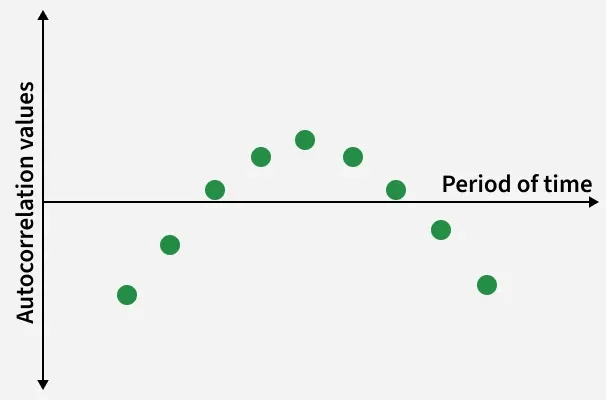
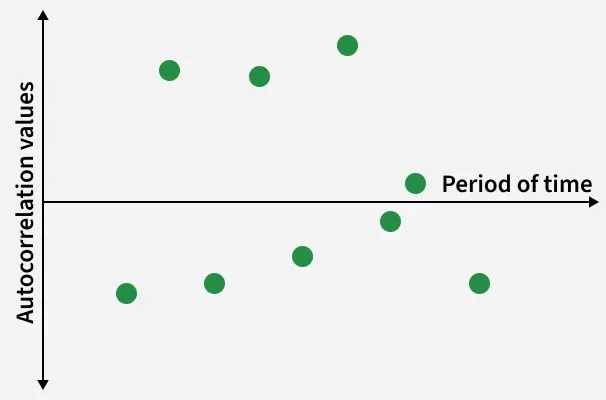
Positive autocorrelation indicates persistence where high values are likely to be followed by high values and low values by low values.
Autocorrelation measures the relationship between a time series and its lagged values. Below are the step-by-step instructions to compute autocorrelation
1. Preprocess the Data
Ensure the time-series data is properly ordered, cleaned, and free from missing or irrelevant values to avoid incorrect correlation results.
2. Calculate the Mean
Compute the mean of the time series, which serves as a reference for measuring deviations in data points.
3. Calculate the Variance
Calculate the variance of the time series to normalize the autocorrelation values.
4. Compute the Autocovariance
For a given lag k compute the autocovariance between the original series and its lagged version.
5. Compute the Autocorrelation Coefficient
Normalize the autocovariance by dividing it by the variance to obtain the autocorrelation coefficient.
6. Repeat for Different Lag Values
Compute autocorrelation coefficients for multiple lag values to analyze how dependency changes over time.
7. Visualize the Autocorrelation
Plot autocorrelation coefficients against their corresponding lags to obtain the Autocorrelation Function (ACF) plot which helps in identifying trends, seasonality and randomness in the data.
Detecting Autocorrelation Using the Durbin–Watson Test
The Durbin–Watson (DW) Test is a statistical test used to detect autocorrelation (serial correlation) in the residuals of a regression model. Autocorrelation occurs when the errors are related to their past values, which violates the assumptions of linear regression.
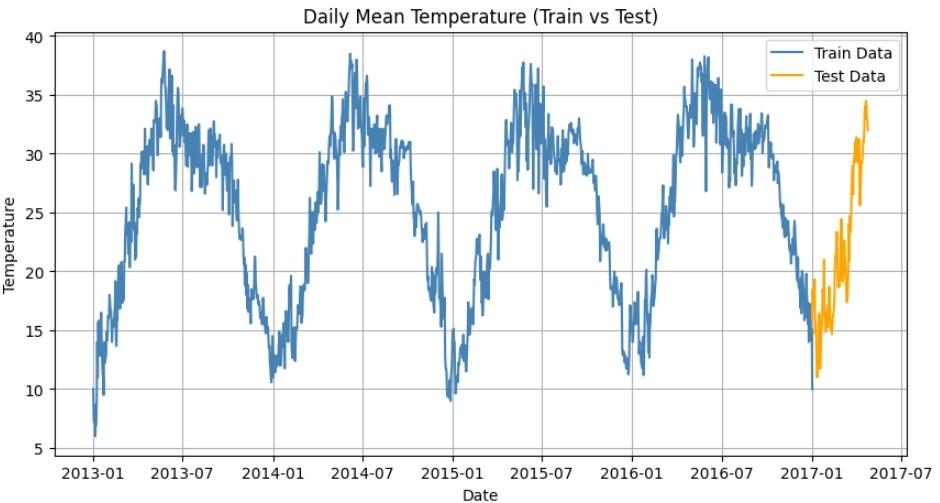
The graph compares daily mean temperatures for the training and testing datasets showing a clear seasonal pattern with repeating yearly peaks and troughs.
The test data (orange) follows the same trend as the train data (blue), indicating consistent temperature behavior over time.
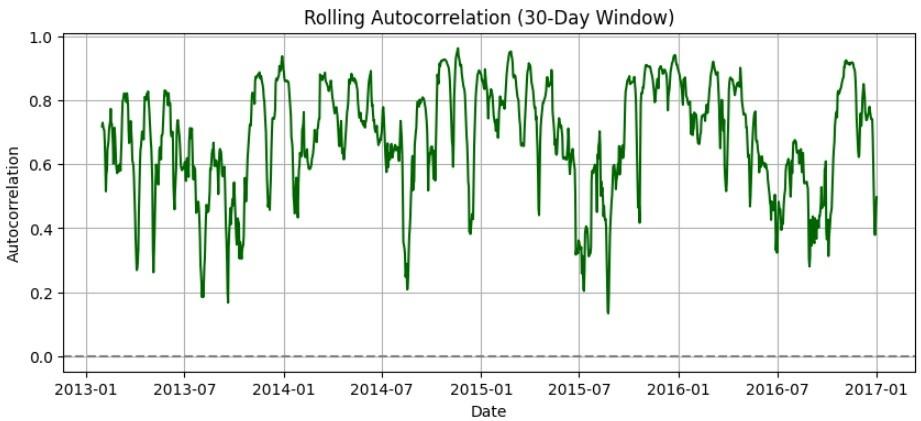
Step 8: Plot Rolling Autocorrelation
Visualize how autocorrelation varies across time.
Zero line helps distinguish positive and negative correlation.
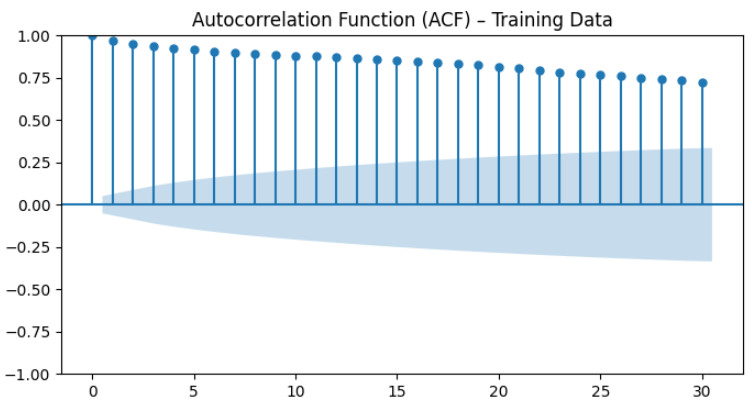
The ACF plot shows strong positive autocorrelation across multiple lags, indicating that daily mean temperatures are highly dependent on past values.
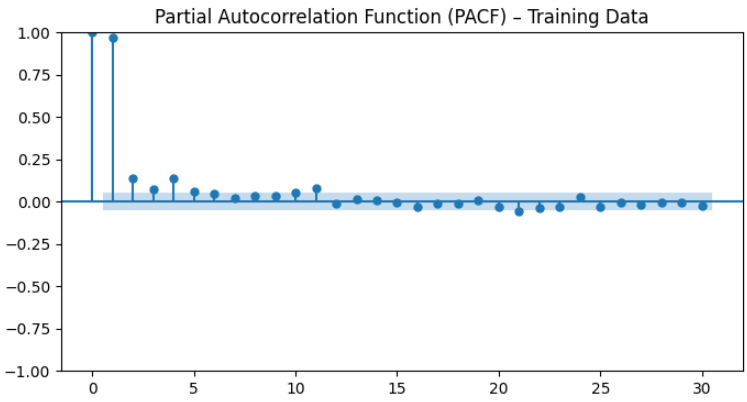
Step 10: Plot Partial Autocorrelation Function (PACF)
PACF shows direct correlation excluding intermediate lags.
Helps determine the order of autoregressive models.
Yule-Walker method ensures stable estimation.
Partial Autocorrelation measures the direct relationship between a time-series variable and its lagged values after removing the effect of intermediate lags. It helps identify the order of autoregressive (AR) models by showing significant direct dependencies.
The PACF plot shows a strong spike at lag 1 followed by insignificant values, indicating that the series is mainly influenced by its immediate past value.