Continuous Integration and Continuous Deployment (CI/CD) in MLOps
Last Updated : 22 Nov, 2025
In MLOps, Continuous Integration (CI) and Continuous Deployment (CD) help automate the development, testing and deployment of machine learning models. Adapting these practices from software engineering makes ML pipelines more reliable, consistent and easier to scale.
Why CI/CD is Needed in MLOps
Unlike traditional software, ML models depend on:
Code
Data
Features
Model artifacts
Infrastructure
Because these components change frequently, CI/CD pipelines help maintain reproducibility, quality and speed throughout the model lifecycle. Every update whether it’s new data, a changed hyperparameter or a bug fix must go through a structured pipeline to avoid unpredictable behavior in production.ext of MLOps
Continuous Integration (CI) in MLOps
CI in MLOps focuses on validating changes across multiple ML components.
Data Validation: Checks for schema changes, missing values, drift and anomalies.
Feature Validation: Ensures feature transformations remain consistent and correct.
Model Training Automation: Re-trains models automatically when new code/data is pushed.
Unit & Integration Tests: Tests for preprocessing pipelines, scripts and model behavior.
Model Evaluation Tests: Accuracy, precision, recall, ROC-AUC, fairness, explainability checks.
Outcome of CI: A validated ML model artifact stored in a model registry ready for deployment.
Continuous Deployment (CD) in MLOps
CD automates the release of validated ML models to production with safety checks. Key Components of CD in MLOps
1. Model Registry Integration: Automatically selects the newest validated model version.
2. Deployment Strategies:
Blue-Green Deployment: Two identical environments; switch traffic only when stable.
Canary Release: Release the model to a small portion of users first.
Shadow Deployment: New model runs parallelly without affecting real users.
3. Automated Performance Monitoring:
Model drift
Data drift
Latency and throughput
Real-time accuracy (where available)
4. Rollback Mechanisms: Automatically revert to the previous model if performance drops.
How CI/CD Improves the ML Lifecycle
Efficiency: Automates repetitive steps like training, testing, packaging and deployment.
Reliability: Prevents bad models from reaching production by enforcing checks.
Scalability: Makes it easy to manage multiple models across teams and environments.
Reproducibility: Tracks every version of data, code and model used in training.
Faster Experimentation: Data scientists can focus on modeling rather than DevOps work.
Example Project (Full CICD Workflow)
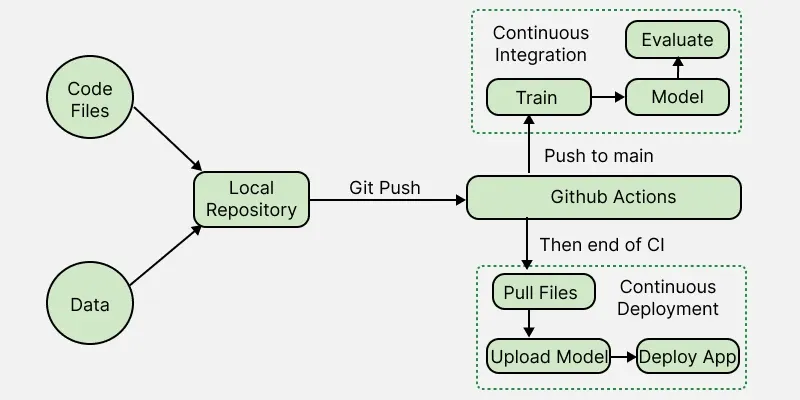
To understand CI/CD in MLOps, consider this simple project where we automate the entire ML workflow from training to deployment using scikit-learn, GitHub Actions, CML and Hugging Face Spaces.