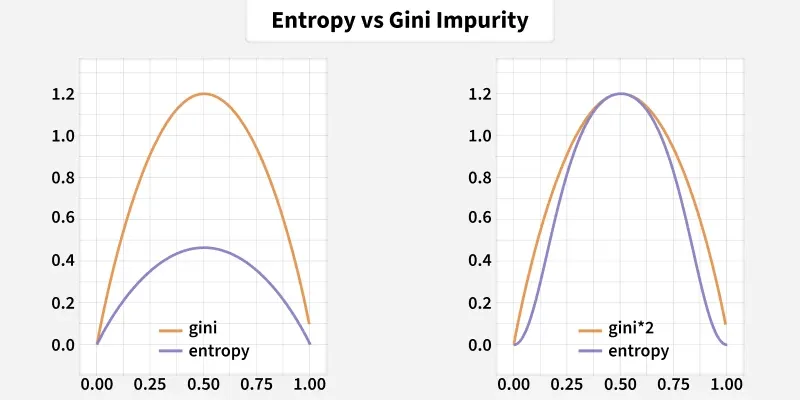
Decision Trees are classification models that split data into nodes based on feature values. To determine the best split, they rely on impurity metrics that evaluate how mixed a node’s class distribution is. Gini Impurity and Entropy are two measures used in decision trees to decide how to split data into branches. Both help determine how mixed or pure a dataset is, guiding the model toward splits that create cleaner groups.
Some common reasons why impurity criteria are essential in decision tree learning are:
Prevents random or uninformative splits that reduce predictive strength.
Helps isolate class boundaries for better interpretability.
Controls node quality and prevents over-growth of branches.
Reduces classification ambiguity by separating noisy samples.
Maintains model consistency across varied datasets.
1. Gini Impurity
Gini Impurity checks how often a randomly selected sample would be mislabeled if assigned by class probability. It is computationally simple and used in tree-based classifiers.
Formula:
Where is the probability of class .
Properties:
Lower values indicate cleaner and more homogeneous nodes.
Nodes become pure when all samples belong to one class.
Slightly biased toward dominant classes during split selection.
2. Entropy
Entropy measures uncertainty in a node’s class distribution and originates from information theory. Higher entropy indicates greater disorder among class labels.
Formula:
Where represents the proportion of class in the node.
Properties:
Zero entropy corresponds to perfectly pure splits.
Sensitive to small fluctuations across class ratios.
Often yields balanced splits with meaningful boundaries.
When To Prefer Which Metric?
Some scenarios where one metric may be more practical are:
Scenario
Gini Impurity
Entropy
Training Speed
Faster computation since it avoids log operations
Slightly slower due to logarithmic calculations
Split Behavior
Creates splits quickly, favoring dominant classes
Produces more balanced node partitions
Dataset Size
Efficient for large, high-dimensional datasets
Useful for structured datasets with balanced classes
Sensitivity to Distribution
Less sensitive to small probability changes
More sensitive to subtle probability differences
Common Usage
Often default in libraries like CART
Preferred when theoretical information gain matters
Customer Behavior Classification: Enables marketing segmentation by grouping users with similar interaction patterns, improving personalized outreach.
Medical Predictions: Assists in screening symptoms or diagnostic attributes, allowing healthcare systems to classify risk more accurately.
Quality Inspection: Detects faulty products by separating normal sensor readings from defective patterns within manufacturing pipelines.
Document Categorization: Organizes incoming text data into relevant topics, improving search and retrieval efficiency in large content systems.
Advantages
Some benefits of impurity based splitting include:
Clear Decision Boundaries: Each split expresses a simple logical condition, making the model inherently explainable and easy to visualize.
Reduced Ambiguity: Sibling branches become more homogeneous, improving consistency across the tree.
Improved Intermediate Node Quality: Refined node splits reduce the complexity needed in later branches, enhancing learning efficiency.
Strong Multi-Class Handling: Effectively separates overlapping classes in datasets with multiple labels.
Flexible Metric Choice: Developers can switch between metrics depending on dataset behavior and performance observations.
Disadvantages
Some disadvantages of impurity metrics are:
Bias Toward Many Unique Values: Features with many categories may appear informative artificially, leading to misleading splits.
Sensitivity to Noise and Imbalance: Noisy datasets or skewed class distributions can distort impurity measurements and reduce accuracy.
Potential for Deep Trees: Without constraints, impurity-driven expansion can increase depth and complexity unnecessarily.
Need for Pruning: Additional regularization techniques such as pruning or depth limits are required to control overfitting and maintain generalization.