Hinge-loss & Relationship with Support Vector Machines
Last Updated : 21 Aug, 2025
Hinge loss is a loss function widely used in machine learning for training classifiers such as support vector machines (SVMs). Its purpose is to penalize predictions that are incorrect or insufficiently confident in the context of binary classification. It is used in binary classification problems where the objective is to separate the data points in two classes typically labeled as +1 and -1. Mathematically, Hinge loss for a data point can be represented as :
Where,
y the actual class (-1 or 1).
f(x) the output of the classifier for the datapoint.
Relationship Between Hinge Loss and SVM
In SVMs, the goal is to find a hyperplane that separates classes with the widest possible margin, improving generalization. The model balances maximizing this margin and penalizing misclassified points through the hinge loss. The objective is:
where controls the trade-off between margin size and classification errors. Hinge loss ensures points are not only correctly classified but also confidently separated.
Step-by-Step Implementation
We will use iris dataset to construct a SVM classifier using Hinge loss.
Step 1: Import Necessary Libraries.
datasets: Contains standard datasets, like Iris.
train_test_split: For splitting data into learning (training) and testing parts.
SGDClassifier: Implements a linear SVM with hinge loss using stochastic gradient descent.
precision_score, recall_score, confusion_matrix: Evaluation metrics to gauge how well the classifier performs.
Step 2: Load the Dataset and Split Data into Training and Test Sets
load_iris() gives both feature data and target labels for the Iris flowers dataset, a standard for testing classifiers. X refers to the feature matrix (measurements) and y is the set of class labels.
Divides the dataset into a training set (for fitting the model) and a test set (for evaluating the model’s ability to generalize). Here, 33% is reserved for testing.
Step 3: Train an SVM Classifier with Hinge Loss, Make Predictions on the Test Set
SGDClassifier(loss="hinge") configures a linear SVM using the hinge loss function, just like traditional SVMs.
max_iter=1000 ensures enough learning steps for the optimizer to potentially converge to a good solution.
.fit(X_train, y_train) actually learns the hyperplane separating the classes, using only the training samples.
Applies the trained SVM model to the test data to predict labels, simulating how it would classify new, unseen examples.
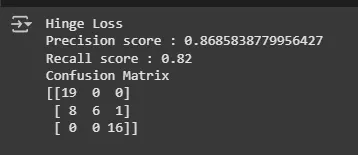
Step 4: Evaluate Model Performance
Precision: Measures how many predicted positives are truly positive.
Recall: Shows how many actual positives were correctly predicted.
Confusion Matrix: Breaks down the types of correct and incorrect predictions across all classes, useful for diagnosing performance in detail.