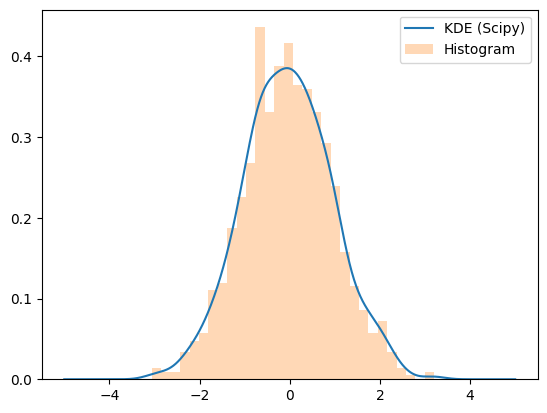
Kernel Density Estimation (KDE) is a non-parametric method used to estimate the probability density function (PDF) of a random variable. Unlike histograms, which use discrete bins, KDE provides a smooth and continuous estimate of the underlying distribution, making it particularly useful when dealing with continuous data.
Given a set of independent and identically distributed (i.i.d.) samples from an unknown distribution with density function , the goal is to estimate using only the samples.
The kernel density estimator at a point x is defined as:
Where:
is the number of data points.
is the bandwidth (smoothing parameter).
is the kernel function, which integrates to 1.
Each data point contributes a small "bump'' to the estimate, centered at , and scaled by the bandwidth . The final estimate is the sum of these bumps.
Kernel Functions
The kernel is typically a symmetric, non-negative function that integrates to 1. Common kernels include:
Kernel type
Function
Gaussian kernel
Epanechnikov kernel
Uniform kernel
Triangular kernel
The choice of kernel has a relatively minor impact on the final estimate compared to the choice of bandwidth .
Bandwidth Selection
The bandwidth parameter h determines the smoothness of the density estimate. It controls how much the individual data points contribute to the overall estimate.
A small bandwidth produces a spiky estimate that may overfit the data.
A large bandwidth smooths the estimate too much, potentially hiding important features.
Optimal Bandwidth Formula
A commonly used formula for bandwidth is the Silverman’s Rule of Thumb:
where:
σ is the standard deviation of the data.
n is the number of observations.
Multivariate KDE
For -dimensional data , KDE generalizes to:
Where:
is a symmetric positive-definite bandwidth matrix.
is a multivariate kernel (often a multivariate Gaussian).
Bandwidth matrix controls smoothing in different directions and correlations among dimensions.
Adaptive KDE: Instead of using a global bandwidth, adaptive KDE varies bandwidth locally depending on the density of data points. Lower bandwidth is used in dense regions, and higher bandwidth in sparse areas.
Fast KDE: Uses data structures like KD-trees or FFT-based convolutions to speed up computation. Libraries like statsmodels and sklearn offer optimized implementations.
Boundary Correction: When estimating densities near the edge of the support (e.g. non-negative variables), KDE underestimates the density. Solutions include reflection and transformation techniques.
Applications
Data Visualization: KDE provides clearer plots for understanding the shape of data distributions, particularly in large datasets.
Anomaly Detection: Points in low-density regions can be flagged as anomalies. KDE forms the basis for several unsupervised anomaly detection algorithms.
Mode Estimation: KDE allows for identifying peaks in the distribution, which correspond to modes.
Bayesian Inference: KDE is often used to approximate posterior distributions obtained via sampling (e.g. MCMC methods).
Image Processing: In image segmentation and denoising, KDE helps in estimating the intensity distribution of pixels.
Limitations and Challenges
Curse of Dimensionality: KDE performs poorly in high-dimensional spaces. As dimensions increase, data sparsity grows, and KDE requires exponentially more samples for a reliable estimate.
Computational Complexity: Evaluating the density at m points takes O(nm) time. This can be prohibitive for large datasets.
Bandwidth Selection: Choosing an optimal bandwidth is difficult and often problem-specific. Poor choices lead to under- or over-smoothing.