|
VOOZH | about |
|
VOOZH | about |
Prerequisites: Recurrent Neural Networks
To solve the problem of Vanishing and Exploding Gradients in a Deep Recurrent Neural Network, many variations were developed. One of the most famous of them is the Long Short Term Memory Network(LSTM). In concept, an LSTM recurrent unit tries to "remember" all the past knowledge that the network is seen so far and to "forget" irrelevant data. This is done by introducing different activation function layers called "gates" for different purposes. Each LSTM recurrent unit also maintains a vector called the Internal Cell State which conceptually describes the information that was chosen to be retained by the previous LSTM recurrent unit.
LSTM networks are the most commonly used variation of Recurrent Neural Networks (RNNs). The critical component of the LSTM is the memory cell and the gates (including the forget gate but also the input gate), inner contents of the memory cell are modulated by the input gates and forget gates. Assuming that both of the segue he are closed, the contents of the memory cell will remain unmodified between one time-step and the next gradients gating structure allows information to be retained across many time-steps, and consequently also allows group that to flow across many time-steps. This allows the LSTM model to overcome the vanishing gradient properly occurs with most Recurrent Neural Network models.
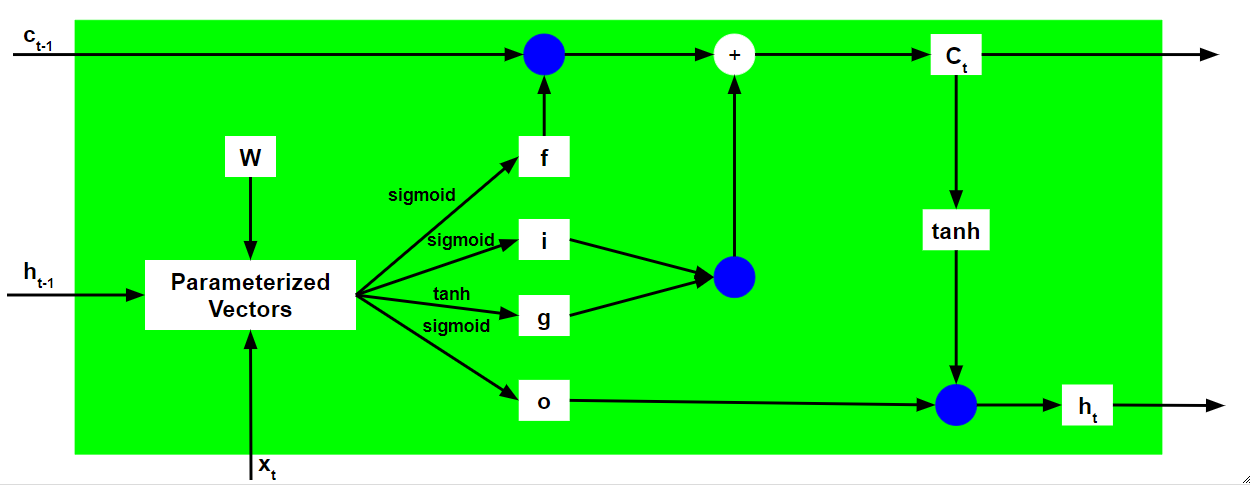
A Long Short Term Memory Network consists of four different gates for different purposes as described below:-
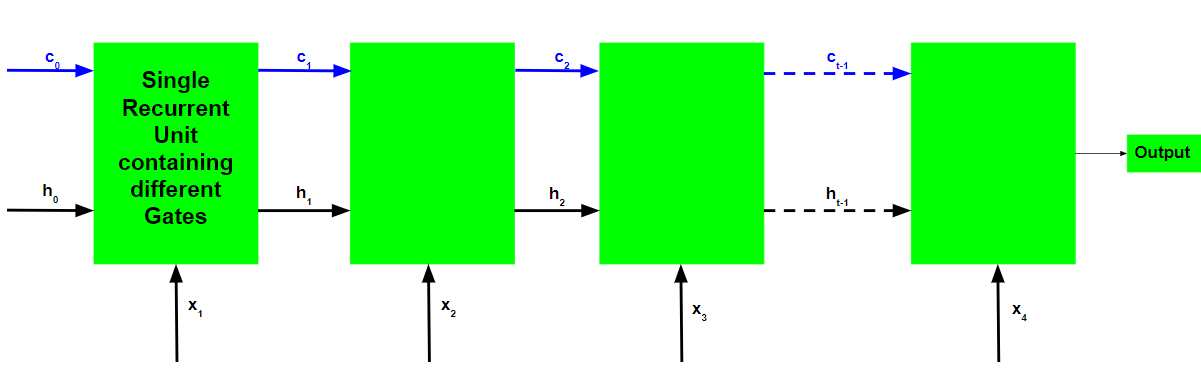
The basic workflow of a Long Short Term Memory Network is similar to the workflow of a Recurrent Neural Network with the only difference being that the Internal Cell State is also passed forward along with the Hidden State.
Working of an LSTM recurrent unit:
The above-stated working is illustrated as below:-
Note that the blue circles denote element-wise multiplication. The weight matrix W contains different weights for the current input vector and the previous hidden state for each gate.
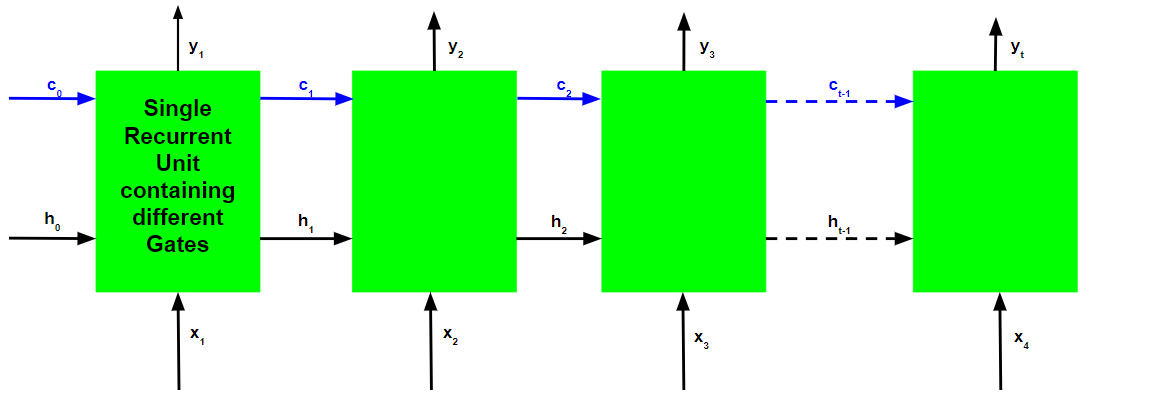
Just like Recurrent Neural Networks, an LSTM network also generates an output at each time step and this output is used to train the network using gradient descent.
The only main difference between the Back-Propagation algorithms of Recurrent Neural Networks and Long Short Term Memory Networks is related to the mathematics of the algorithm.
Let be the predicted output at each time step and be the actual output at each time step. Then the error at each time step is given by:-
The total error is thus given by the summation of errors at all time steps.
Similarly, the value can be calculated as the summation of the gradients at each time step.
Using the chain rule and using the fact that is a function of and which indeed is a function of , the following expression arises:-
Thus the total error gradient is given by the following:-
Note that the gradient equation involves a chain of for an LSTM Back-Propagation while the gradient equation involves a chain of for a basic Recurrent Neural Network.
How does LSTM solve the problem of vanishing and exploding gradients?
Recall the expression for .
The value of the gradients is controlled by the chain of derivatives starting from . Expanding this value using the expression for :-
For a basic RNN, the term after a certain time starts to take values either greater than 1 or less than 1 but always in the same range. This is the root cause of the vanishing and exploding gradients problem. In an LSTM, the term does not have a fixed pattern and can take any positive value at any time step. Thus, it is not guaranteed that for an infinite number of time steps, the term will converge to 0 or diverge completely. If the gradient starts converging towards zero, then the weights of the gates can be adjusted accordingly to bring it closer to 1. Since during the training phase, the network adjusts these weights only, it thus learns when to let the gradient converge to zero and when to preserve it.