|
VOOZH | about |
|
VOOZH | about |
Neural Networks and Machine Learning are two terms closely related to each other; however, they are not the same thing, and they are also different in terms of the level of AI. Artificial intelligence, on the other hand, is the ability of a computer system to display intelligence and most importantly learn from such data without the need for being programmed. Artificial neural networks are part of machine learning training algorithms based on the human brain's structure, allowing it to solve more complicated tasks, such as image and voice recognition.
In this article, we will explore What is Machine Learning, what are Neural Networks, Machine Learning Neural Networks, and the Integration of Neural Networks in Machine Learning.
Table of Content
Machine Learning (ML) is a paradigm of AI allowing algorithms to adapt to data, to make a prediction, without being explicitly programmed. Machine learning is centred on developing methods and models that can tend to classify, learn, decide and adapt based on experience. Instead of operating in a scripted way, as prescribed by the developer, ML systems reshape and fine-tune their behaviour on the data received. ML can be used to perform several tasks such as classification, prediction, and optimization among others due to the ability to analyze large data sets and come up with features that may be! Hard for a man to perceive. The goal is to make the systems able to give a response that will apply to other problems that a system has never encountered before.
Neural Networks are a set of machine learning algorithms that imitate the brain's neural structure comprising of neurons connected to form layers. Every neuron receives inputs, multiplies them with a weight, and passes through an activation function to give the output, in a way that is somewhat similar to the functioning of biological neurons. These networks have an input layer, one or more hidden layers, and an output layer which enable the network to learn complicated patterns and representations of data. Neural networks also work by making changes in the values at the interior of the network (weights and biases), which is done using backpropagation to minimize the amount of error in predictions. It is especially beneficial when one needs to deal with data where the relations between the variables are complex and nonlinear: image recognition or NLP and game AI, for example.
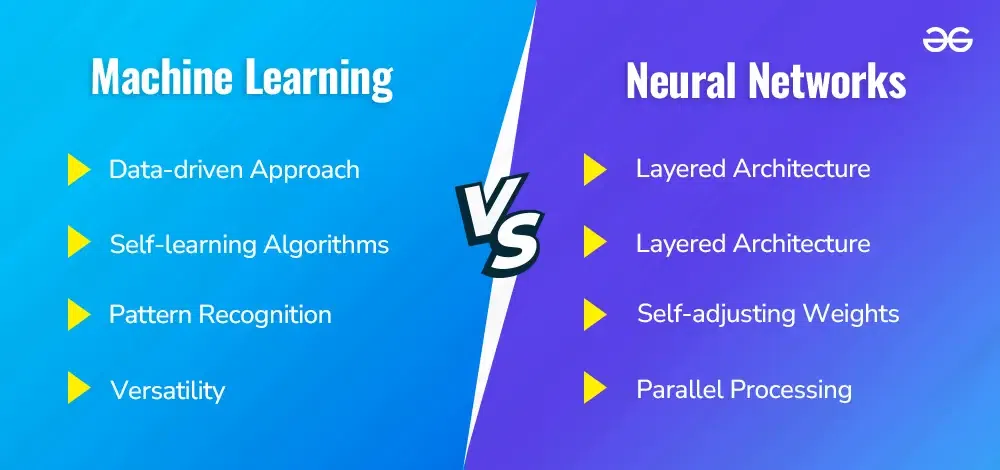
Parameters | Machine Learning | Neural Networks |
|---|---|---|
Definition | ML is a broad field of AI focused on creating models that learn from data to make decisions or predictions. | NNs are a subset of ML, inspired by the human brain, consisting of layers of neurons that hierarchically process data. |
Scope | Encompasses various algorithms, including regression, decision trees, SVMs, clustering, and NNs. | Primarily focused on deep learning models like CNNs, RNNs, and fully connected NNs. |
Data Processing | Can work on both structured and unstructured data using various techniques. | Specializes in working with unstructured, high-dimensional data like images, videos, and audio. |
Model Interpretability | Models like linear regression, decision trees, and k-NN are generally more interpretable and easier to explain. | NNs, especially deep networks, are often considered "black boxes" due to complex layer interactions. |
Training Complexity | Simpler ML algorithms (e.g., linear regression) have lower training complexity. | NNs, especially deep learning models, require high computational power and time to train. |
Learning Mechanism | Can involve supervised, unsupervised, or reinforcement learning, depending on the algorithm. | Primarily uses supervised learning, though unsupervised and reinforcement learning variants (e.g., GANs, Q-networks) exist. |
Performance with Big Data | Traditional ML models may struggle with very large datasets. | NNs are well-suited for handling massive datasets and benefit from larger amounts of data. |
Feature Engineering | Requires significant feature engineering to improve model performance. | NNs often require little to no manual feature engineering, as they learn feature representations directly from data. |
Use of Layers | No layered architecture; models are typically a function of input and output. | Utilizes multiple layers (input, hidden, output) to progressively extract high-level features from raw data. |
Handling Non-linearity | Many traditional ML algorithms (e.g., linear regression) struggle with non-linear relationships. | NNs excel at capturing complex, non-linear relationships in data through activation functions. |
Generalization | Performance on unseen data depends on the chosen algorithm and the quality of feature selection. | NNs can generalize well but are prone to overfitting if not properly regularized (e.g., using dropout, L2 regularization). |
Parallel Processing | Many traditional ML algorithms are not inherently parallelizable. | NNs can take advantage of parallel processing with GPUs, especially during training phases |
Real-time Processing | Traditional ML models can be adapted for real-time applications but may need optimization. | NNs, especially with architectures like RNNs or LSTMs, are effective for real-time applications like language translation and video analysis. |
1. Subset of Machine Learning: Neural network is one of the popular techniques of ML model. These are classified according to the type of task involved and the type of data to be used as; supervised, unsupervised and reinforcement learning.
2. Deep Learning:Deep learning has emerged as an offshoot of neural networks where the model includes two or more hidden layers also called as deep neural networks. Neural networks are further developed into deep learning that solves complicated tasks such as image and speech and natural language processing and robotic control systems.
3. Feature Learning: This makes the latter vastly different from most of the classic ML algorithms that can only be applied when the features are extracted from the data beforehand. For this reason, NNs are very well applied in unstructured data such as images, videos, and text.
4. Combining with Other ML Techniques: It is also noteworthy that neural networks can be used with other machine learning models. For instance:
5. Transfer Learning: This concept utilises pre-trained neural networks (which are often deep learning models) in a broader context of ML systems, enabling anytime new models to be trained for a specific task to be applied to other slightly similar tasks. That helps in cutting down the training time and yields high outcomes in areas such as computer vision and NLP.
6. Model Optimization: Backpropagation and gradient descent being the most needed algorithms for training neural networks are also implemented with other broader ML optimization strategies.
In conclusion, it can be stated that Neural networks are a powerful subset of machine learning that have greatly contributed to fields such as computer vision, natural language processing and robotics. Although they are capable of sub-optimally learning intricate patterns from huge amounts of data, the prime limitations like data requisites, interpretability of decisions, computational conceit and susceptibility to adversarial attacks impede the approaches. The enhancement of neural networks into broader systems of machine learning improves the efficiency of models, however, brings complexity such as overfitting and longer training intervals. Thus, overcoming these challenges demands constant improvements in optimization methods, ethical standards, and computer technologies to achieve the potential of the application in full.