|
VOOZH | about |
|
VOOZH | about |
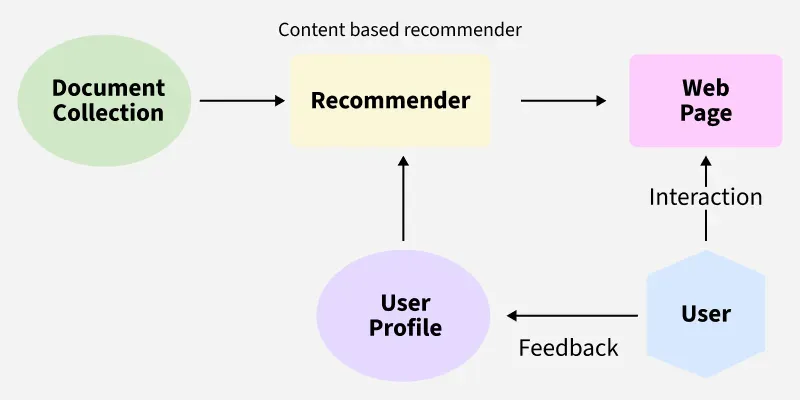
Recommendation systems are an important part of many digital platforms, like for suggesting movies on Netflix, recommending products on Amazon etc. Among the different types of recommendation approaches, Content-Based Recommender Systems focus on the characteristics of items and the preferences of users to generate personalized recommendations. It uses information about a user’s past behavior and item features to recommend similar items.
This can include explicit feedback such as ratings or even implicit feedback like clicks, views or time spent on content. Based on this data, the system generates a user profile, which is then used to find items that closely match the user's preferences. As time passes, the user continues to interact with the system which results in more accurate and relevant suggestions.
The User Profile is a representation of the user’s preferences. We model it as a feature vector, capturing characteristics of items the user liked or interacted with.
Example: If a user likes action movies directed by Christopher Nolan and starring Christian Bale, their profile may have high weights for the features “action” “Christopher Nolan” and “Christian Bale”
Each item is also represented as a vector of relevant features. Key features depend on the domain:
The item profile captures the essence of what the item is about. This information is later compared with the user profile to measure similarity.
The Utility Matrix represents the preferences of users for different items. Each row corresponds to a user and each column corresponds to an item. The matrix can be partially filled, as users rarely rate or interact with all available items.
| User / Movie | Inception | The Dark Knight | Interstellar | The Notebook |
|---|---|---|---|---|
| User A | 5 | 4 | 5 | 1 |
| User B | 4 | 5 | ? | ? |
Some of the columns are blank in the matrix that is because we don’t get the whole input from the user every time, and the goal of a recommendation system is not to fill all the columns but to recommend a movie to the user which they will prefer.
Once the user and item profiles are created the system must determine how well each item aligns with the user's preferences. Two common approaches are:
Cosine similarity is used to measure the angle between the user vector and the item vector. The smaller the angle (closer to 0), the higher the similarity.
Formula:
Where:
A higher similarity score indicates a better match and such items are recommended to the user.
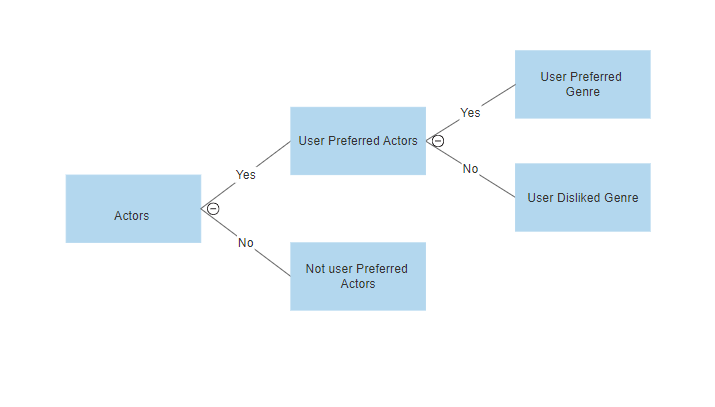
Instead of calculating similarities, we can treat recommendation as a classification problem, predicting whether a user will like or dislike an item.
This approach can be extended using:
It works well when we have labeled data and want more interpretable rules for recommendations.
Content-Based Recommender Systems offer a way to suggest items by analyzing user behavior and item attributes. They come with limitations but their effectiveness can be increased when combined with other techniques in hybrid models.
Other type of recomedation sytems is Collaborative Filtering which you can refer from: Collaborative Filtering in Machine Learning