Online vs. Offline Feature Store: Understanding the Differences and Use Cases
Last Updated : 23 Jul, 2025
In the realm of machine learning (ML) and data engineering, feature stores have emerged as crucial components for managing and serving features to models. As organizations increasingly recognize the importance of leveraging data for predictive analytics, the choice between online and offline feature stores becomes pivotal.
A feature store is a centralized repository for storing, sharing, and managing features used in machine learning models. It acts as a bridge between raw data and model training/deployment, ensuring that features are consistently defined, versioned, and accessible across different teams and projects.
Types of Feature Stores
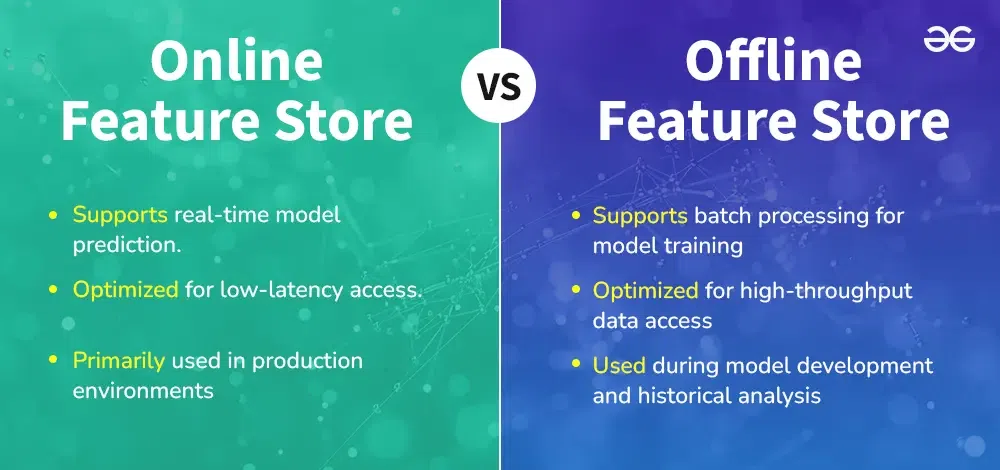
Online Feature Store: Primarily designed to serve real-time features to production models. These feature stores enable low-latency access, ensuring that models can respond quickly to incoming data.
Offline Feature Store: Used primarily for batch processing, these stores are optimized for training and validating models. They often handle large volumes of historical data and are not concerned with real-time performance.
Online Feature Store: Characteristics and Use Cases
Characteristics
Low Latency: Online feature stores are optimized for quick access, typically in milliseconds. They use in-memory databases or highly performant databases to minimize response time.
Real-time Data Ingestion: These systems can handle data streams, allowing for real-time feature computation as new data arrives.
Scalability: Designed to scale horizontally to accommodate varying loads of requests from models in production.
Consistency and Freshness: Online feature stores ensure that the features served to models are fresh and consistent with the latest data.
Use Cases
Real-Time Predictions: Applications like fraud detection, recommendation systems, or dynamic pricing require instant feature access to make timely predictions.
Interactive Applications: User-facing applications that need to adapt quickly based on user behavior or environmental factors benefit from online feature stores.
A/B Testing: Running experiments where features need to be served consistently across different user segments in real-time.
Offline Feature Store: Characteristics and Use Cases
Characteristics
Batch Processing: Offline feature stores are geared towards batch operations, where large datasets can be processed to generate features for model training.
Historical Data Access: They store extensive historical data, enabling the analysis of trends and the creation of features that depend on long-term data patterns.
Data Transformation: Offline stores typically support complex data transformations and aggregations that can take time but enhance the quality of features.
Version Control: Offline feature stores often include version control mechanisms, allowing teams to track changes in features over time.
Use Cases
Model Training: When developing new models or retraining existing ones, offline feature stores provide the necessary historical features to inform the training process.
Batch Scoring: In situations where predictions are needed for a large dataset rather than in real-time, offline feature stores enable efficient scoring.
Data Exploration: Data scientists can use offline stores for exploratory data analysis, helping them understand feature significance before moving to production.
Key Differences Between Online and Offline Feature Stores
Feature
Online Feature Store
Offline Feature Store
Latency
Low (milliseconds)
High (seconds to minutes)
Data Access
Real-time, often streaming
Batch-oriented, historical
Use Cases
Real-time predictions, interactive apps
Model training, batch scoring, data analysis
Data Volume
Typically handles smaller, more current datasets
Capable of managing large historical datasets
Infrastructure
Requires high-performance databases
Can utilize distributed systems or data lakes
Consistency
Must ensure real-time data freshness
Focuses on historical accuracy and reliability
Choosing the Right Feature Store
The decision between an online and offline feature store largely depends on the specific needs of an organization and its applications:
Nature of the Application: If your application requires real-time predictions, an online feature store is essential. For applications primarily focused on model development and batch processing, an offline feature store is more appropriate.
Data Volume and Velocity: Consider the speed at which data arrives and how much historical data needs to be processed. High-velocity, high-volume environments may benefit from a hybrid approach.
Team Structure and Expertise: Organizations with specialized teams focusing on either real-time applications or data science may choose to implement separate stores to optimize for their respective workflows.
The Future of Feature Stores
As machine learning continues to evolve, the concept of feature stores is also advancing. Many modern feature stores now offer hybrid capabilities, allowing organizations to handle both online and offline features within a unified framework. This convergence provides a more streamlined approach to managing features, reducing complexity and ensuring consistency across different stages of the ML lifecycle.
Conclusion
In summary, understanding the differences between online and offline feature stores is critical for organizations looking to effectively leverage machine learning. By evaluating the specific requirements of applications, data characteristics, and team capabilities, organizations can make informed decisions about their feature management strategies. As the ML landscape continues to grow, so too will the technologies and methodologies surrounding feature stores, ensuring that they remain at the forefront of data-driven decision-making