|
VOOZH | about |
|
VOOZH | about |
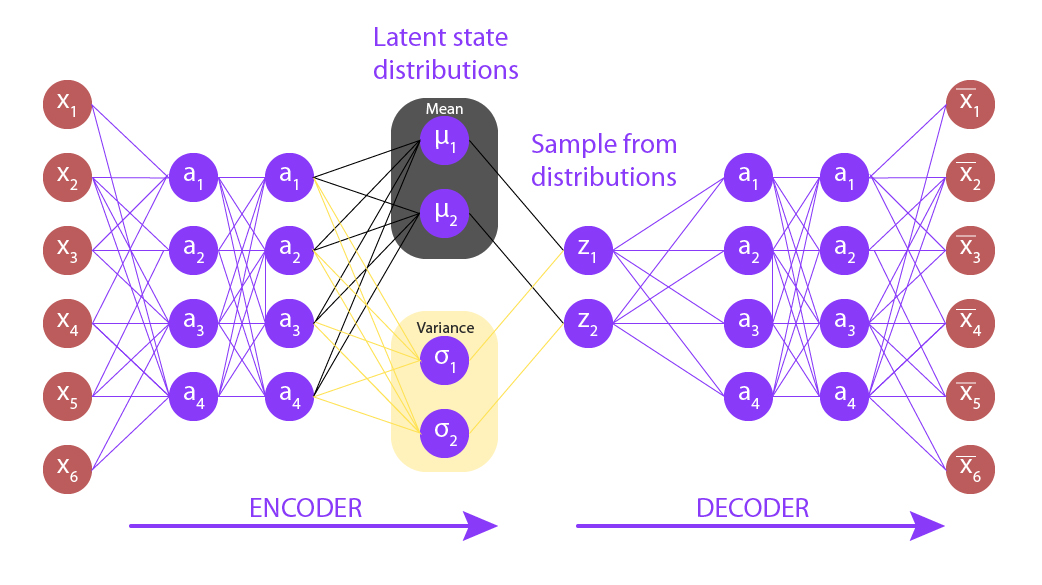
Variational autoencoder was proposed in 2013 by Knigma and Welling at Google and Qualcomm. A variational autoencoder (VAE) provides a probabilistic manner for describing an observation in latent space. Thus, rather than building an encoder that outputs a single value to describe each latent state attribute, we’ll formulate our encoder to describe a probability distribution for each latent attribute.
Autoencoders basically contains two parts:
Variational autoencoder is different from autoencoder in a way such that it provides a statistical manner for describing the samples of the dataset in latent space. Therefore, in the variational autoencoder, the encoder outputs a probability distribution in the bottleneck layer instead of a single output value.
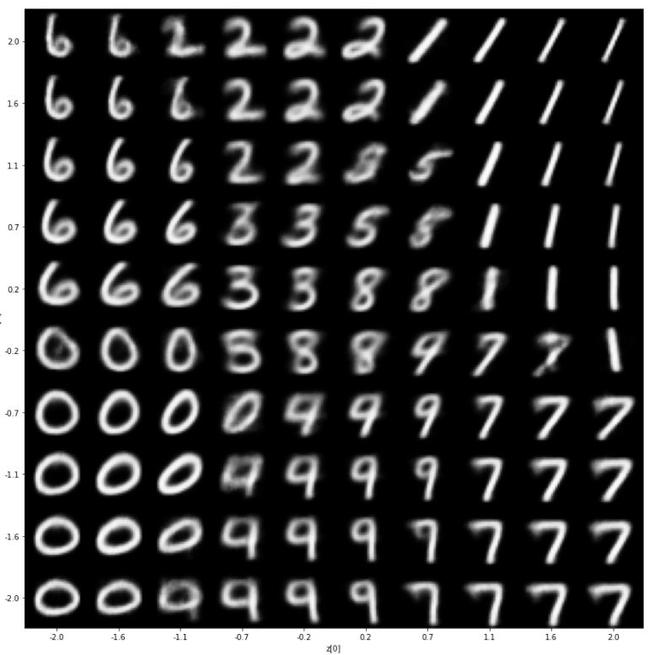
👁 ImageThe Variational Autoencoder latent space is continuous. It provides random sampling and interpolation. Instead of outputting a vector of size n, the encoder outputs two vectors:
Output is an approximate posterior distribution q(z|x). Sample from this distribution to get z. let's look at more details into Sampling:
KL divergence stands for Kullback Leibler Divergence, it is a measure of divergence between two distributions. Our goal is to Minimize KL divergence and optimize ???? and ???? of one distribution to resemble the required distribution.Of
For multiple distribution the KL-divergence can be calculated as the following formula:
where X_j \sim N(\mu_j, \sigma_j^{2}) is the standard normal distribution.
Suppose we have a distribution z and we want to generate the observation x from it. In other words, we want to calculate
We can do it by following way:
But, the calculation of p(x) can be quite difficult
This usually makes it an intractable distribution. Hence, we need to approximate p(z|x) to q(z|x) to make it a tractable distribution. To better approximate p(z|x) to q(z|x), we will minimize the KL-divergence loss which calculates how similar two distributions are:
By simplifying, the above minimization problem is equivalent to the following maximization problem :
The first term represents the reconstruction likelihood and the other term ensures that our learned distribution q is similar to the true prior distribution p.
Thus our total loss consists of two terms, one is reconstruction error and the other is KL-divergence loss:
In this implementation, we will be using the MNIST dataset, this dataset is already available in keras.datasets API, so we don't need to add or upload manually.
Model: "encoder"
__________________________________________________________________________________________________
Layer (type) Output Shape Param # Connected to
==================================================================================================
input_3 (InputLayer) [(None, 28, 28, 1)] 0
__________________________________________________________________________________________________
conv2d_2 (Conv2D) (None, 14, 14, 32) 320 input_3[0][0]
__________________________________________________________________________________________________
conv2d_3 (Conv2D) (None, 7, 7, 64) 18496 conv2d_2[0][0]
__________________________________________________________________________________________________
flatten_1 (Flatten) (None, 3136) 0 conv2d_3[0][0]
__________________________________________________________________________________________________
dense_2 (Dense) (None, 16) 50192 flatten_1[0][0]
__________________________________________________________________________________________________
z_mean (Dense) (None, 2) 34 dense_2[0][0]
__________________________________________________________________________________________________
z_log_var (Dense) (None, 2) 34 dense_2[0][0]
__________________________________________________________________________________________________
sampling_1 (Sampling) (None, 2) 0 z_mean[0][0]
 z_log_var[0][0]
==================================================================================================
Total params: 69, 076
Trainable params: 69, 076
Non-trainable params: 0
__________________________________________________________________________________________________
Model: "decoder"
_________________________________________________________________
Layer (type) Output Shape Param #
=================================================================
input_4 (InputLayer) [(None, 2)] 0
_________________________________________________________________
dense_3 (Dense) (None, 3136) 9408
_________________________________________________________________
reshape_1 (Reshape) (None, 7, 7, 64) 0
_________________________________________________________________
conv2d_transpose_3 (Conv2DTr (None, 14, 14, 64) 36928
_________________________________________________________________
conv2d_transpose_4 (Conv2DTr (None, 28, 28, 32) 18464
_________________________________________________________________
conv2d_transpose_5 (Conv2DTr (None, 28, 28, 1) 289
=================================================================
Total params: 65, 089
Trainable params: 65, 089
Non-trainable params: 0
_________________________________________________________________
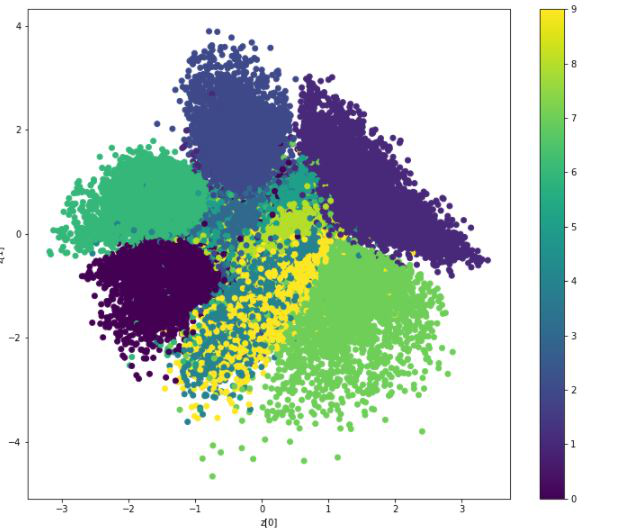
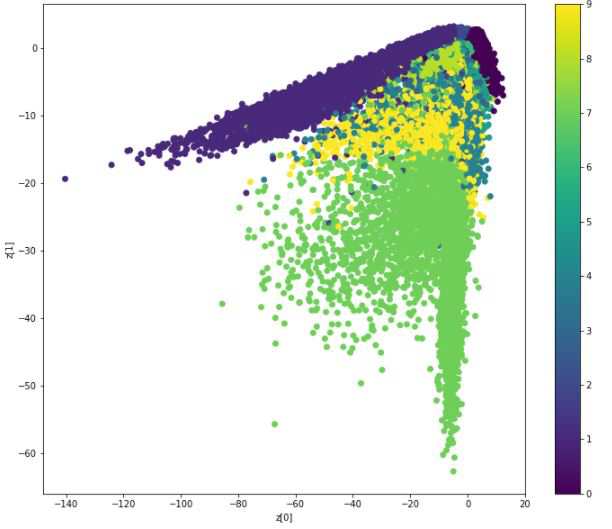
Here, we can see that the distribution is not separable and quite skewed for different values, that's why we use KL-divergence loss in the above variational autoencoder.
References: