|
VOOZH | about |
|
VOOZH | about |
In machine learning, optimizers and loss functions are two components that help improve the performance of the model. A loss function measures the performance of a model by measuring the difference between the output expected from the model and the actual output obtained from the model. Mean square loss and log loss are some examples of loss functions. The optimizer helps to improve the model by adjusting its parameters so that the loss function value is minimized. SGD, ADAM, and RMSProp are some examples of optimizers. The focus of this article will be the various loss functions supported by the SGD module of Sklearn. Sklearn provides two classes of SGD: SGDClassifier for classification tasks and SGDRegressor for regression tasks.
Stochastic Gradient Descent (SGD) is a variant of the gradient descent algorithm. Gradient descent is an iterative optimization technique used to minimize a given loss function and find the global minimum or maximum. This loss function can take various forms, as long as it is differentiable. Here's a breakdown of the process:
Gradient descent has a drawback when dealing with large datasets. It requires using the entire training dataset to update the model's parameters. When dealing with millions of records, this process becomes slow and computationally expensive.
Stochastic Gradient Descent (SGD) addresses this issue by using only a single randomly selected data point (or a small batch of data points) to update the parameters in each iteration. However, SGD still suffers from slow convergence because it necessitates performing forward and backward propagation for every individual data point. Additionally, this approach leads to a noisy path toward the global minimum.
The SGD classifier supports the following loss functions:
Hinge loss serves as a loss function in training of classifiers. It is employed specifically in 'maximum margin' classification with SVMs being a prominent example.
Mathematically, Hinge loss can be represented as :
Here,
Lets understand it with the help of below graph:
We can identify three cases in the loss function
Case 1: Correct Classification and |y| ≥ 1
In this case the product t.y will always be positive and its value greater than 1 and therefore the value of 1-t.y will be negative. So, the loss function value max(0,1-t.y) will always be zero. This is indicated by the green region in above graph. Here there is no penalty to the model.
Case 2: Correct Classification and |y| < 1
In this case the product t.y will always be positive, but its value will be less than 1 and therefore the value of 1-t.y will be positive with value ranging between 0 to 1. Hence the loss function value will be the value of 1-t.y. This is indicated by the yellow region in above graph. Here though the model has correctly classified the data we are penalizing the model because it has not classified it with much confidence (|y| < 1) as the classification score is less than 1.
Case 3: Incorrect Classification
In this case the product t.y will always be negative therefore the value of 1-t.y will be always positives. So the loss function value max(0,1-t.y) will always be the value given by 1-t.y. Here the loss value will increase linearly with increase in value of y. This is indicated by the red region in above graph.
Huber loss is a loss function used in regression. Its variant for classification is called as modified Huber loss.
Mathematically the Huber Loss can be expressed as
if, and otherwise.
Here,
The modified Huber loss can be graphically represented as:
For values of yt > -1 (the light red, yellow and green area in the graph) it is basically hinge loss squared.
For values of yt <-1 the loss function value is -4yt indicated by the dark red area in graph.
Log loss or binary entropy loss is the loss function used for logistic regression.
Mathematically, it can be expressed as:
Here, we have two classes - Class 1 and Class 0
Case Class 1: Second term in the equation becomes 0 and we will be left with first term only.
Case Class 0: First term in the equation becomes 0 an wee will be left with the second term only.
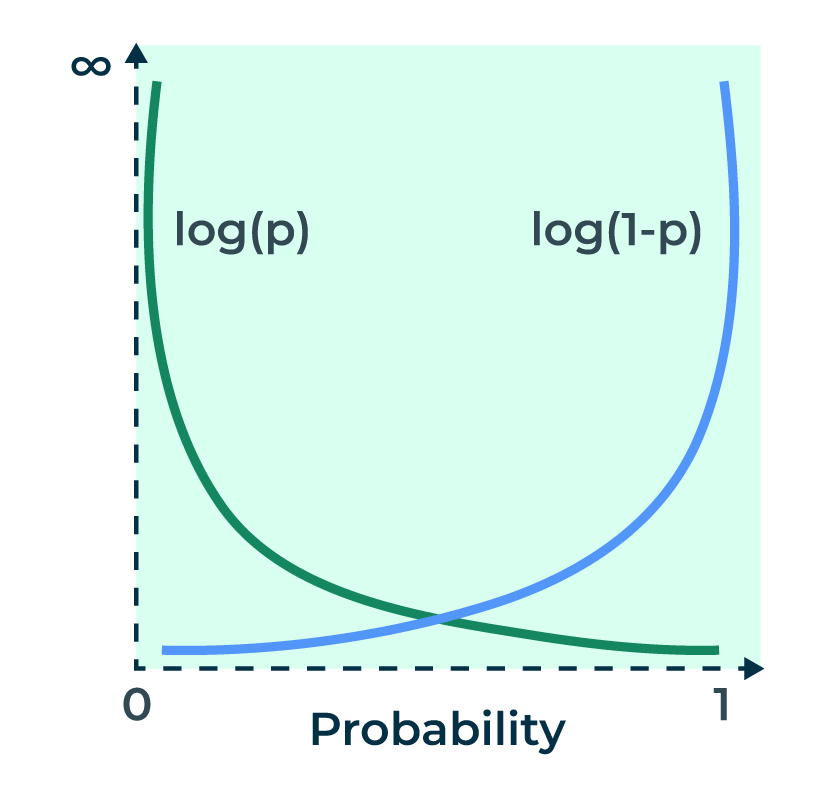
Let us understand the log loss with the help of graph:
Class 1 - The green line represents Class 1. When the predicted probability is close to 1, the loss approaches zero and when the predicted probability is close to 0, loss approaches infinity.
Class 0 - The blue line represents Class 0. When the predicted probability is close to 0, the loss approaches zero and when the predicted probability is close to 1, loss approaches infinity.
Note the above the graph is the log loss for individual data point and not for the whole equation. Actual loss is obtained by summing the loss values of individual data point and it depends on the probability value .
SGD regressor supports the following loss functions.
The ordinary least squares is the square of the difference between the actual value and predicted value.
The lost function can be mathematically be expressed as:
Here,
It tends to penalize model more and more for larger differences thereby giving more weight to outliers
Graphically, it can be represented for one point as below:
The mean squared error (MSE) or squared error gives too much importance to outliers and Mean Average error (MAE) (here instead of squaring we take absolute value of errors) gives equal weightage to all points. Huber loss combines MSE and MAE to give best of both wold- it is quadratic(MSE) when the error is small else MAE. For a loss value less than delta we use MSE and for loss value greater then delta we use MAE. The delta value is a hyperparameter.
The equation of Huber loss is given by:
Here,
The use of delta in the second part of the equation is to make the equation differentiable and continuous.
The epsilon insensitive loss can be mathematically be expressed as:
Here,
The value of epsilon determines the distance within which errors are considered to be zero . The loss function ignores error which are less than or equal to epsilon value by treating them zero.
Thus the loss function effectively forces the optimizer to find such a hyperplane that a tube of width epsilon around this hyperplane will contain all the datapoints.
Load the IRIS Dataset
Output:
Hinge Loss
Precision score : 0.98125
Recall score : 0.98
Confusion Matrix
array([[19, 0, 0],
 [ 0, 15, 1],
 [ 0, 0, 15]])
Model training and evaluation using Modified Huber Loss
Output:
Modified Huber
Precision score : 0.9520000000000001
Recall score : 0.76
Confusion Matrix
array([[19, 3, 0],
 [ 0, 3, 0],
 [ 0, 9, 16]])
Model training and evaluation using Log Loss
Output:
Log Loss
Precision score : 0.9413333333333332
Recall score : 0.78
Confusion Matrix
array([[19, 2, 0],
 [ 0, 4, 0],
 [ 0, 9, 16]])
Output:
Squared Error
Coefficient of determination: 0.9128269523492567
Model training and evaluation using Huber Loss function
Output:
Huber Error
Coefficient of determination: 0.9148961830574946
Output:
Epsilon Insensitive Loss Function
Coefficient of determination: 0.4266448634462471