|
VOOZH | about |
|
VOOZH | about |
Spline regression is a flexible method used in statistics and machine learning to fit a smooth curve to data points by dividing the independent variable (usually time or another continuous variable) into segments and fitting separate polynomial functions to each segment. This approach avoids the limitations of linear models by allowing the curve to bend at specified points, called knots, thereby capturing nonlinear relationships between variables more accurately.
In this article, we will explore spline regression in R Programming Language covering its concepts, implementation using different packages, and interpretation of results.
Now we will discuss the different types of Splines.
Now we will discuss step by step to implement Spline Regression in R Programming Language.
To perform spline regression in R, you'll need the `splines` package. Additionally, for accessing example datasets, we install and load the `Ecdat` package.
To prepare for spline regression using the Clothing dataset from the Ecdat package in R, we first load the dataset and then visualize it to understand its structure and characteristics. Loading the Clothing dataset allows us to inspect its variables and relationships visually, which is crucial for preparing and understanding the data before fitting spline regression models.
Output:
 tsales sales margin nown nfull npart naux hoursw hourspw inv1 inv2
1 750000 4411.765 41 1 1.0000 1.0000 1.5357 76 16.75596 17166.67 27177.04
2 1926395 4280.878 39 2 2.0000 3.0000 1.5357 192 22.49376 17166.67 27177.04
3 1250000 4166.667 40 1 2.0000 2.2222 1.4091 114 17.19120 292857.20 71570.55
4 694227 2670.104 40 1 1.0000 1.2833 1.3673 100 21.50260 22207.04 15000.00
5 750000 15000.000 44 2 1.9556 1.2833 1.3673 104 15.74279 22207.04 10000.00
6 400000 4444.444 41 2 1.9556 1.2833 1.3673 72 10.89885 22207.04 22859.85
 ssize start
1 170 41
2 450 39
3 300 40
4 260 40
5 50 44
6 90 41Next, we proceed to build a spline regression model using the lm function in R, incorporating B-spline basis functions generated by the bs function from the splines package. This approach allows us to fit a regression model that can effectively capture nonlinear relationships present in the data.
Output:
Call:
lm(formula = tsales ~ bs(inv2, knots = c(12000, 60000, 150000)),
 data = Clothing)

Residuals:
 Min 1Q Median 3Q Max
-921708 -329164 -125551 223018 3598276

Coefficients:
 Estimate Std. Error t value Pr(>|t|)
(Intercept) 419589 136370 3.077 0.002238 **
bs(inv2, knots = c(12000, 60000, 150000))1 712180 213810 3.331 0.000948 ***
bs(inv2, knots = c(12000, 60000, 150000))2 63428 140939 0.450 0.652929
bs(inv2, knots = c(12000, 60000, 150000))3 847253 269728 3.141 0.001810 **
bs(inv2, knots = c(12000, 60000, 150000))4 1308842 707178 1.851 0.064949 .
bs(inv2, knots = c(12000, 60000, 150000))5 -14067 996832 -0.014 0.988748
bs(inv2, knots = c(12000, 60000, 150000))6 1345263 419450 3.207 0.001450 **
---
Signif. codes: 0 ‘***’ 0.001 ‘**’ 0.01 ‘*’ 0.05 ‘.’ 0.1 ‘ ’ 1

Residual standard error: 562100 on 393 degrees of freedom
Multiple R-squared: 0.08582, Adjusted R-squared: 0.07186
F-statistic: 6.149 on 6 and 393 DF, p-value: 3.54e-06Visualize the fitted spline regression line along with confidence intervals to understand how well the model fits the data.
Output:
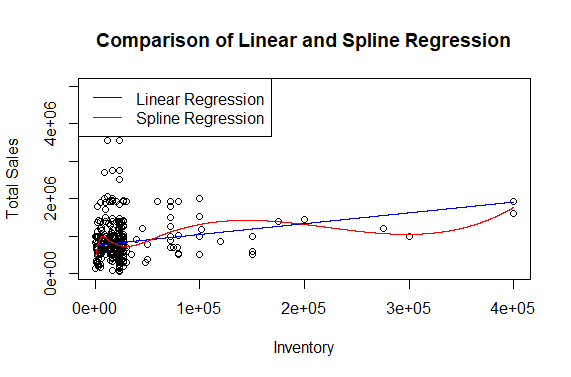
Contrasting spline regression with linear regression underscores the advantages of splines in capturing nonlinear relationships in data. Unlike linear regression, which assumes a constant relationship between variables, spline regression allows for more flexible modeling by fitting piecewise polynomials that can adapt to changing patterns in the data.
Output:
This flexibility enables splines to better capture complex and nonlinear relationships, offering improved accuracy in modeling real-world phenomena where relationships may vary across different ranges or segments of the predictor variable. By accommodating such variations, splines mitigate the limitations of linear models, making them suitable for datasets with intricate and nonlinear structures.
Explore advanced techniques in spline regression such as using different types of splines and generalized additive models (GAMs) for more complex data patterns.
Output:
Spline regression is highly effective in modeling seasonal sales trends, where sales data exhibit complex patterns over time.
Spline regression is a versatile and powerful tool for modeling nonlinear relationships in data. By understanding how to implement and evaluate spline regression in R, you can enhance your data analysis and predictive modeling capabilities. Whether you're handling nonlinear trends or fitting piecewise polynomials, spline regression offers a robust solution for many statistical challenges.