Generative Adversarial Networks (GANs) are neural network models that consist of two neural networks i.e., the generator and the discriminator which work in opposition. The generator creates synthetic data while the discriminator evaluates it. This adversarial process helps GANs produce high-quality realistic data.
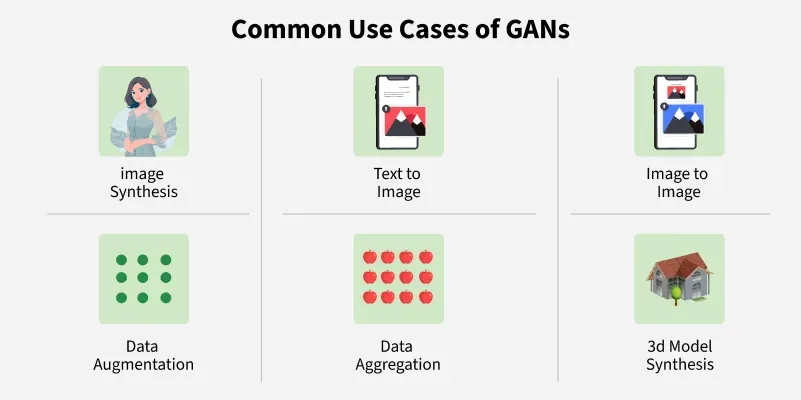
1. Image Synthesis: GANs are widely used for image synthesis generating realistic images from a given dataset. This includes faces and more. The generated images can be used in various industries like gaming, entertainment and advertising.
2. Text-to-Image Synthesis: They can create images directly from text descriptions. This is especially useful for illustration and animation where an image is needed based on specific scenes, objects or attributes described in text.
3. Image-to-Image Translation: They can translate images between different domains which include:
Converting grayscale images to color
Changing the season of a scene summer to winter.
Transforming sketches into photorealistic images
Style transfer e.g., making a photo look like a painting.
4. Anomaly Detection: They can help detect unusual patterns in data. For example they can identify fraud in financial transactions, detect network intrusions or spot medical conditions in images by finding patterns that don’t match the usual ones.
5. Data Augmentation: They can generate additional data from limited datasets a technique especially useful for training deep learning models. In fields like computer vision, speech recognition and natural language processing. This helps increase the diversity of data without the need for manual labeling.
6. 3D Model Synthesis: It can also generate high-quality 3D models for use in industries like architecture, design or gaming. These models can range from objects and scenes to detailed designs and landscapes.
Newly Discovered Use Cases
Beyond traditional applications GANs are now being used in several advanced fields:
Security and Cyber Threat Detection: GANs help to mitigate adversarial attacks on deep learning systems. By generating fake data and training models to recognize them, GANs strengthen the security of AI models particularly in cybersecurity.
Data Generation for Restricted Environments: In industries like healthcare where data is limited they are used to generate realistic datasets. This is vital for training AI models when there is insufficient data for traditional approaches.
Privacy-Preserving Applications: GANs are being explored for data encryption in areas like defense and military. By using GANs in a competitive framework they generate and crack encryption codes offering a new approach to data security.
Data Manipulation: GANs also enable pseudo style transfer and allow modifications to specific features in an image. For example they can add a smile to a face or adjust only the eyes in a photo. This technique is also useful in fields like natural language processing and speech processing.
Disadvantages
Training Difficulty: GANs are complex and computationally expensive, requiring significant resources for effective training.
Overfitting: It can overfit to training data and produce synthetic data that lacks diversity and fails to generalize well.
Bias and Fairness: It can learn biases present in the training data which can lead to discriminatory outputs.
Interpretability: GANs are often referred to as black-box models making it difficult to understand how they arrive at their results.
Quality Control: They may generate unrealistic or irrelevant data if not trained properly affecting the quality of the synthetic data.
Real-Life Case Studies
1. NVIDIA’s Use of GANs for Creating Realistic Human Faces
NVIDIA a company known for its graphics technology uses GANs like StyleGAN to create highly realistic human faces. These faces are computer-generated but look so real that it’s hard to tell they aren’t.
NVIDIA uses these faces in its GauGAN tool which allows artists to create realistic images of things like landscapes and objects just by drawing basic shapes. This technology is used in video games, movies and virtual reality (VR) to create life like characters and environments.
2. DeepMind’s GAN Applications in Healthcare
DeepMind a research company owned by Google uses GANs to help in healthcare especially with medical images. They use GANs to turn low-quality MRI scans into high-quality images which helps doctors make better diagnoses without needing expensive equipment.
They also use GANs to predict how diseases like diabetic retinopathy and age-related macular degeneration will progress allow doctors to detect and treat these conditions.
3. Creating Data for Self-Driving Cars
Companies like Waymo a part of Google’s parent company Alphabet use GANs to create synthetic data for training self-driving cars. These cars need a lot of data to learn how to drive safely in different situations such as varying road conditions, weather and environments.
It help by generating realistic images of these scenarios even if they haven’t happened in the real world. This synthetic data helps the car’s system learn to handle a wide range of driving conditions and make better decisions on the road.
While GANs offer many benefits they also come with challenges like difficult training and potential bias. As the technology improves GANs will continue to open new doors for innovation and practical applications.