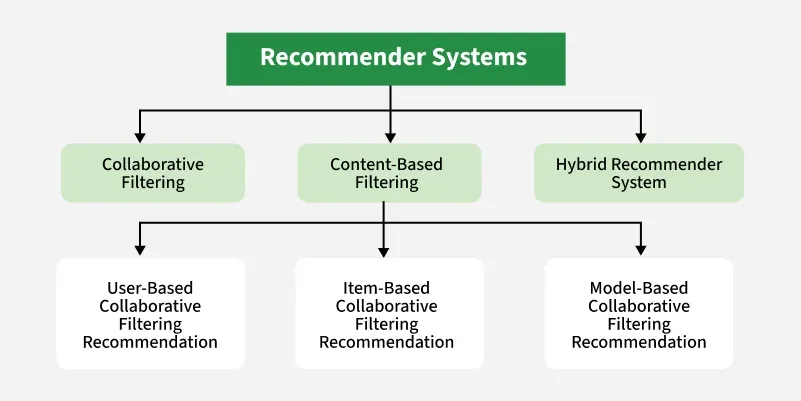
Recommender Systems are tools that suggest items to users based on their behaviour, preferences or past interactions. They help users find relevant products, movies, songs or content without manually searching for them. They are widely used in platforms like YouTube, Amazon and Netflix.
1. Content-Based Filtering: Content-based filtering recommends items similar to those a user liked earlier by analyzing item features and user preference profiles.
Useful when users have strong, consistent preferences.
Seen in movie apps suggesting films of the same genre or style.
Advantage: Personalization without needing other users data.
Limitation: Lack of novelty because it focuses on similar items only.
2. Collaborative Filtering: Collaborative filtering identifies similarities in user behavior and recommends items based on patterns derived from many users.
Works well with large datasets of user interactions.
Used in Amazon’s “Users who bought this also bought” and Netflix suggestions.
Advantage: Discovery of new items outside a user’s past history.
Limitation: Cold-start issues with new items or new users.
3. Hybrid Recommendation Systems: Hybrid systems combine collaborative and content-based methods to offer more accurate and robust recommendations.
Useful where both user behavior and item features provide value.
Seen in platforms like Netflix that blend metadata and viewing patterns.
Advantage: Reduced weaknesses and better overall performance.
Limitation: Increased complexity and higher computational cost.
4. Knowledge-Based Recommendation Systems: Knowledge-based systems use explicit domain knowledge and user requirements rather than historical behavior to suggest items.
Ideal for high-involvement domains like real estate or financial products.
Seen in travel planning apps or loan product matchers.
Advantage: No need for past interactions.
Limitation: Effort required to build domain-specific rules.
5. Context-Aware Recommendation Systems: These systems use contextual information such as time, location, device or mood to personalize recommendations.
Effective in mobile and location-based applications.
Seen in restaurant suggestions based on time of day or location.
Advantage: Higher relevance through situational awareness.
Limitation: Complexity in capturing and processing contextual data.
Working
Let's see how a recommender system works,
Data Collection: Collect ratings, clicks, views, purchases, searches and item metadata.
Data Preprocessing: Clean data, handle missing values and prepare user–item matrices.
Feature Engineering: Transform user and item characteristics into meaningful vectors.
Model Training / Similarity Computation: Use algorithms like collaborative filtering, content-based models or deep learning.
Prediction: Generate relevance scores for unseen items based on learned patterns.
Ranking & Recommendation: Sort items by predicted relevance and recommend the top ones.
Feedback Loop: Update the model continuously as new user interactions arrive.
Implementation
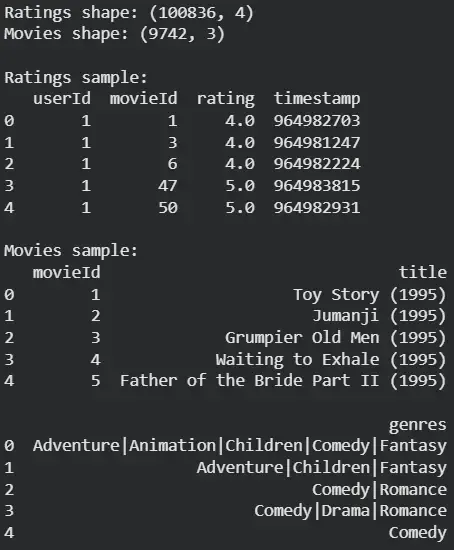
Let's see how a recommendation system works with an example of movie recommender system,