|
VOOZH | about |
|
VOOZH | about |
Time series forecasting is a crucial aspect of predictive modeling, often used in fields like finance, economics, and meteorology. It involves using historical data points to predict future trends. One important concept within time series analysis is lag, which plays a significant role in understanding and modeling the relationship between past and future values in a time series.
In this article, we will explore the concept of lag in time series forecasting, its importance, and how it is applied in forecasting models.
Before diving into the concept of lag, let’s briefly understand time series forecasting. A time series is a sequence of data points collected or recorded at regular time intervals. The primary goal of time series forecasting is to predict future values based on previously observed values. This is widely used in predicting stock prices, sales, weather, and more.
Forecasting models utilize various techniques such as moving averages, exponential smoothing, and autoregressive integrated moving average (ARIMA) models. A critical part of these models is how they use historical data to make predictions, which brings us to the concept of lag.
In time series analysis, lag refers to the delay between an observed data point and its preceding values. Specifically, lag is the time difference between two observations in a sequence, or the number of steps back in time a past observation is from the current time.
Example of Lag:
Let’s consider a simple time series representing the monthly sales of a company over five months:
Month | Sales (in units) |
|---|---|
1 | 200 |
2 | 220 |
3 | 230 |
4 | 240 |
5 | 250 |
In this example:
Thus, a lag of 1 refers to the immediate previous observation, a lag of 2 refers to two steps back, and so on.
Lag is important because it helps to identify patterns and relationships between past and present data points. Time series models, such as ARIMA, heavily rely on lag to capture autocorrelations (the correlation between observations at different time lags) in the data.
Key reasons why lag is essential:
There are several types of lag used in time series analysis, depending on the relationship being analyzed:
The Autoregressive Integrated Moving Average (ARIMA) model is one of the most commonly used time series models that leverage lag. In ARIMA, the model forecasts a time series based on the linear relationship between an observation and a number of lagged observations.
In the ARIMA model, determining the optimal number of lags (the parameter p) is critical for accurate predictions.
Selecting the optimal lag is crucial to ensure accurate forecasting. There are a few common techniques to identify the best lag for time series models:
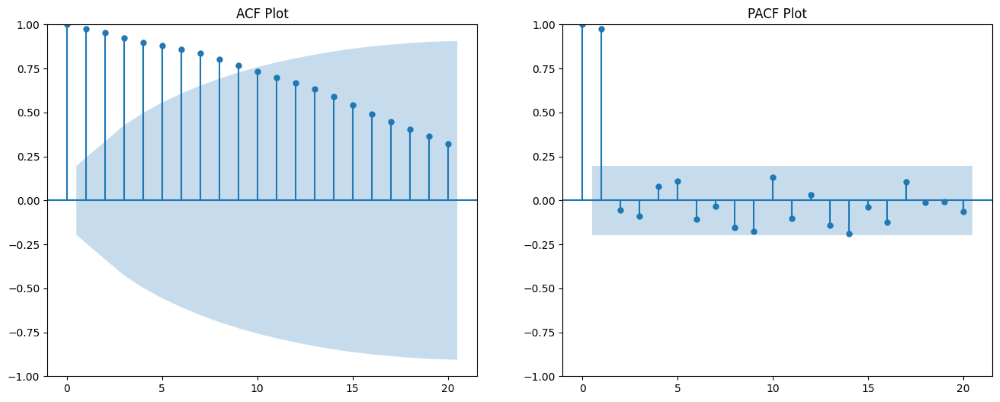
TheAutocorrelation Function (ACF) helps to measure the correlation between an observation and its lagged values. The ACF plot shows the strength of correlation across different lags. If a series has strong correlations at specific lags, those lags can be considered for use in the model.
The Partial Autocorrelation Function (PACF) measures the correlation between an observation and its lagged observations while controlling for the correlations of all shorter lags. The PACF plot helps to find the direct relationship between a variable and its past values, filtering out the intermediate lags.
The Akaike Information Criterion (AIC) and Bayesian Information Criterion (BIC) are statistical metrics that evaluate model performance. These metrics penalize complex models and help in selecting the optimal lag by fitting models with different lags and comparing their AIC/BIC scores. The model with the lowest score is preferred.
In some cases, performing a grid search for different lag values and comparing model accuracy can be beneficial. This involves trying multiple lag combinations and selecting the one with the best performance based on accuracy metrics like Mean Squared Error (MSE) or Root Mean Squared Error (RMSE).
To select the optimal lag in time series forecasting, we can use autocorrelation plots and statistical methods like Partial Autocorrelation Function (PACF) or Autocorrelation Function (ACF) plots. In Python, the statsmodels library provides tools for performing these tasks.
Here’s how you can implement and choose the optimal lag in Python using ACF, PACF, and information criteria (like AIC):
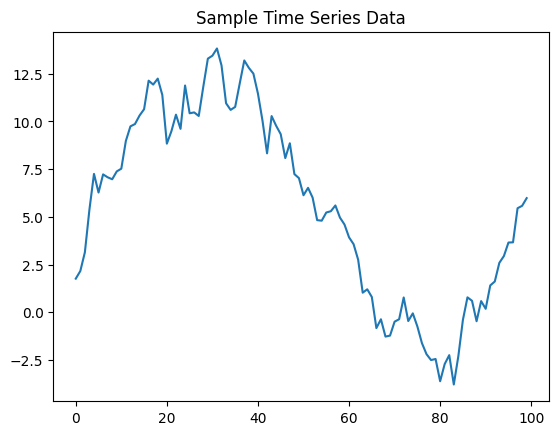
For this example, we will use a simple time series. You can replace it with your dataset.
Output:
You can use the Autocorrelation Function (ACF) and Partial Autocorrelation Function (PACF) plots to visually select the optimal lag for an ARIMA model.
Output:
Alternatively, you can use Akaike Information Criterion (AIC) or Bayesian Information Criterion (BIC) to choose the optimal lag by fitting ARIMA models with different lags and comparing the AIC/BIC scores.
Output:
Lag: 1, AIC: 290.97158925836254
Lag: 2, AIC: 292.3695498699307
Lag: 3, AIC: 292.63569462782016
Lag: 4, AIC: 294.6330969513839
Lag: 5, AIC: 296.07875295289756
Lag: 6, AIC: 297.6370086026085
Lag: 7, AIC: 298.9122341233797
Lag: 8, AIC: 296.61311484062776
Lag: 9, AIC: 294.7954409798874
Lag: 10, AIC: 294.25539005911094

Optimal Lag based on AIC: 1
While lag is a powerful tool in time series forecasting, it comes with certain challenges:
Lag in time series forecasting is a fundamental concept that helps to establish relationships between past and future values. By incorporating lagged observations into forecasting models, analysts can capture patterns, detect trends, and make more accurate predictions.
Whether using simple lag, lag operators, or advanced models like ARIMA, understanding how lag works is key to effective time series analysis. However, selecting the right lag and managing challenges like stationarity are crucial for ensuring the accuracy and robustness of forecasts.