|
VOOZH | about |
|
VOOZH | about |
Fine tuning and transfer learning both helps models to use what they have learned from one task to perform better on another task. While both might seem similar but they differ in how they are applied and how their approaches work.
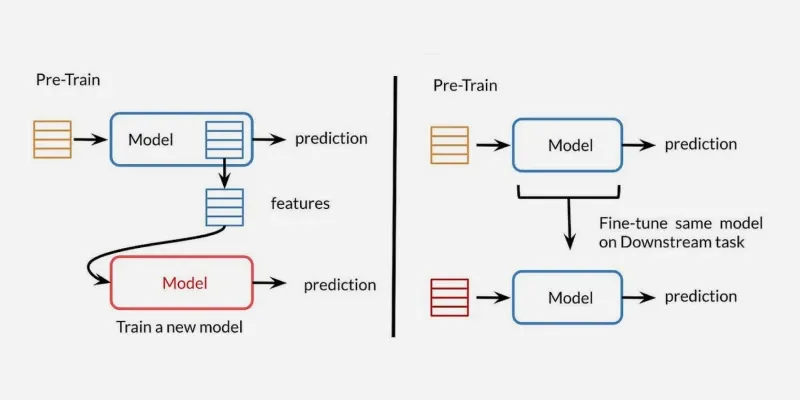
Transfer Learning freezes most of the pre-trained model and trains only the final layers, while Fine-Tuning updates part or all of the pre-trained model’s layers to better fit the new task.
Transfer Learning involves using a pre-trained model’s learned features as fixed representations and training only the final layers on new data. It’s useful when you have limited new data and want to quickly adapt a model without retraining everything.
Fine-Tuning on the other hand goes a step further by allowing some or all of the pre-trained model’s layers to be retrained (adjusted) on the new dataset. This helps the model better adapt to the specifics of the new task but requires more data and computation.
The summary table of the differences between transfer learning and fine tuning:
| Aspect | Transfer Learning | Fine-Tuning |
|---|---|---|
| Training Scope | Only final layers are retrained; the rest of the model is frozen. | Entire model or specific layers is retrained allowing more adaptation. |
| Data Requirements | Works well with smaller datasets due to reusing pre-learned features. | May require more data as the model is adjusted more thoroughly. |
| Computational Cost | Less computationally expensive as only the final layers are trained. | More computationally expensive due to retraining the entire model or more layers. |
| Adaptability | Limited adaptation to new tasks; mainly changes final layers. | More adaptable to new tasks, adjusting both feature extraction and classifier layers. |
| Risk of Overfitting | Lower risk of overfitting with smaller datasets since only the final layers are trained. | Higher risk of overfitting, especially with small datasets and a large number of trainable parameters. |
Understanding when and how to use these methods can significantly enhance the performance of machine learning models especially when you’re working with limited data or in scenarios where training a model from scratch would be computationally expensive.
In this article we saw the differences between fine tuning and transfer learning highlighting when to use each method based on dataset size, task similarity and computational resources.