|
VOOZH | about |
|
VOOZH | about |
In calculus, approximations in derivatives usually mean using the derivative to estimate how a function behaves near a point — instead of working with the exact (and often complicated) formula of the function.
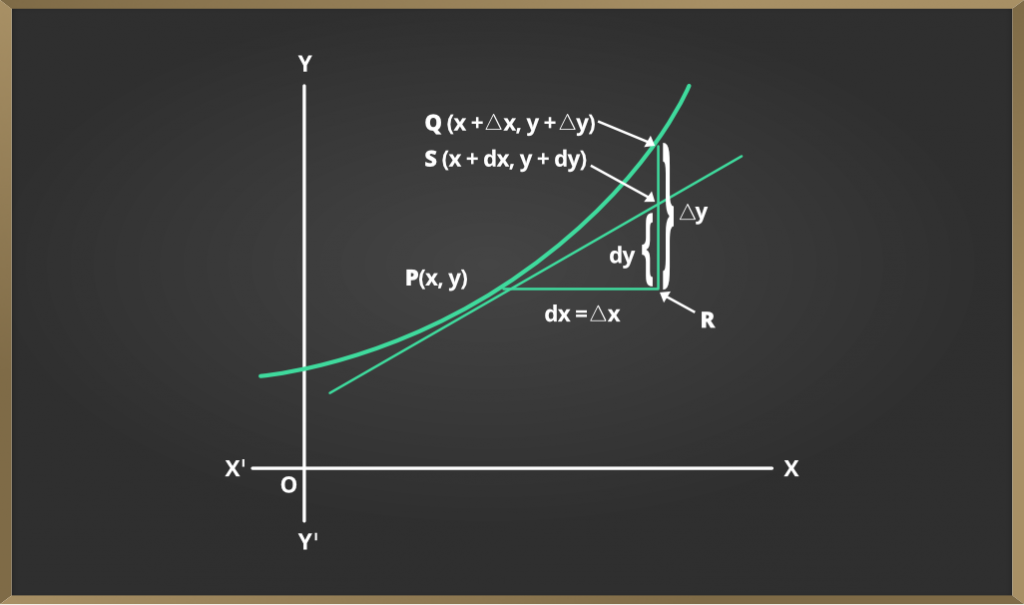
Let f be a given function and let y = f(x). Let ∆x denote a small increment in x.
👁 Application-of-Derivatives-2
Now the increment in y is like the increment in x, denoted by
∆y, is given by ∆y = f (x + ∆x) - f (x)
⇒ ∆y/∆x = [f(x + ∆x) - f (x)]/∆x
If dx = ∆x is relatively small when compared to with x dy ≈ ∆y.
⇒ dy/dx ≈ [f(x + ∆x) - f (x)]/∆x
⇒ dy/dx × ∆x + f(x) ≈ f(x + ∆x)
Thus, f(x + ∆x) ≈ f'(x) × ∆x + f(x)
Therefore, the formula for linear approximation is given as:
f(x + ∆x) ≈ f(x) + f′(x)(∆x)
Where:
- f(a) is the value of the function at a,
- f′(a) is the derivative of the function at a,
- (x − a) is the deviation from point a.
Example 1: Find the approximate value of √26.
Solution:
Let the f(x) = √x and the derivative of this is f’(x)= 1/(2√x)
Now we know the formula of approximation
f(x + ∆x) ≈ f(x) + f′(x)(∆x)
Here we will assume x near to 25 which is a perfect square.
So we will assume ∆x = 1
f(x + ∆x) = f(x) + f’(x) . ∆x
⇒ f(25 + 1) = f(25) + f'(25) × 1
⇒ f(26) = √25 + (1/(2 × √(25))
⇒ f(26) = 5 + 1/10 √26
⇒ f(26) = 5 + 0.1 = 5.1
Example 2: Find the approximate value of f(3.02), where f(x) = 3x2 + 5x + 3.
Solution:
Let x = 3 and Δx = 0.02. Then,
Since, f(3.02) = f(x + Δx) = 3(x + Δx)2 + 5(x + Δx) + 3
Note that Δy = f(x+Δx) - f(x).
Therefore, f(x + Δx) = f(x) + Δy
≈ f(x) + f'(x)Δx (as ds = Δx)
⇒ f(3.02) ≈ (3x2 + 5x + 3) + (6x + 5)Δx
⇒ f(3.02) = (27 + 15 + 3) + (18 + 5)(0.02)
⇒ f(3.02) = 45 + 0.46 = 45.46Hence, the approximate value of f(3.02) is 45.46.
In situations where the derivative of a function is difficult to compute analytically, numerical differentiation can be used to approximate derivatives. These approximations are based on finite differences.
A higher-order approximation can be derived using the Taylor series, which expands a function into an infinite sum of terms based on the function’s derivatives at a specific point. The more terms we include, the better the approximation becomes.