 |
VOOZH | about |
|
VOOZH | about |
Bivariate analysis is a statistical method used to explore the relationship between two variables. The goal is to understand whether and how the two variables are related — and if they are, then describe the nature, strength, and direction of that relationship.
It is a quantitative analysis that examines two variables denoted as X and Y. Bivariate analysis aims to understand to what extent one variable (possibly independent) predicts the value of another (possibly dependent). It helps uncover correlations and associations between different factors in data analysis.
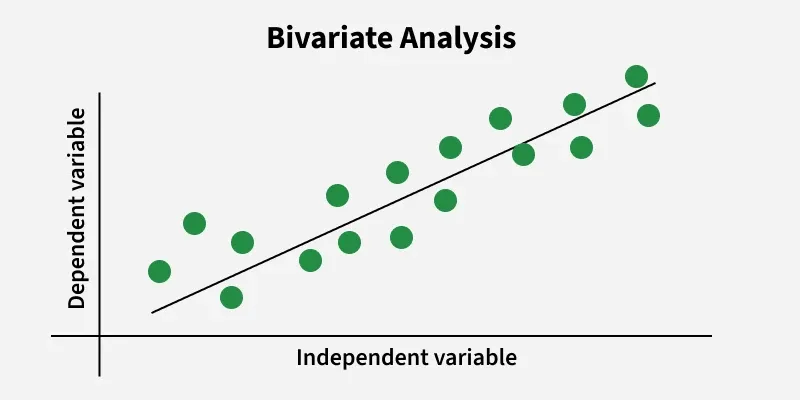
👁 bivariate_analysisFor instance, consider a study examining the relationship between exercise duration (X) and heart rate (Y) during physical activity. By analyzing this bivariate data, we can determine if there's a correlation between the duration of exercise (independent) and heart rate(dependent).
Example:
A teacher collected data of total hours studied by students and total marks scored by them:
Total Hours Studied in a Week
Marks scored out of 700
14
450
12
413
20
490
22
566
24
576
29
640
13
340
The teacher can determine the correlation between the two variables, which is 0.926.
This shows that the two variables have a very strong positive association.
In other words, the marks scored by a student in a test is directly correlated to number of hours studied by him/her.
In this article, we will dive into bivariate analysis in depth.
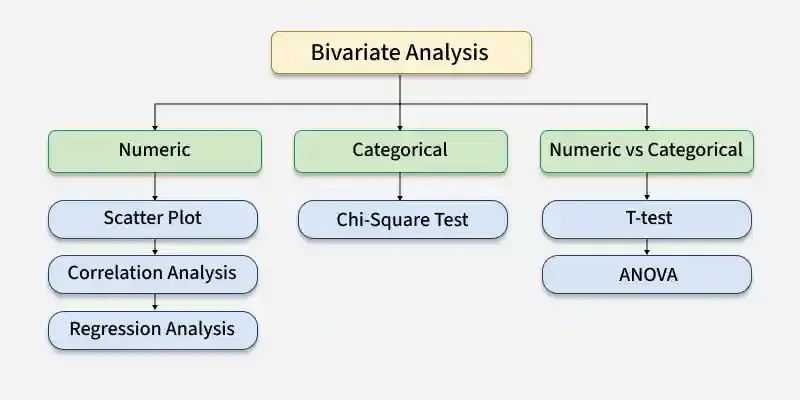
The type of bivariate analysis used depends on the nature of the variables involved — whether they are numerical, categorical, or ordinal. The choice of statistical technique is guided by how these variables interact.
1) Numerical Vs Numerical:
In this type, both the independent and dependent variables are numerical.
2) Categorical vs Categorical:
Here, both variables are categorical. The goal is often to test for association or independence.
3) Numerical vs Categorical:
In this scenario, one variable is numerical (usually the dependent), and the other is categorical (often the independent).
The various types of methods used in bivariate analysis are:
Scatter Plots visually display the relationship between two variables. Each dot on the plot represents a single observation, (xi, yi). The pattern formed by the dots can reveal the nature of the relationship between the variables—whether it's positive, negative, or no correlation.
Correlation Analysis quantifies the strength and direction of the relationship between two continuous variables.
Regression analysis explores the relationship between two or more variables by predicting one variable (the dependent variable) based on the values of one or more other variables (the independent variables).
The chi-square test examines the association between two categorical variables by comparing the observed frequencies in a contingency table to the frequencies that would be expected if the variables were independent.
T-tests and analysis of variance (ANOVA) are used to compare means between groups for one or more independent variables. In bivariate analysis, they can be applied to examine whether there are significant differences in the mean values of a continuous variable across different categories of another variable.
The basic difference between univariate, bivariate, and multivariate analysis is explained in the table added below:
Univariate Analysis | Bivariate Analysis | Multivariate Analysis |
|---|---|---|
Univariate analysis involves the analysis of a single variable. This helps to describe and summarize the characteristics and distribution of that variable. | Bivariate analysis involves the analysis of the relationship between two variables. This helps to examine how one variable behaves about another. | Multivariate analysis involves the simultaneous analysis of three or more variables. This helps to examine the complex relationships between multiple variables. |
Techniques used in univariate analysis include:
| Techniques used in bivariate analysis include
| Common techniques used in multivariate analysis include:
|
Univariate analysis is useful for understanding the basic properties of a variable and identifying any outliers or patterns within it. | Bivariate analysis helps in understanding the strength and direction of the relationship between two variables. It is particularly useful for identifying associations or dependencies between variables. | Multivariate analysis allows for the exploration of interactions and dependencies among multiple variables. It helps in understanding the combined effect of several variables on an outcome or in identifying latent structures within the data. |
Some of the applications of bivariate analysis in computer science are given below:
Machine Learning and Data Processing
Software Engineering
Network and System Performance Analysis
Human-Computer Interaction (HCI)
Natural Language Processing (NLP)

.webp)