|
VOOZH | about |
|
VOOZH | about |
Chapter 4 of the Class 10 RD Sharma Mathematics textbook, "Triangles," covers the properties and theorems related to triangles, including similarity, congruence, and the Pythagorean theorem. Exercise 4.5 focuses on applying these properties to solve problems related to triangles.
This section provides detailed solutions for Exercise 4.5 from Chapter 4 of the Class 10 RD Sharma Mathematics textbook. The exercise involves problems that require students to apply various properties and theorems of triangles, such as criteria for similarity and congruence, to find unknown lengths and angles in given triangles. Solutions are presented step-by-step to aid understanding and mastery of the concepts.
Solution:
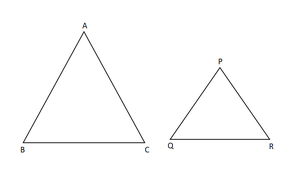
👁 ImageGiven: perimeter of two similar triangles are 25 cm, 15 cm and one side 9 cm
To find : the other side.
Let the two triangles be ABC & PQR.
Let one of its side is (AB) = 9 cm and the other side of other triangle be PQ.
∆ABC ∼ ∆PQR. [Since the ratio of corresponding sides of similar triangles is same as the ratio of their perimeters.]
AB/PQ = BC/QR = AC/PR = 25/15
9/PQ = 25/15
25 PQ = 15 × 9
PQ = (15×9)/25
PQ =(3× 9 )/5
PQ = 27/5
PQ = 5.4 cm
Hence, the corresponding side of other ∆ is 5.4 cm.
Solution:
👁 ImageGiven,
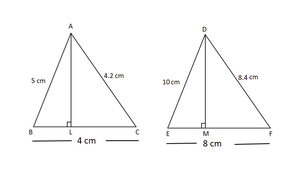
AB = 5 cm, BC = 4 cm, CA = 4.2 cm, DE = 10 cm, EF = 8 cm, and FD = 8.4 cm
AL ⊥ BC, DM ⊥ EF
To find: AL: DM
Now In ∆ABC and ∆DEF,
AB/DE=BC/EF=AC/DF=1/2 [both triangles are similar]
[In similar triangle the ratio of corresponding altitude is same as the ratio of the corresponding sides.]
AL: DM = 1: 2
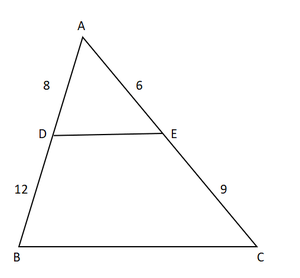
Question 15. D and E are the points on the sides AB and AC respectively, of a ΔABC such that AD = 8 cm, DB = 12 cm, AE = 6 cm, and CE = 9 cm. Prove that BC = 5/2 DE.
Solution:
👁 ImageAE/EC=6/9=2/3.......(1)
AD/DB=8/12=2/3......(2)
from (1) and (2) we know that
AD/DB=AE/EC
ED∥CB
Now In△AED and △ACB,
ED∥CB
∠AED=∠ACB
∠ADE=∠ABC
△AED∼△ACB [by AAA criteria]
AE/AC=ED//CB
AE/EC+AE= ED/CB [AC=AE+EC]
6/6+9= ED/CB
6/15=2/5=ED/CB
CB=5/2ED
Hence proved
Solution:
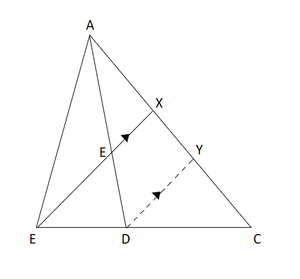
👁 ImageGiven: In ∆ABC, D is the midpoint of BC, E is the midpoint of AD. BE produced meets AC at X.
To prove : BE: EX = 3 : 1
Now In Δ BCX and ΔDCY,
∠CBX = ΔCBY (corresponding angles)
∠CXB = ΔCYD (corresponding angles)
ΔBCX∼ΔDCY (AA similarity)
BC/DC = BX/ DY = CX/CY [ corresponding sides of two similar triangles are proportional]
BX/DY = BC/DC
BX/DY = 2DC/DC [As D is the midpoint of BC]
BX/DY = 2/1………...(i)
Now In ΔAEX and ΔADY,
∠AEX = ΔADY (corresponding angles)
∠AXE = ΔAYD (corresponding angles)
ΔAEX ∼ ΔADY (AA similarity)
AE/AD = EX/DY = AX/AY [ corresponding sides of two similar triangles are proportional]
EX/DY = AE/AD
EX/DY = AE/2AE [ D is the midpoint of BC]
EX/DY = ½…………..…(ii)
On Dividing eqn. (i) by eqn. (ii) we get,
BX/EX = 4/1
BX = 4EX
BE + EX = 4EX
BE = 4EX - EX
BE = 3EX
BE /EX = 3/1
BE : EX = 3:1
Hence proved
Solution:
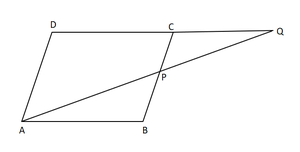
👁 ImageGiven : ABCD is a parallelogram and APQ is a straight line meeting BC at P and DC produced at Q.
To prove : BP x DQ = AB x BC
Now In ∆ABP and ∆QDA,
∠B = ∠D [Opposite angles of parallelogram]
∠BAP = ∠AQD [Alternate interior angles]
∆ABP ~ ∆QDA [By AA similarity]
AB/QD = BP/DA [the corresponding sides of similar triangles are proportional]
DA = BC [opposite sides of a parallelogram are equal]
AB/QD = BP/BC
AB × BC = QD × BP
Hence proved
(i) ΔOMA ∼ ΔOLC
(ii)OA/OC=OM/OL
Solution:
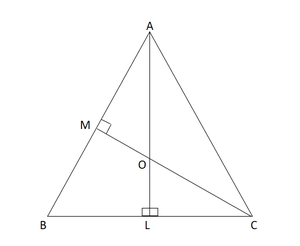
👁 ImageGiven,
AL ⊥ BC and CM ⊥ AB
To prove:
(i) ΔOMA ∼ ΔOLC
(ii)OA/OC=OM/OL
Now In Δ OMA and ΔOLC,
∠MOA = ∠LOC [Vertically opposite angles]
∠AMO = ∠CLO [Each 90°]
ΔOMA ~ ΔOLC [By AA similarity]
OA/OC=OM/OL [Corresponding parts of similar Δ are proportional]
Hence proved
Solution:
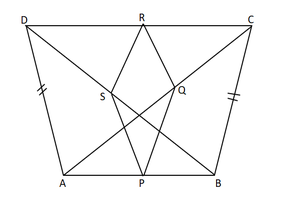
👁 ImageGiven,
ABCD is a quadrilateral in which AD = BC and P, Q, R, S are the mid points of AB, AC, CD, BD, respectively.
To prove: PQRS is a rhombus
Now,
In ΔABC, P and Q are the mid points of the sides B and AC respectively
PQ ∥ BC and PQ = 1/2 BC. [By the midpoint theorem]
In ΔADC, Q and R are the mid points of the sides AC and DC respectively
By the mid-point theorem, we get,
QR ∥ AD QR = 1/2 AD [By the mid-point theorem]
QR = 1/2 BC [AD = BC]
Now In ΔBCD,
RS∥BC and RS = 1/2 AD [By the mid-point theorem]
RS= 1/2 BC [AD = BC]
From above eqns.
PQ = QR = RS
PQRS is a rhombus.
Hence proved
Solution:
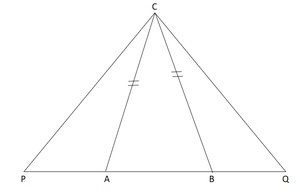
👁 ImageGiven : ΔABC is isosceles ∆ and AP x BQ = AC²
To prove : ΔAPC∼ΔBCQ.
we know that,
ΔABC is an isosceles triangle AC = BC.
AP x BQ = AC² (given)
AP x BQ = AC x AC
AP x BQ = AC x BC
AP/BC = ABQ……….(1).
so, ∠CAB = ∠CBA [as AC = BC]
180° – ∠CAP = 180° – ∠CBQ [angles opposite to equal sides are EQUAL]
∠CAP = ∠CBQ ………..(2)
In ∆APC and ΔBCQ
AP/BC = AC/BQ [From equation 1]
∠CAP = ∠CBQ [From equation 2]
ΔAPC∼ΔBCQ [By SAS similarity criterion]
Hence proved
Solution:
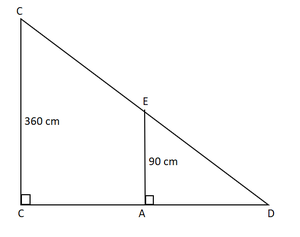
👁 ImageAD=1.2 m/sec ×4 sec =4.8 m =480 cm
Suppose the length of the shadow of the girl be x cm when she at position D. Therefore,
BD = x cm
In ∆BDE and ∆BAC,
∠BDE=∠BAC [each90°]
∠DBE=∠ABC [Common angle ]
∆BDE∼∆BAC [ by AA similarity]
BE/BC=DE/AC=BD/AB [Corresponding sides are proportional]
90/360=x/480+x
1/4= x/480+x
4x=480+x
4x−x=480
3x=480
x=480/3=160
Hence, the length of her shadow after 4 seconds is 160 cm.
Solution:
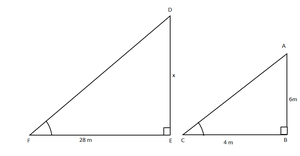
👁 ImageLet AB be stick and DE be tower.
A 6 m long stick casts a shadow of 4 m
So, AB = 6 m and BC = 4 m
Let DE casts shadow at the same time, So EF = 28 m
Let height of tower DE = x
Now in ∆ABC and ∆DEF,
∠B = ∠E (each 90°)
∠C = ∠F (shadows at the same time)
∆ABC ~ ∆DEF [AA criterion]
AB/DE=BC/EF [ Corresponding sides are proportional ]
6/x=4/28
x=42 m
Hence height of tower is 42 m
Solution:
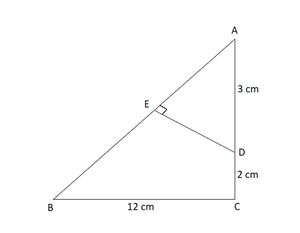
👁 ImageGiven : ΔACB is right-angled triangle at C = 90°.
According to the figure : BC = 12 cm , AD=3 cm, DC = 2 cm.
AC = AD + DC = 3 +2= 5 cm
Now In ∆ACB,
AB² = AC² + BC² [by Pythagoras theorem]
AB² = 5² + 12²
AB² = 25 + 144 = 169
AB= √169 = 13
AB = 13 cm
Now In ΔABC & ΔADE,
∠BAC = ∠DAE [common]
∠ACB = ∠AED [each 90°]
ΔABC∼ΔADE [by AA similarity criterion]
AB/AD = BC/DE = AC/AE [ corresponding sides of two similar triangles are proportional]
13/3 = 12/ DE = 5/AE
13/3 = 12/DE
13 DE = 12×3
DE = 36/13
13/3 = 5/AE
13 AE = 5×3
AE = 15/13
Hence, the length of DE= 36/13 & AE = 15/13
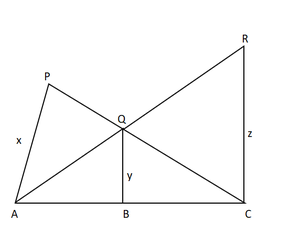
👁 ImageGiven:
PA, QB and RC are each perpendicular to AC
To prove : 1/X+1/Z=1/Y
Now In ΔPAC and ΔQBC,
∠PCA = ∠QCB [common angle]
∠PAC = ∠QBC [Corresponding angles]
ΔPAC ~ ΔQBC [by AA criteria]
PA/QB = AC/BC [ Corresponding parts of similar triangles are proportional]
x/y = AB/BC
y/x = BC/AC
Now In ΔRCA and ΔQBA,
∠RAC = ∠QAB [common angle]
∠RCA = ∠QBA [Corresponding angle]
ΔRCA ~ΔQBA [by AA criteria]
RC/QB = AC/AB [ Corresponding parts of similar triangles are proportional]
z/y= AC/AB
y/z= AB/AC
y/z + y/z = BC + AC/ AC = 1 [by adding both eq we get]
y/z + y/z = 1
1/x + 1/z = 1/y [multiplying both sides by y]
Hence proved
Solution:
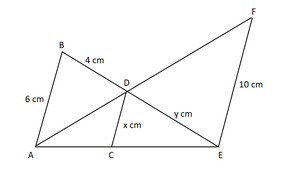
👁 ImageGiven : AB || CD || EF , AB = 6 cm, CD = x cm, BD = 4 cm, and DE = y cm and EF = 10 cm.
Now In ∆ECD and ∆EAB,
∠CED = ∠AEB [common]
∠ECD = ∠EAB [corresponding angles]
∆ECD ~ ∆EAB ……....(1) [By AA similarity]
∴ EC/EA = CD/AB [Corresponding parts of similar triangles are proportional]
EC / EA = x/6 ……………(2)
In ∆ACD and ∆AEF
∠CAD = ∠EAF [common]
∠ACD = ∠AEF [corresponding angles]
∆ACD ~ ∆AEF [By AA similarity]
∴ AC/AE = CD/EF [Corresponding parts of similar triangles are proportional]
AC /AE = x/10 ……………..(3)
EC/EA+ AC /AE = x/6 + x/10 [by Adding eq 2 & 3]
(EC + AC) /AE =( 5x + 3x)/30
AE / AE = 8x /30
1 = 8x/30
x = 30/8
x = 3.75 cm
∆ECD ~ ∆EAB [From eq (i)]
DC/AB = ED /EB [Corresponding parts of similar triangle are proportional]
3.75/6 = y/y+4
6y = 3.75(y+4)
6y = 3.75y + 15
6y - 3.75y = 15
2.25y = 15
y = 15/2.25
y = 6.67 cm
Hence, x = 3.75 cm and y = 6.67 cm.