|
VOOZH | about |
|
VOOZH | about |
This exercise contains questions regarding the similarity of triangles. Questions in this exercise are based on the concepts of properties of two similar triangles. The RD Sharma Solutions Class 10 provides all solutions required for a quick preparation for exams. The following questions and their solutions are prepared to help and boost the morale of students as many find mathematics a tough subject.
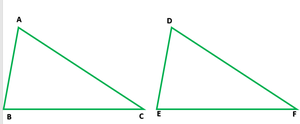
Since, △ABC ∼ △DEF,
So,
ar.(△ACB)/ar.(△DEF) = (BC)2/(EF)2
16/25 = (2.3)2/EF2
(4)2/(5)2 = (2.3)2/EF2
4/5 = 2.3/EF
EF = (2.3 × 5)/4
EF = 11.5/4 = 2.875 cm
Hence, EF = 2.875 cm
Since, △ABC ∼ △DEF
So,
ar.(△ACB)/ar.(△DEF) = (AB)2/(DE)2
9/5 = AB2/(5.1)2
(3)2/(8)2 = AB2/(5.1)2
3/8 = AB/5.1
AB = (3 × 5.1)/8 = 15.3/8
Hence, AB = 1.9125 cm
Since, △ABC ∼ △DEF
So,
ar.(△ACB)/ar.(△DEF) = (AB)2/(DE)2
= (19)/(8)2 = 361/64
Hence, ar.(△ABC):ar.(△DEF) = 361:64
Since, △ABC ∼ △DEF
So,
ar.(△ACB)/ar.(△DEF) = (AB)2/(DE)2
⇒ 36/64 = AB2/(6.2)2
⇒ 6/8= AB/(6.2)
⇒ AB/6.2 = 6/8
⇒ AB = (6 × 6.2)/8 = 37.2/8
AB = 4.65
Hence AB = 4.65 cm
Since, △ABC ∼ △DEF
So,
ar.(△ACB)/ar.(△DEF) = (AB)2/(DE)2
(1.2)2/(1.4)2 = 1.44/1.96 = 144/196 = 36/49
Hence, ar.(△ABC):ar.(△DEF) = 36:49
According to the question
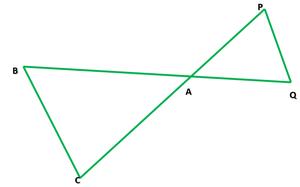
It is given that, BC = 10 cm, PQ = 5 cm, BA = 6.5 cm and AP = 2.8 cm
Also, △ACB ∼ △APQ
So, BC/PQ = AB/AQ = AC/AP
10/5 = 6.5/AQ = AC/2.8
6.5/AQ = 10/5
⇒ AQ = (6.5 × 5)/10 = 3.25
and AC/2.8 = 10/5
⇒ (2.8 × 10)/5 = 5.6
AC = 5.6m, AQ = 3.25cm
As we know that △ACB ∼ △APQ,
So, ar.(△ACB)/ar.(△APQ) = (BC)2/(PQ)2
ar.(△ACB)/ar.(△APQ) = (10)2/(5)2 = 100/25 = 4/1
Hence, ar(△ACB):ar(△APQ) = 4:1
Let us consider two similar triangles, ABC and PQR whose altitudes are AD and PO
It is given that the areas of two similar triangles are 81 cm2 and 49 cm2
So, △ABC = 81 cm2 and △PQR = 49 cm2
So, ar.(△ABC)/ar.(△PQR) = (AB)2/(PQ)2
81/49 = (AB/PQ)2
9/7 = AB/PQ
Now, in △ABD and △PQO
∠B = ∠Q
∠ADB = ∠POQ = 90°
Hence, △ABD ~ △PQO
So, AB/PQ = AD/PO
Hence, AD/PO = 9/7
Or
AD:PO = 9:7
As we know, that the ratio of the areas of two similar triangles are proportional to the square of their corresponding altitudes and also the squares of their corresponding medians.
So, the ratio in their medians = 9 : 7
Given that both the triangles are similar
So, the area of larger triangle(ABC) = 169 cm2
and area of the smaller triangle(PQR) = 121 cm2
The length of the longest sides of the larger triangles(AC) = 26 cm
Let us assume the length of longest side of the smaller triangle(PR) = x
So, the ar.(△ABC)/ar.(△PQR) = (AC)2/(PR)2
169/121 = (26)2/(x)2
13/11 = 26/x
x = (13 × 26)/11
x = 22
Hence, the length of the longest side of the smaller triangle is 22 cm.
Given that, the area of the first triangle = 25 cm2
and the area of second = 36 cm2
Altitude of the first triangle = 2.4 cm
Let us consider the altitude of the second triangle = x
It is given that both the triangles are similar, so
ar.(first triangle)/ar.(second triangle) = (Altitude of the first triangle)2/(Altitude of the second triangle)2
⇒ 25/36 = (2.4)2/x2
⇒ 2.4/x = 5/6
⇒ x = (2.4 × 6)/5 = 14.4/5 = 2.88
Hence, the altitude of the second triangle is 2.88cm
Given that the length of the corresponding altitude of two triangles are 6 cm and 9 cm
Also, both the triangles are similar
So,
ar.(first triangle)/ar.(second triangle) = (6)2/(9)2
= 36/81
= 4/9
Hence, the ratio of the areas of triangles is 4:9
Given that,
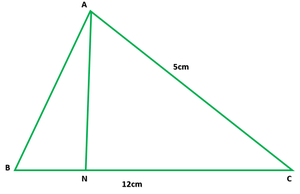
In ∆ABC, ∠A = 90°
AN ⊥ BC
BC = 12 cm, AC = 5 cm
So, in ∆ANC and ∆ ABC,
∠ANC = ∠BAC = 90°
∠C =∠C [Common]
So, by AA,
∆ANC ∼ ∆ ABC
ar.(∆ANC)/ar.(∆ABC) = (AC)2/(BC)2 = (5)2/(12)2 = 25/144
Hence, the ratio of the areas of ∆ANC and ∆ABC is 25:144
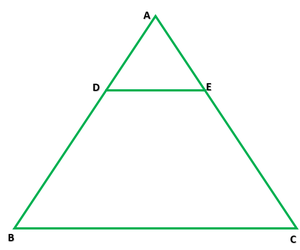
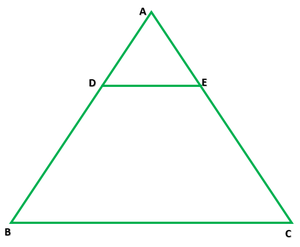
Given that, DE || BC
So, In ∆ADE and ∆ABC
∠ADE = ∠B
∠BAC = ∠DAE
So, by AA
∆ADE ~ ∆ABC
(i) Given that DE = 4 cm, BC = 6 cm and ar(∆ADE) = 16 cm2
As we know that ∆ADE ∼ ∆ABC
So, ar(∆ADE)/ar(∆ABC) = DE2/BC2
16/ar(∆ABC) = 42/62 = 16/36
So, 16 × area ∆ABC = 16 × 36
⇒ ar.(∆ABC) = 36cm2
(ii) Given that DE = 4cm, BC = 8 cm and ar(∆ADE) = 25 cm2
As we know that ∆ADE ∼ ∆ABC
So, ar(∆ADE)/ar(∆ABC) = DE2/BC2
25/area(∆ABC) = (4)2/(8)2 = 16/64
area(∆ABC) = (25 × 64)/16 = 100 cm2
(iii) Given that, DE : BC = 3 : 5
As we know that ∆ADE ∼ ∆ABC
area(∆ADE)/area(∆ABC) = DE2/BC2 = (3/5)2 = 9/25
25 (area(∆ADE)) = 9 (area ∆ABC)
25 (area(∆ADE)) = 9(area ∆ADE + area trapezium BCED)
area(∆ADE)/area of trapezium BCED = 9/16
Hence, the ratio of the areas of ∆ADE and the trapezium BCED is 9:16
Given that, in ∆ABC, D and E are the mid points of AB and AC
So, DE||BC and DE = 1/2BC
In ∆ADE and ∆ABC,
∠ADE = ∠B
∠DAE = ∠BAC [Common]
By AA
∆ADE ∼ ∆ABC
So, ar(∆ADE)/ar(∆ABC) = (DE)2/(BC)2
Hence, the ratio of the areas of ∆ADE and ∆ABC is 1:4
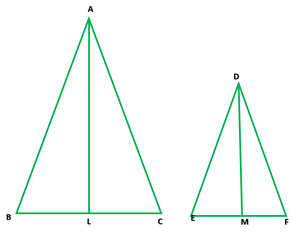
Let us consider ∆ABC and ∆DEF
It is given that, area ∆ABC = 100 cm2
and area ∆DEF = 49 cm2
AL perpendicular BC and DM/EF
AL = 5cm,
Let DM = x cm
It is given that ∆ABC ~ ∆DEF
So, ar(∆ABC)/ar(∆DEF) = AL2/DM2
100/49 = (5)2/(x)2
100/49 = 25/x2
x2 = (25 × 49)/100 = 49/4
x =
Hence, the length of altitude of second triangle is 3.5cm