VOOZH about

URL: https://www.geeksforgeeks.org/maths/complex-number-formula/

⇱ Complex Number Formulas - GeeksforGeeks


  • Courses
  • Tutorials
  • Interview Prep

Complex Number Formulas

Last Updated : 21 Feb, 2026

A complex number is a number that can be written in the form z = a + ib, where a is the real part, b is the imaginary part, and i is the imaginary unit defined by i² = −1.

In simple terms, a complex number is the combination of a real number and an imaginary number written in standard form. Operations on complex numbers are similar to operations on polynomials.

Addition and Subtraction of Complex Numbers

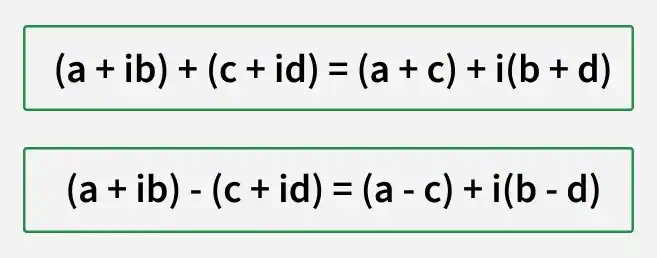
The addition and subtraction of complex numbers are fundamental operations. Similar to polynomials, we combine like terms. That is, we add or subtract the real parts together and the imaginary parts together.

Let z₁ = a + ib and z₂ = c + id, where a, b, c, and d are real numbers.

Formula:

👁 complex-

Example:

  • Addition: (3 + 4i) + (2 − 5i) = (3+2) + (4−5)i = 5 − i
  • Subtraction: (6 − 9i) − (1 + 6i) = (6−1) + (−9−6)i = 5 − 15i

Multiplication of Complex Numbers

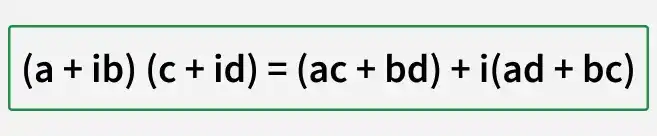
Multiplication of complex numbers means finding the product of two complex numbers using the distributive property, just like multiplying polynomials.

If z = a + ib and w = c + id, then their product is: zw = (a + ib)(c + id).

(a + ib)(c + id) = ac + iad + ibc + i²bd

Since i² = −1, (a + ib)(c + id) = (ac − bd) + i(ad + bc)

👁 complex_2

Example:

(7 + 2i)(3 − 4i)
= 21 − 28i + 6i − 8i²
= 21 − 22i − 8(−1)
= 29 − 22i

Division of Complex Numbers

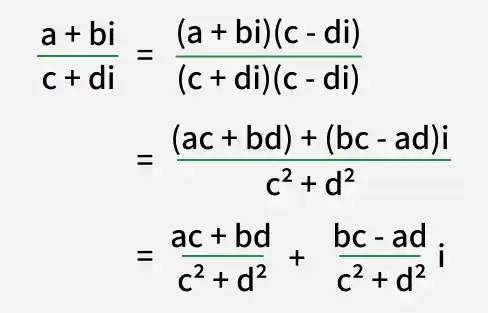
Division of complex numbers is similar in idea to real-number division, but we remove the imaginary part from the denominator using the conjugate.

If z₁ = a + ib and z₂ = c + id, then

z₁ / z₂ = (a + ib) / (c + id)

Formula:

👁 complex_3

Example:

(3 + 4i) / (1 + 2i)

Multiply by conjugate (1 − 2i):

= (3 + 4i)(1 − 2i) / (1² + 2²)
= (3 − 6i + 4i − 8i²) / 5
= (3 − 2i − 8(−1)) / 5
= (11 − 2i) / 5
= 11/5 − (2/5)i

➣ Also Check: Conjugate of Complex Number

Equality of Complex Numbers

Two complex numbers are said to be equal if and only if their real parts are equal and their imaginary parts are equal.

If z₁ = a + ib and z₂ = c + id, then

z₁ = z₂ ⇔ a = c and b = d

Note:

  • If a ≠ c or b ≠ d, then the complex numbers are not equal.
  • Always write complex numbers in standard form a + ib before comparing.
  • That the sum of two complex conjugates is real and that their product is also real.

Example: Check whether the complex numbers are equal:

z₁ = 5 − 2i + 7
z₂ = 1 + 4i + 11 − 6i

Solution:

Step 1: Simplify

z₁ = (5 + 7) − 2i = 12 − 2i
z₂ = (1 + 11) + (4i − 6i) = 12 − 2i

Step 2: Compare

Real parts: 12 = 12
Imaginary parts: −2 = −2
Since both parts are equal, z₁ = z₂

Example: Find x and y if x + yi = 2y − (3x − 7)i.

Solution:

Since two complex numbers are equal, their real parts and imaginary parts must be equal.

Compare real parts:
x = 2y … (1)

Compare imaginary parts:
y = −(3x − 7) … (2)

Substitute x = 2y into (2):
y = −(6y − 7)
y = −6y + 7
7y = 7 ⇒ y = 1

From (1):
x = 2y = 2

So, x = 2 and y = 1.

Dividing complex numbers

You probably already know that you can write an expression like 2 / (3 - √2) as a fraction with a rational denominator by multiplying the numerator and denominator by 3 + √2.

2 / (3 - √2) = ( 2 / (3 - √2)) * (3 + √2)/(3 + √2) 

= (6 + 2√2) / (9 - 2)

= (6 + 2√2) / 7

Because zis always real, you can use a similar method to write an expression like 2 / (3 - 5i) as a fraction with a real denominator, by multiplying the numerator

and denominator by 3+ 5i(as 3 + 5i is the complex conjugate of 3 - 5i)

This is the basis for dividing one complex number by another.

Example: Find the real and imaginary parts of 1/(3 + i).

Solution

Multiply the numerator and denominator by 3 - i 

 (As  3 - i is the conjugate of the denominator  3 + i)

1/( 3 + i) = ( 3 - i) / [( 3 + i)( 3 - i]

= ( 3 - i) / (9 + 1)

= ( 3 - i) / 10

The real part is 3/10 and the imaginary part is -1/10. 

Modulus and Argument of Complex Numbers

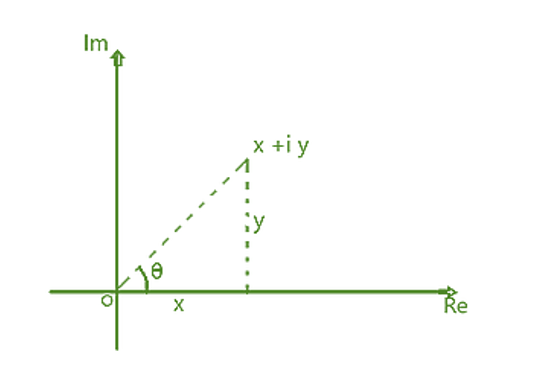
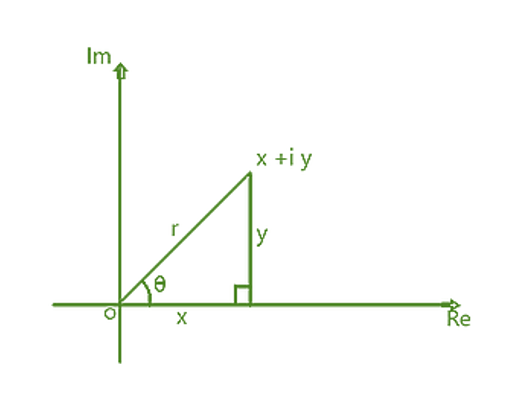
The below figure shows the point representing z = x + iy on an argand diagram.

👁 Image

The distance of this point from the origin is √x² + y². 

This distance is called the modulus of z and is denoted by |z|. 

So, for the complex number z = x + yi,

|z| = √x² + y² .

Notice that z\bar{z} =  (x + iy)(x - iy) = x² + y², then |z| = z×\bar{z}

The argument i.e angle θ is measured anticlockwise from the positive real axis. By convention, the argument is measured in radians.

Arg z (θ) = tan¯1(b/a), The argument should lie between −π to π,

Modulus-argument form / Polar form of a complex number

In the below figure, you can see the relationship between the components of a complex number and its modulus and argument. 

👁 Image

Using trigonometry, you can see that sinθ = y/r and so y = rsinθ.

Similarly, cosθ = x/r so x = rcosθ.

Therefore, the complex number z = x + yi can be written as:

z = r (cosθ + i sinθ)

This is called the modulus-argument form / Polar form of the complex number and is sometimes written as (r, θ).

Solved Example

Question 1: Solve the equation (2 + 3i)z = 9 - 4i.

Solution:

We have (2 + 3i)z = 9 - 4i

⇒ z = (9 - 4i) / (2 + 3i)

       = [(9 - 4i) / (2 + 3i)] * [(2 - 3i)(2 - 3i)]

       = (18 - 27i - 8i + 12i2) / (4 - 6i + 6i - 9i2)

       = (6 - 35i) / 13

       = (6 / 13) - (35 / 13)i

Question 2: Find the real and imaginary parts of 1/(5 + 2i).

Solution:

Multiply the numerator and denominator by 5 - 2i

 (As 5 - 2i is the conjugate of the denominator 5 + 2i)

1/(5 + 2i) = (5 - 2i) / [(5 + 2i)(5 - 2i)]

= (5 - 2i) / (25 + 4)

= (5 - 2i) / 29

The real part is 5/29 and the imaginary part is -2/29. 

Question 3: Write the following complex numbers in the modulus-argument form

(i) z1 = √3 + 3i 

(ii) z2 = √3 - 3i 

Solution:

(i) For z1 = √3 + 3i , we have

modulus |z1| = √(√3)2 + (3)2 = 2√3

θ = tan¯1(3 / √3 ) = π / 3

⇒ arg z1 = π / 3

so, z1 =  2√3(cos(π / 3) + i sin(π / 3))

(ii)  For z2 = √3 - 3i, we have 

modulus |z2| = √(√3)2 + (3)2 = 2√3

θ = tan¯1(-3 / √3 ) = -π / 3

⇒ arg z2 = -π / 3

so, z2 =  2√3(cos(-π / 3) + i sin(-π / 3))

Question 4: For the given complex number, find the argument of the complex number, giving your answers in radians in exact form or to 3 significant

figures as appropriate.

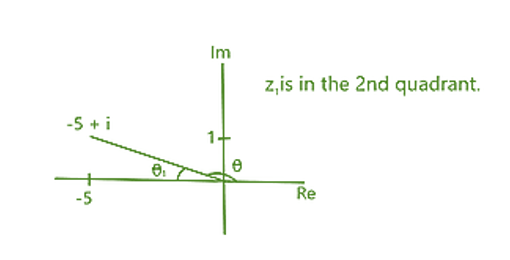
(i) z1 = −5+ i

Solution:

👁 Image

θ1 = tan¯1(1/5) = 0.1973...

so arg z1 = π - 0.1973... = 2.94 (3 s.f)

Question 5: Express the given complex number (-4) in the polar form.

Solution:

Given, complex number is -4 i.e z = -4 +0 i

Let r cos θ = -4 …(1)

and r sin θ = 0 …(2)

 Now, squaring and adding (1) and (2), we get

r2cos2θ + r2sin2θ = (-4)2

r2(cos2θ + sin2θ) = 16

We know that, cos2θ + sin2θ = 1, then the above equation becomes,

r2 = 16

r = 4 (Conventionally, r > 0)

Now, substitute the value of r in (1) and (2), we get

4 cos θ = -4 and 4 sin θ = 0

⇒ cos θ = -1 and sin θ = 0

Therefore, θ = π

Hence, the polar representation is,

-4 = r cos θ + i r sin θ

4 cos π + 4i sin π = 4(cos π + i sin π)

Thus, the required polar form is 4 cos π+ 4i sin π = 4(cos π+i sin π).

Unsolved Practice Problems

  1. Simplify:
  2. Find the conjugate of the complex number .
  3. Divide:
  4. Find the modulus and argument of the complex number .
  5. Solve the quadratic equation .
  6. Express the complex number in rectangular form .
  7. If and , find .
  8. Find the real and imaginary parts of the complex number .
  9. Prove that the product of a complex number and its conjugate is a real number.
  10. Find all complex numbers such that .

Answer:-

  1. 22-7i
  2. -2-7i
  3. 2,
  4. z=-2+3i, z=-2-3i
  5. 2, 11
  6. (a + bi) (a - bi)= a2+ b2
  7. ±3i
Comment

Explore