|
VOOZH | about |
|
VOOZH | about |
Degrees of Freedom (DOF) are the number of independent values in a data set that are free to vary while satisfying a given condition or constraint.
The following points help to understand Degrees of Freedom more easily:
Example: Total Marks Constraint
Suppose five students together scored a total of 250 marks.
You can freely choose the marks of the first four students. For example, their marks may be:
40, 55, 60, and 45
After choosing these four values, the marks of the fifth student are automatically fixed. To make the total equal to 250, the fifth student must score 50 marks.
This means:
- The first four values can vary freely.
- The fifth value depends on the other four values and cannot vary independently.
Therefore, only four values are independent.
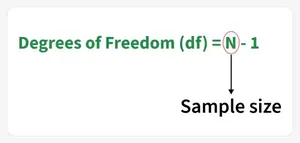
Degrees of Freedom (DOF) = 5 − 1 = 4.
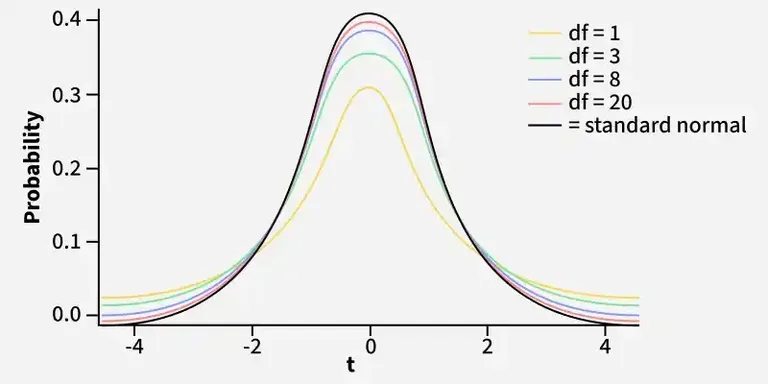
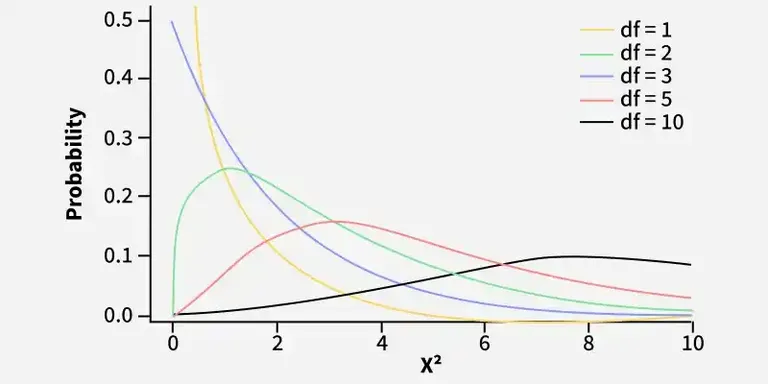
Degrees of freedom help determine the critical value used in hypothesis testing. Different values of degrees of freedom change the shape of probability distributions such as the t-distribution and chi-square distribution.
In a t-test, the calculated t-value is compared with a critical value from the Student’s t-distribution. The shape of this distribution depends on the degrees of freedom.
In a chi-square test, the calculated chi-square value is compared with a critical value from the chi-square distribution. The shape of this distribution also depends on the degrees of freedom (df).
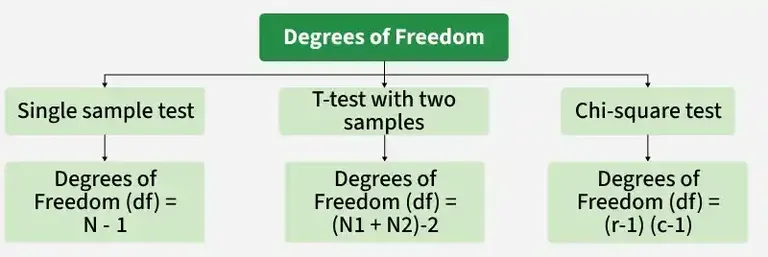
The following table shows the formulas used to calculate Degrees of Freedom for some commonly used statistical tests:
| Test | Formula | Notes |
|---|---|---|
| One-sample t-test | df = n − 1 | n represents the total number of observations in the sample |
| Independent samples t-test | df = n₁ + n₂ − 2 | n₁ and n₂ represent the sample sizes of the two groups |
| Dependent samples t-test | df = n − 1 | n represents the total number of paired observations |
| Simple linear regression | df = n − 2 | Two degrees of freedom are used for estimating the regression parameters |
| Chi-square goodness of fit test | df = k − 1 | k represents the total number of categories or groups |
| Chi-square test of independence | df = (r − 1) × (c − 1) | r represents the number of rows and c represents the number of columns in the contingency table |
| One-way ANOVA | Between-group df = k − 1 Within-group df = N − k Total df = N − 1 | k represents the number of groups, and N represents the total number of observations |
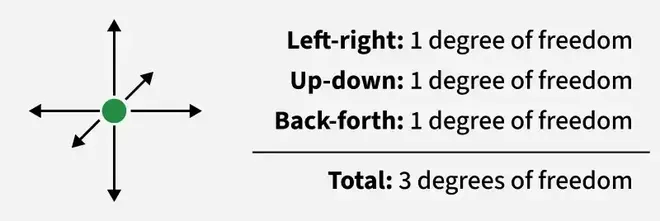
In mechanics, Degrees of Freedom (DOF) describe the number of independent directions in which an object can move. A moving object can have different types of motion,n such as left-right, up-down, and forward-backwards movement. Each independent movement represents one degree of freedom.
Therefore, an object moving freely in three-dimensional space has three degrees of freedom.
For example, a helicopter moving through space can move:
- Left and right
- Up and down
- Forward and backward
So, it has 3 degrees of freedom for motion.
On the other hand, an elevator can move only up and down because it is restricted by the elevator shaft. Therefore, it has only 1 degree of freedom.
If there are two elevators moving independently, the system has 2 degrees of freedom because each elevator can move separately.
Example 1: Determine the degrees of Freedom for the given set of data.
Data: 5, 7, 4, 6, 10, 12
Solution:
Number of Values, n = 6
Degree of Freedom = n-1
= 6 - 1
= 5
Example 2: Evaluate the Degree of Freedom for the given set of observations.
Observations: 1, 7, 5, 12, 17, 18, 19, 25
Solution:
Number of Values, n = 8
Degree of Freedom = n - 1
= 8 - 1
= 7
Example 3: Evaluate the degrees of Freedom for the given set of observations.
Observation 1: 1, 7, 5, 12, 17, 18, 19, 25
Observation 2: 14, 15, 21, 29, 10
Solution:
- Number of Values in Observation 1, n1 = 8
- Number of Values in Observation 2, n2 = 5
Degree of Freedom = n1 + n2 - 2
= 8 + 5 - 2
= 11
Example 4: Evaluate the Degree of Freedom for the given set of observations.
Observation 1: 1, 6, 5, 13, 17
Observation 2: 12, 11, 26
Solution:
- Number of values in observation 1, n1 = 5
- Number of values in observation 2, n2 = 3
Degree of Freedom = n1 + n2 - 2
= 5 + 3 - 2
= 6