|
VOOZH | about |
|
VOOZH | about |
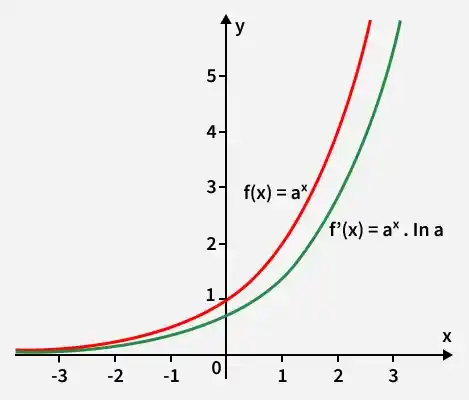
It describes the rate of change in an exponential function with respect to the independent variable. The derivative of an exponential function like ax (a > 0) is the same function multiplied by a constant (the natural log of a). For example, ax becomes ax ln a when differentiated.
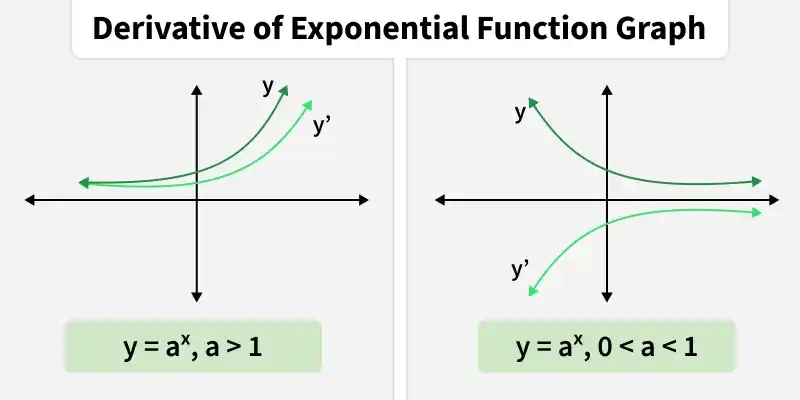
It can be obtained through the first principles of differentiation, utilizing limit formulas, and its graph increases when a > 1 and decreases when 0 < a < 1.
The formula for the differentiation or derivative of the exponential function is:
It can be proved by using the first principle, where we find the derivative of a function using the definition of limits. From the definition of limits, we know that
For the function f(x) = ax, using the First Principle,
=
=
= ax ln a {Since, }
Hence, the derivative of the Exponential Function ax is the product of ax and the natural logarithm of a.
Taking a = e in ax , our function will be f(x) = ex
So, f'(x) = ex ln e
ex ln(e) = ex logee (ln is a natural logarithm with base e)
ex logee = ex (from logarithm formulas, logaa = 1 )
Hence, f'(x) = ex
The nature of the graph of exponential function changes when the value of 'a' increases or decreases with respect to 1.
Since exponential function ax is only defined when a > 0 and derivative of a function is tangent to the graph or curve of that function. Hence, the graph of exponential function derivative is increasing for a > 0.
Exponential Function and Logarithmic Function are inverse of each other with change in base.
Exponential Form | Logarithmic Form |
|---|---|
x = ay | y = logax |
x = ey | y = ln x |
The derivative of exponential and logarithmic functions is mentioned below:
Example 1: Find the derivative of esin x.
Solution:
Given that y = esin x
using chain rule
dy/dx = esin x(cos x)
Example 2: Differentiate elog x.
Solution:
Let y = elog x
then dy/dx = elog x.1/x
Now we know that from the property of logarithm that elog x = x
Hence, dy/dx = elog x.1/x = x.1/x = 1
Example 3: Find the derivative of ex.log x.
Solution:
y = ex.log x
Here the function is in u.v form
Applying the product rule of differentiation we u.v' + v.u'
dy/dx = ex(log x)' + log x(ex)'
⇒ dy/dx = ex.1/x + log x.ex
1. Find the derivative of the function
2. Determine the derivative of the function
3. Calculate the derivative of the function
4. Find the derivative of the function
5. Determine the derivative of the function