|
VOOZH | about |
|
VOOZH | about |
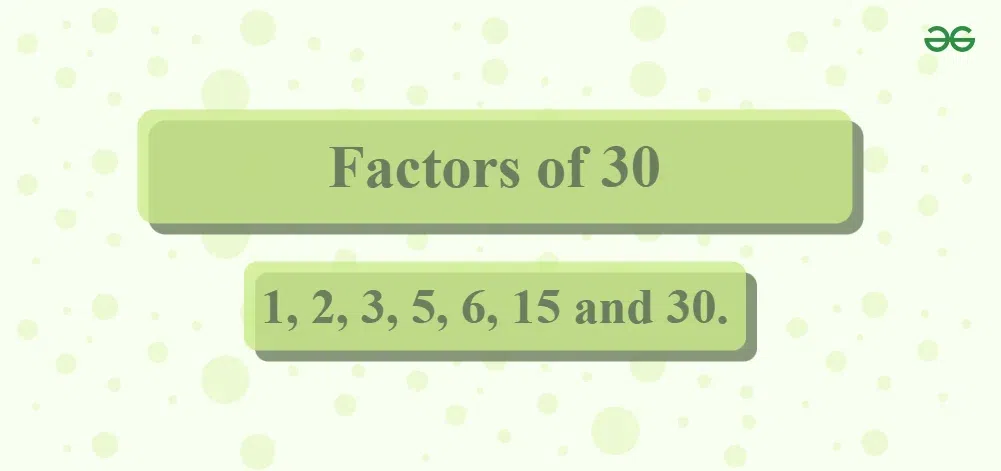
by Factors of 30 are 1, 2, 3, 5, 6, 15 and 30. These numbers can be divided by the number 30 exactly without leaving any remainder. There are negative and positive pairings of integers that are factors of 30. A negative factor of 30 is a number that has a sign of negative and is a factor of 30, Similarly, the positive factors of 30 are those numbers that have positive signs and are factors of 30.
Factors are the building blocks of numbers, and finding them helps us break down a number into its smaller components. In this article, we will learn about “What are Factors?”, “Factors of 30?”, and “How to Find Factors of 30?”.
Table of Content
Factors of a number are the whole numbers that can be multiplied together to produce that number. For example, the factors of 30 are 1, 2, 3, 5, 6, 10, 15, and 30.
Factors can be categorized into two types:
The numbers that divide 30 completely with zero remainders and no decimal points in the quotient are known as the factors of 30. Thus, 1, 2, 3, 5, 6, 10, 15, and 30 are the factors of 30. So, Let's multiply two pairs of numbers to get 30:
The following factors of 30 are:
Factors of 30 are 1, 2, 3, 5, 6, 10, 15, and 30.
Read More about Factor of a Number.
There are two ways to find the factors of 30:
Let's discuss both the method in detail.
By multiplying any numbers that gives you 30, So, by using different numbers, you can find the pairs of factors and use the multiplication method to get the factors of 30. Let's see the pairing of numbers in the form of factors of 30:
So, These factors of 30 are represented in the pair form of the multiplication method.
By dividing 30 by different numbers, you can find the pairs of factors and use the division method to get the factors of 30. So, Let's see the pairing of numbers in the form of factors of 30:
So, These factors of 30 are represented in pair form of the Division method.
Prime factorization is the process of representing 30 as a product of its prime factors. Thus, the situation where the number 30 can be expressed as the product of 2, 3, and 5 lies behind the prime factorization of 30.
As we have seen the prime factorization of 30 is given as;
30 = 2 × 3 × 5
Hence, the Prime factors of 30 are 2, 3 and 5.
Read More about Prime Factorization.
Using the factor tree method, we can also determine the prime factors of the number 30. The following are the steps to use the factor tree approach to identify the prime factors of 30:
There are two ways to write the factors of 30: positive pairs and negative pairs. Below are the pairs of 30 that are positive and negative:
Below are the positive factor pairs of 30.
- 1 × 30 = 30; (1,30)
- 2 × 15 = 30; (2,15)
- 3 × 10 = 30; (3,10)
- 5 × 6 = 30; (5,6)
Below are the negative factor pairs of 30.
- -1 × -30 = 30; (-1,-30)
- -2 × -15 = 30; (-2,-15)
- -3 × -10 = 30; (-3,-10)
- -5 × -6 = 30; (-5,-6)
Read More,
Example 1: Sonu has (-6) as one of the factors of 30. He wants to find the factor that makes the pair of factors of the number 30 with -6.
Solution:
To identify the factor that pairs with -6 to give a product of 30, Sonu can divide 30 by -6. In this case, one of the factors of 30 is (-6).
The equation factor 30 ÷ (-6) = (-5) can be solved.
So, the other factor is -5.
Example 2: What is the Sum of all the Factors of 30?
Solution:
Let's find the sum of all factors of 30, Therefore the factors of 30 are; 1, 2, 3, 5, 6, 10, 15, 30
So, the sum of these factors are 1+2+3+5+6+10+15+30 = 72
So, The total sum of factors of 30 is 72.
Example 3: List the common factors between 30, and 35.
Solution:
We can determine the factors of each number and discover the numbers that they share in order to find the common factors of two numbers. Now let's locate the factors 35 and 30.
Factors of 30: 1, 2, 3, 5, 6, 10, 15, 30
Factors of 35: 1, 5, 7, 35Therefore, the common factors between 30 and 35 are 1 and 5.
Example 4: If -3 is a factor of 30, what is the other factor in the pair?
Solution:
We can calculate the other part by dividing 30 by -3,
30/-3 = -10.
Therefore, the pair of factors is (-3, -10), as (−3)×(−10) = 30.
Q1: Determine the positive factors of 30.
Q2: If 4 is a factor of 30, what is the other factor in the pair?
Q3: List the factors of 30 that are between 5 and 15.
Q4: Find a pair of factors of 30 whose product is 30.