|
VOOZH | about |
|
VOOZH | about |
Interval notation is a method used to represent continuous sets of real numbers by specifying their boundaries. Written intervals resemble ordered pairs but are not used to indicate specific points. Instead, they serve as a concise means to express inequalities or systems of inequalities, providing a shorthand form to describe the range of values within those boundaries.
Interval notation helps in classifying a range of numbers as a single representation which makes it easier to understand the numeric representation in mathematical terms.
In this article, we will discuss Interval Notation in detail including the different types of interval notations and their representations along with solved examples and practice problems.
Table of Content
Interval notation is a concise and effective way to represent intervals or sets of real numbers on the number line between two defined points on the real line. It uses brackets, parentheses, and inequalities to denote the boundaries and characteristics of the interval, making it a valuable tool in mathematics and other fields. Interval notation simplifies the expression of relationships between numbers within a given range, enhancing our ability to work with inequalities and intervals in a clear and standardized manner.
Interval Notation acts as a vehicle for representation of a portion of the real number spectrum by utilizing the values that establish its boundaries. It is a potent tool for representing inequalities. For instance, when we express an interval as 2 < x < 7, it signifies a collection of numbers positioned between 2 and 7.
Interval Notation is method of illustrating a range on the number line between two numbers, in the form of a subset denoting real number continuum.
It includes the numerical realm situated amid two explicitly defined values. For instance, the collection of values denoted as "y" that adhere to the conditions 3 ≤ y ≤ 9 forms an interval encompassing 3, 9, and all intervening numbers.
Let's consider a scenario where we aim to convey the assortment of real values {y | -4 < y < 6} using interval notation. This can be presented as (-4, 6).
The representation for the same on the number line is given below:
👁 Interval-Notation-on-Number-Line
The spectrum of real numbers can be denoted as (-∞, ∞) which can be represented as whole real line.
👁 Real-Number-Interval-Notation
Representation of the real number continuum on the numerical axis.
Interval notation is a concise method for representing ranges of real numbers using brackets, parentheses, and inequalities. It helps express the continuum of real numbers and simplifies the communication of mathematical ideas involving intervals.
Example: The interval [1, 5] represents all real numbers greater than or equal to 1 and less than or equal to 5.
Interval notation is a powerful tool to convey inequalities by indicating the boundaries and characteristics of a range of values. It streamlines the representation of inequalities in a standardised and intuitive format.
Example: The inequality (x > 3) can be expressed in interval notation as (3, ∞), which represents all real numbers greater than 3.
Interval notation can be seen as a way to represent sets of real numbers, offering a clear and uniform method to define and describe these sets, enhancing our ability to work with them in various mathematical contexts.
Example: The set of all real numbers between -1 and 1 can be represented in interval notation as (-1, 1).
In mathematics, interval notation is commonly used to denote the domain of a function, helping specify the set of input values for which the function is defined. It simplifies the description of these input intervals.
Example: The domain of a function f(x) = √x is represented in interval notation as [0, ∞) because it includes all non-negative real numbers.
Similar to its use in describing domains, interval notation can represent the range of a function, providing a concise and precise way to express the set of output values produced by the function over certain intervals of the domain.
Example: The range of a function g(x) = x² for all real numbers is expressed as [0, ∞), which includes all non-negative real numbers.
Read More: Domain and Range
Intervals may be categorized depending on the numerical content of the collection. Certain collections encompass the designated terminal points within the notation, whereas others might encompass the endpoints partially or not at all. Below classifications of intervals are recognized:
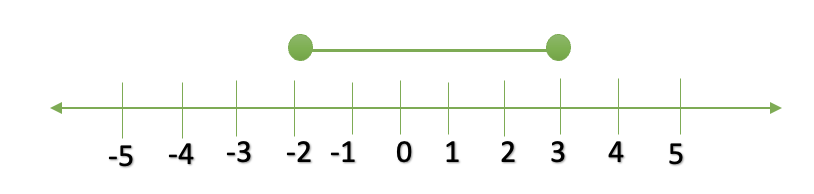
A closed interval range forms a set of real numbers that thoughtfully encompasses both of its terminal values. To exemplify, the range [2, 5] incorporates all real numbers starting from 2 and concluding at 5, thoughtfully embracing 2 and 5 within.
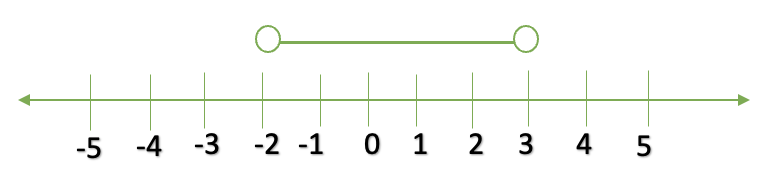
An open interval range represents a collection of real values that intentionally excludes its boundary points. As an illustration, the range (0, 1) encompasses all real numbers within the span of 0 to 1, deliberately omitting 0 and 1 themselves.
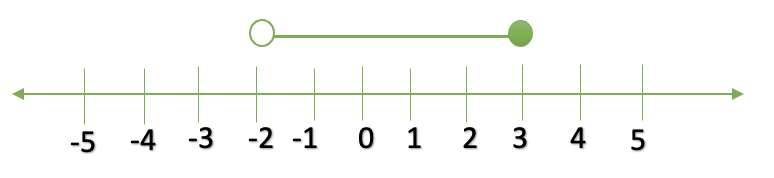
A semi-open range comprises one terminal point but thoughtfully avoids the other. To illustrate, the range [1, 3) encompasses all real values greater than or equal to 1 but less than 3, deliberately excluding 3.
Infinite intervals extend infinitely in one direction, either towards positive or negative infinity, without specific boundaries. These intervals arise when dealing with unbounded sets of real numbers. Unlike bounded intervals with finite limits, infinite intervals possess no fixed endpoint and are denoted by either ∞ (infinity) or -∞ (negative infinity).
To represent infinite intervals, use arrows on the number line. For example, (-∞, 5) signifies all real numbers less than 5, so draw an arrow pointing to the left from 5. Similarly, (3, ∞) represents all real numbers greater than 3, so draw an arrow pointing to the right from 3.
To represent infinite intervals, mathematical notation employs ∞ and -∞, much like the use of brackets and parentheses in standard interval notation.
For instance, an interval that includes all real numbers greater than 5 given value can be expressed as [5, ∞), indicating it extends indefinitely towards positive infinity and includes '5'. Conversely, (-∞, 7] signifies all real numbers less than or equal to '7' with no upper bound.
Characteristics | Open Interval | Closed Interval |
|---|---|---|
Definition | An interval that does not include the endpoints is called an open interval. | An interval that includes the endpoints is called a closed interval. |
Brackets | Open interval uses parenthesis. | Closed interval uses square brackets. |
Representation | It is represented as (a, b). | It is represented as [a, b]. |
Example | An example of open interval is 2 < x < 9. | An example of closed interval is 2 ≤ x ≤ 9. |
Also Check: Open Interval and Closed Interval
👁 Half - Open Interval Notation
Applications of Interval Notation include the following:
Example 1. Determine if 2.5 in the open interval (1, 5).
Solution:
Yes, 2.5 in the open interval (1, 5).
Example 2. Write the intervals range of real numbers where y is greater than 3 and less than 6?
Solution:
The interval range of x is greater than 3 and less than 6 is open interval for 3, 6 represented as (3, 6).
Example 3. Write the intervals range of real numbers where x is greater than 2 and less than 7.
Solution:
The interval range of x is greater than 2 and less than 7 is open interval for 2, 7 represented as (2, 7).
Example 4. Write the intervals range of real numbers where x is greater than equal to 2 and less than equal to 7.
Solution:
The interval range of x is greater than 2 and less than 7 is closed interval for 2, 7 represented as [2, 7].
Example 5. Write the intervals range of real numbers where x is greater than equal to 2 and less than 7.
Solution:
The interval range of x is greater than 2 and less than 7 is half - open interval for 2, 7 represented as [2, 7).
Q1: Determine if 0 is in the closed interval [-2, 3] ?
Q2: Write the intervals set of real values y such that y is less than or equal to -1.
Q3: Write the intervals range of real numbers where x is greater than equal to 2 and less than 7.
Q4: Write the intervals range of real numbers where x is greater than equal to 2 and less than 7.
Q5: Write the intervals range of real numbers where x is greater than equal to 2 and less than 7.
Interval notation is a method used in mathematics to describe a range of real numbers between two endpoints on a number line. It uses brackets and parentheses to indicate whether the endpoints are included or excluded from the interval. For example, the notation [a,b] includes both endpoints a and b, while (a,b) excludes them. This notation helps clearly define sets of numbers, such as the domain or range of functions, and is useful for expressing and solving inequalities. It also distinguishes between different types of intervals, such as open, closed, half-open, and infinite intervals, each serving to accurately describe numerical ranges in various mathematical contexts.

.png)