 |
VOOZH | about |
|
VOOZH | about |
A number line is a basic mathematical tool used to represent numbers on a straight line.
👁 both_direcionExample: On a number line, 5 lies to the right of 0, so it is greater than 0, while −3 lies to the left of 0, so it is smaller than 0.
A number line can be drawn very easily; just follow the below-given steps:
Step 1: Make a straight line with arrows at both ends. You can also make it go up and down.
Step 2: Decide on a scale depending on your number. Let's say your number is 8; you might choose a scale of 2. If it's 75, you could go with a scale of 15 or 25. It depends on the number you have.
Step 3: Put marks at even spaces. If your scale is 2, mark 0, 2, 4, 6, 8, and so forth.
Step 4: Identify and circle the point on the line that represents your number. For example, if your number is 8, find that spot and circle it.
Understanding arithmetic on a number line starts with locating numbers. Zero is the midpoint, with positive numbers to the right and negative numbers to the left. Moving left means decreasing value; for instance, 1 is greater than -1. The number line also locates integers, fractions, and decimals. It's a useful tool to visualize and compare numerical values.
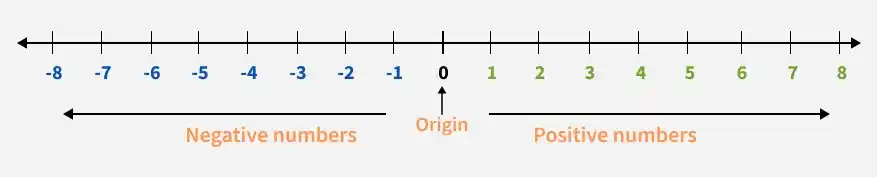
The numbers less than zero and placed on the left-hand side of the number lines are called negative numbers. They include number such as, -12, -31, -101, etc.
The numbers greater than zero and placed on the right-hand side of the number lines are called positive numbers. They include number such as, 2, 12, 56, etc.
👁 Positive and Negative Numbers on Number Line
The number line from 1 to 100 represents integers in sequential order. It serves as a visual tool to understand the relative magnitude and relationships between numbers, aiding in mathematical concepts like addition, subtraction, and ordering.
A number line has two parts. On the left of zero is the negative part, and on the right is the positive part. The negative part has numbers smaller than zero, and the positive part has numbers larger than zero. The number line keeps going forever in both directions (left and right).
Look at the different sections of the number line to understand these features:
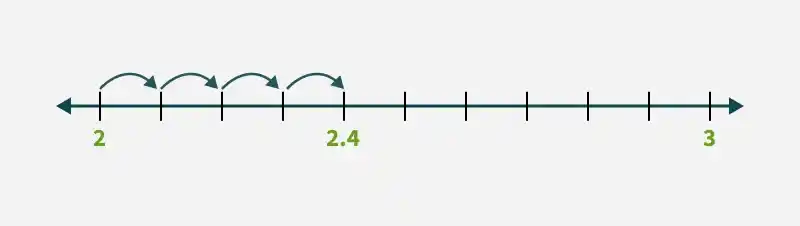
A number line can represent different types of numbers, such as whole numbers, fractions, decimals, integers, rational numbers, and irrational numbers. Decimals can also be placed accurately on a number line by dividing the space between two whole numbers into equal parts.
Example: Represent 2.4 on a number line.
This point represents 2.4 on the number line.
Rational numbers are the numbers that are represented in the form of p/q, and they can also be easily represented on the number line.
Irrational numbers are the numbers that are not represented in the form of p/q, and they can also be easily represented on the number line.
Addition on a number line involves moving to the right for positive numbers and to the left for negatives. It's a visual method where combining integers is represented by shifting along the line to reach the sum.
On adding two positive numbers on a number line, the resultant will always be positive. For example 3 + 2 = 5
On adding two negative numbers on a number line, the resultant will always be negative. For example (-3) + (-2) = (-5).
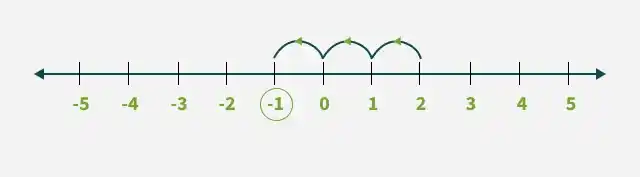
Subtraction on a number line involves moving to the left from a given point. The numerical difference between two values is represented by the distance traveled. For instance, subtracting 30 from 50 on a number line implies moving 20 units to the left.
On subtracting two positive numbers on a number line, the result can be a positive number or a negative number, depending on whether the first number is greater or smaller.
For example:
Case 1: 2 − 3 = −1
Here, the first number 2 is smaller than 3, so when we subtract 3 from 2, the result is −1.
Case 2: 3 − 2 = 1
Here, the first number 3 is greater than 2, so when we subtract 2 from 3, the result is 1.
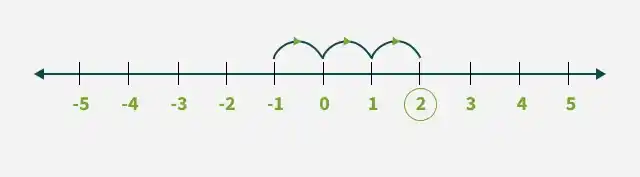
Subtraction on a number line helps us understand how numbers change when we subtract. When we subtract a negative number, it is the same as adding a positive number, so we move to the right on the number line.
Steps:
Example: Represent −1 − (−3) on a number line.
Start at −1 on the number line. Since we are subtracting −3, move 3 steps to the right. You land on 2, so the result is −1 − (−3) = 2.
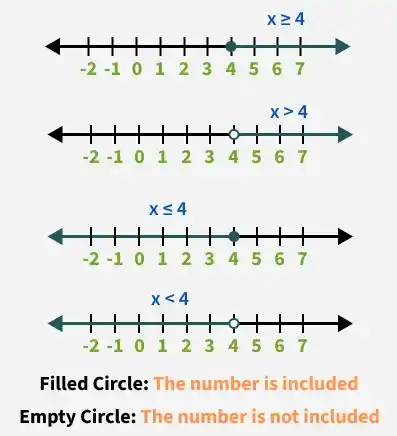
A number line can also be used to represent inequalities, which show that one number is greater than or less than another. On the number line, the position of a number helps us understand whether it is greater than, less than, or equal to another value.
Graphing inequalities on a number line helps us visually show the set of numbers that satisfy a given condition. Symbols such as ≥, >, ≤, and < indicate how numbers are compared, and the number line helps us clearly see the range of values that make the inequality true. While graphing inequalities on a number line, an open circle is used when the number is not included (< or >), and a closed circle is used when the number is included (≤ or ≥). The shaded part of the line shows the set of possible values.
Example: Represent the inequalities x≥4, x>4, x≤4, and x<4 on a number line.
First, draw a number line and mark the point 4.
Example 1: Add 8 and 6 using a number line.
Example 2: From 9, use 3 units to the left.
Example 3: Subtract 5 from 7 using a number line.
Q1: On a number line, mark the position of the number -2.
Q2: Graph the inequality y > 7 on a number line and indicate the shaded region.
Q3: Choose an appropriate scale and mark the points at equal intervals from 0 to 10 on a number line.
Q4: Given the inequality z ≤ 5, graph it on a number line and highlight the section that satisfies the inequality.
Q5: Place the numbers 1, 4, and 7 on a number line. Indicate which number is greater and which is smaller.


.png)
.png)
.png)
.png)
-660.jpg)
-660.jpg)
-660.jpg)