|
VOOZH | about |
|
VOOZH | about |
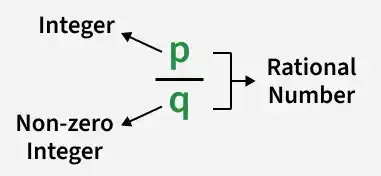
A rational number is any number that can be written in the form
👁 420851506For example, the numbers 0, 2, 4.5, 2/3, −8/7, −7.2, 0.333, and √64 are included.
Key Points
1. Fraction Form: A rational number is written as p/q, where p is the numerator and q ≠ 0 is the denominator.
Examples: 3/5, −7/2
2. Decimal Form: A rational number can also be written as a terminating or repeating decimal.
Examples:
3. Representing Rational Numbers on Number Line
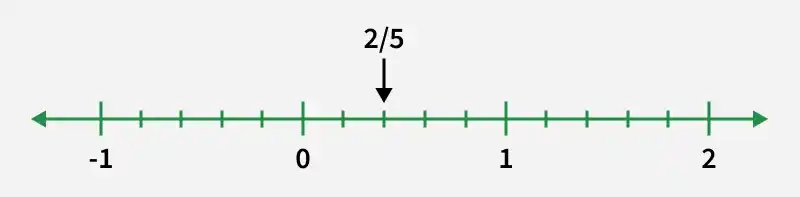
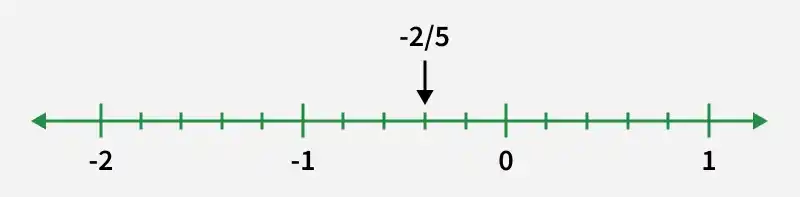
Rational numbers are a subset of real numbers therefore, they can be represented on the real line. The steps to represent a rational number are as follows:
- Step 1: First find if the number is positive or negative, if positive then it will be plotted on the RHS of zero and if negative, it will be on the LHS of zero.
- Step 2: Identify if the given rational number is proper or improper. If proper then it will lie between 0 and 1 in case of positive and 0 and -1 in case of negative rational number.
- Step 3: If improper then convert it into a mixed fraction. In this case, the rational number will lie just beyond the whole number part.
- Step 4: Now after steps 1, 2, and 3 we have to plot only the proper fraction part. To plot this cut the area between the two successive desired numbers by drawing lines n-1 times where n is the denominator of the proper fraction part.
- Step 5: Now count the lines equal to the value of the numerator. This will represent the desired rational number on a real line.
Example 1: Represent 2/5 on Real Line
Example 2: Represent -2/5 on Real Line
👁 420851508Rational Numbers can be classified into following types:
The standard form of a rational number is defined as having no common factors other than one between the dividend and divisor, and hence the divisor is positive.
Example: 12/36 is a rational number. When simplified by dividing the numerator and denominator by 12: 12/36 = 1/3
Since 1 and 3 have no common factors other than 1, the rational number 1/3 is in standard form.
Positive rational numbers are those in which both numerators and denominators are either positive or negative. In case both numerators and denominators are negative, -1 can be eliminated as common factor, which gives us ultimately a positive rational number.
Examples: 2/5, -3/-5, etc.
Negative rational numbers are those in which either the numerator or the denominator is a negative integer.
Examples: -1/2, 3/-4
Terminating decimals are the rational numbers whose decimal representations end or terminate after a certain number of digits. A rational number has a terminating expansion if the denominator is in the form of 2m × 5n, where either m or n can be zero.
Examples: 4/5 = 0.8, 3/4 = 0.75
Repeating decimals are the rational numbers whose decimal representations have a repeating pattern. The decimal expansion of a non-terminating rational number doesn't end. The same digit or group of digits is repeated after fixed interval
Examples: 1/3 = , 2/7 =
To identify a rational number, check if it can be written as a fraction where both the top number (numerator) and the bottom number (denominator) are whole numbers, and the bottom number isn't zero. Rational numbers also have decimal forms that either end after a few digits or repeat a specific pattern.
For example: Which of the following numbers are rational numbers?
a) -1.75
b) 2/3
c) √5
d) π
a) -1.75 is a rational number as it has a terminating decimal expansion.
b) 2/3 is also a rational number as it can be expressed in the form of a ratio of two integers.
c) √5 is an irrational number because it has a decimal expansion with infinitely many digits without any repetition.
d) π is also an irrational number as it has a decimal expansion with infinitely many digits without any repetition.
Thus, only (a) and (b) are the rational numbers out of all the given numbers.
There are four most common operations for Rational Numbers, which includes the following:
To add rational numbers, first make the denominators the same and then add the numerators.
Example:Add 3/4 and 1/6
Step 1: Find the LCM of 4 and 6 = 12
Step 2: Convert to equivalent fractions
3/4 = 9/12, 1/6 = 2/12
Step 3: Add the numerators
9/12 + 2/12 = 11/12
Subtraction is similar to addition. First make the denominators the same, and then subtract the numerators.
Example:Subtract 2/5 from 1/3
Step 1: LCM of 3 and 5 = 15
Step 2: Convert to equivalent fractions
1/3 = 5/15, 2/5 = 6/15
Step 3: Subtract the numerators
5/15 − 6/15 = −1/15
Multiply the numerators together and the denominators together.
Example:−11/3 × 4/5
= (−11 × 4) / (3 × 5)
= −44/15
To divide rational numbers, multiply the first fraction by the reciprocal of the second fraction.
Example:3/5 ÷ 4/7
= 3/5 × 7/4
= (3 × 7) / (5 × 4)
= 21/20
Example 1: Check which of the following is irrational or rational: 1/2, 13, -4, √3, and π.
Rational numbers are numbers that can be expressed in the form of p/q, where q is not equal to 0.
1/2, 13, and -4 are rational numbers as they can be expressed as p/q.
√3, and π are irrational numbers as they can not be expressed as p/q.
Example 2: Check if a mixed fraction, 3(5/6), is a rational number or an irrational number.
Simplest form of 3(5/6) is 23/6
Numerator = 23, which is an integer
Denominator = 6, is an integer and not equal to zero.
So, 23/6 is a rational number.
Example 3: Determine whether the given numbers are rational or irrational.
(a) 1.33 (b) 0.1 (c) 0 (d) √5
a) 1.33 is a rational number as it can be represented as 133/100.
b) 0.1 is a rational number as it can be represented as 1/10.
c) 0 is a rational number as it can be represented as 0/1.
d) √5 is an irrational number as it can not be represented as p/q.
Example 4: Simplify (2/3) × (6/8) ÷ (5/3).
(2/3) × (6/8) ÷ (5/3) = (2/3) x (6/8) × (3/5)
= (2 × 6 × 3)/(3 × 8 × 5)
= 36/120 = 3/10
Example 5: Arrange the following rational numbers in ascending order: 1/3, -1/2, 2/5, and -3/4.
Common denominator for 3, 2, 5, and 4 is 60. Thus
1/3 = 20/60
-1/2 = -30/60
2/5 = 24/60
-3/4 = -45/60
For negative numbers, the one with the more negative value is smaller:
−45/60 < −30/60 < 20/60 < 24/60
Thus, ascending order of given rational numbers is: −3/4 < −1/2 < 1/3 < 2/5
Q1. Find two rational number between 2/3 and 3/4
Q2. Find the sum of -3/5 and 6/7
Q3. Find the first five equivalent rational numbers of -7/8
Q4. Represent 4/3 on Real Line
Q5. Find the Product of -19/3 and 2/57