|
VOOZH | about |
|
VOOZH | about |
The Law of Large Numbers (LLN) is a mathematical theorem in probability and statistics that helps us understand how averages work over time. It states that if an experiment is repeated many times, the average result will approach the expected value more closely.
Law of Large Numbers states that the average is closer to the expected or theoretical value as the number of trials or observations increases.
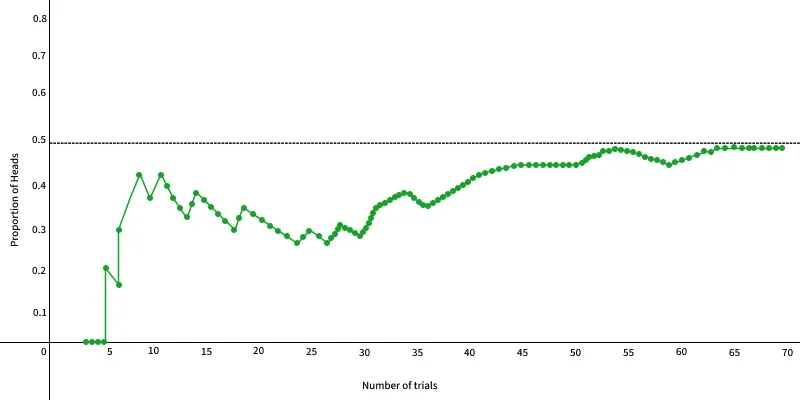
For example: if you flip a fair coin many times, the proportion of heads and tails will get closer to 50% each.
In the graph below, we can see how the proportion of heads approaches 0.5 as the number of trials increases.
👁 law_of_large_numbersThe law of large numbers is important because of the following traits:
Example explaining the law of large numbers: Imagine your bag contains blue and red balls- 50% red, 50% blue.
- If you draw just one ball, it could be red or blue — there's no way to predict the exact outcome, and that single draw doesn’t tell you much about the overall mix in the bag.
- Now suppose you draw 10 balls one by one, noting the color each time. You might get 6 red and 4 blue, or maybe 7 red and 3 blue. The ratio likely won’t be exactly 50:50, but it’ll be close.
- Now imagine repeating this process hundreds or even thousands of times. As your sample size grows, the proportion of red to blue balls in your recorded results will get closer and closer to the actual 50:50 ratio in the bag.
That’s the Law of Large Numbers:
The more trials you perform, the closer your observed average (or proportion) gets to the true theoretical value.
There are two versions of the law of large numbers, which will be discussed below.
Various types of the Law of Large Numbers are:
The WLLN states that, for a series of independent and identically distributed random variables (such as coin flips), as the number of observations rises the sample average will converge to the theoretical mean.
Imagine you have a fair coin and flip it several times to determine the Weak Law of Large Numbers (WLLN). The Weak Law of Large Numbers indicates that the proportion of heads (or tails) seen will get closer and closer to 0.5 (since the coin is fair, and the probability of obtaining a head or a tail is 0.5), as you increase the number of coin flips.
The Strong Law of Large Numbers (SLLN) states that, for a sequence of independent and identically distributed random variables with a finite expected value, the sample average almost surely (with probability 1) converges to the expected value as the number of observations approaches infinity.
Returning to the coin flipping example, the proportion of heads will almost surely (with probability 1) settle at exactly 0.5 in the long run.
Both versions essentially mean that with enough trials, the results will stabilize around the expected average.Various limitations of the Law of Large Numbers are:
The Law of the Iterated Logarithm (LIL) refines the results of the Law of Large Numbers by precisely describing the magnitude of fluctuations of the sample average around the expected value. It shows that although the sample average converges to the expected value (as stated in the Strong Law of Large Numbers), it still exhibits small, diminishing oscillations around that value.
In the coin flipping example, the LIL indicates that, as the number of coin flips rises, the sample average will not only converge to 0.5 but also offer a specific range within which it is most likely to fall.
The Law of Large Numbers (LLN) is widely used in Computer Science, especially in areas involving randomness, estimation, and simulation. Some of the key applications are:
Law of Large Numbers is a fundamental concept in probability theory and statistics that has significant applications in finance.
In finance, the Law of Large Numbers is particularly relevant in the context of portfolio management and risk analysis. Here are a few examples:
Example 1: A fair six-sided die is rolled repeatedly. What is the expected average value of the outcomes as the number of rolls increases
Solution:
Expected value of rolling a fair six-sided die is the average of the numbers 1 through 6, which is (1 + 2 + 3 + 4 + 5 + 6)/6 = 3.5
According to the Law of Large Numbers, as the number of rolls increases, the average outcome will approach 3.5
Example 2: In a game, a player flips a fair coin. If it lands heads, the player wins $1; if it lands tails, the player loses $1. What is the expected average profit/loss for the player as the number of flips increases?
Solution:
Expected value of flipping a fair coin is 0.5 for heads and 0.5 for tails
Expected profit/loss for each flip is (0.5 × $1) + (0.5 × -$1) = $0
Therefore, the expected average profit/loss for the player as the number of flips increases approaches $0 by the Law of Large Numbers
Example 3: A bag contains 20 red balls and 30 blue balls. A ball is drawn from the bag, and the color is noted. The ball is then returned to the bag, and the process is repeated. What is the expected proportion of red balls drawn as the number of draws increases?
Solution:
Probability of drawing a red ball on any single draw is 20/(20+30) = 20/50 = 2/5
By the Law of Large Numbers, as the number of draws increases, the proportion of red balls drawn will approach 2/5
Example 4: A factory produces light bulbs, and historical data show that 5% of the bulbs are defective. If a random sample of bulbs is taken from the production line, what is the expected proportion of defective bulbs as the sample size increases?
Solution:
Probability of selecting a defective bulb from the production line is 0.05
As the sample size increases, by the Law of Large Numbers, the proportion of defective bulbs in the sample will approach 0.05