|
VOOZH | about |
|
VOOZH | about |
NCERT Solutions for Class 10 Maths Chapter 12 – Areas Related to Circles is developed for students to solve problems in a carefree manner and without any frustration. This article covers all the problems related to this chapter in NCERT Solutions Class 10 Maths.
Chapter 12 - Areas Related to Circles covers The topic of calculating the area and circumference of a circle using common formulas. Additionally, there are inquiries about calculating the areas of composite figures, a sector, and a segment.
Class 10 Maths NCERT Solutions Chapter 12 Exercises |
|---|
|
Solution:
Since we have to find the radius of the final circle we will use the formula of the circumference of circle C = 2πr.
Radius (r1) = 19 cm
Radius (r2) = 9 cm
Circumference of a circle with a radius of 19 cm is 2π * 19 = 38π cm.
Circumference of a circle with a radius of 9 cm is 2π * 9 = 18π cm.
Total Circumference is = 38π + 18π = 56π cm
Now using C = 2πr3 we will find r3 which is:
56π = 2π * (r3)
Therefore, the radius of the circle which has a circumference equal to the sum of the circumference of the given two circles is 28 cm.
Solution:
Area of circle is = πr2 cm2
Area of circle1 = 64π cm2
Area of circle2 = 36π cm2
Total Area = 100π cm2
Now in order to find the radius of the required circle:
100π = πr2
r = 10 cm.
Therefore, the radius of the circle having an area equal to the sum of the areas of the two circles is 10cm.
Solution:
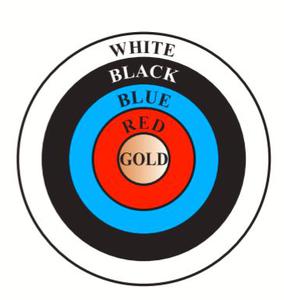
Radius (r1) of gold region (i.e., 1st circle) = 21/2 = 10.5 cm
Also, as per the question, it is Given that each circle is 10.5 cm wider than the previous circle.
Therefore, radius (r2) of 2nd circle = 10.5 + 10.5 = 21 cm
Radius (r3) of 3rd circle = 21 + 10.5 = 31.5 cm
Radius (r4) of 4th circle = 31.5 + 10.5 = 42 cm
Radius (r5) of 5th circle = 42 + 10.5 = 52.5 cm
Area of gold region = Area of 1st circle = π*(10.5)*(10.5) cm2 = 346.5 cm2
Area of red region = Area of 2nd circle − Area of 1st circle = π*(21)*(21) - π*(10.5)*(10.5) = 1039.5 cm2
Area of blue region = Area of 3rd circle − Area of 2nd circle =π*(31.5)*(31.5) -π*(21)*(21) = 1732.5 cm2
Area of black region = Area of 4th circle − Area of 3rd circle = π*(42)*(42)-π*(31.5)*(31.5)= 2425.5 cm2
Area of white region = Area of 5th circle − Area of 4th circle=π*(52.5)*(52.5)- π*(42)*(42)= 3118.5 cm2
Hence, areas of gold, red, blue, black, and white regions are 346.5 cm2, 1039.5 cm2, 1732.5 cm2, 2425.5 cm2, and 3118.5 cm2 respectively.
Solution:
The diameter of the wheel of the car = 80 cm
So the Radius (r) of the wheel of the car = 40 cm
Now Calculating the Circumference of wheel = 2πr = 2π (40) = 80π cm
Speed of car = 66 km/hour
Speed(cm/min)= 110000 cm/min
Distance travelled by the car in 10 minutes = 110000 × 10 = 1100000 cm
Let the number of revolutions of the wheel of the car be p.
So, equating it now
We get, p × Distance traveled in 1 revolution = Distance traveled in 10 minutes
80π * p = 1100000
p = 4375
Hence, each wheel of the car will make 4375 revolutions.
Solution:
Let the radius of the circle be r.
Circumference of circle = 2πr
Area of circle = πr2
Also in the question, it is given that, the circumference of the circle and the area of the circle are equal.
Hence, 2πr = πr2
r = 2 units
Hence, the radius of the circle is 2 units.
Option A is the correct answer.
Solution:
Given: r=66cm and ∅=60°
Area of sector=∅/(360°) *πr2
=60/360*22/7*6*6
=132/7
Solution:
Given: circumference of circle=22cm and ∅=90°
To find r=?
2πr=22
Radius =r=22/2πr cm=7/2cm
Area of quadrant =∅/(360°) *πr2
=90/360*22/7*7/2*7/2
=77/8cm2
Solution:
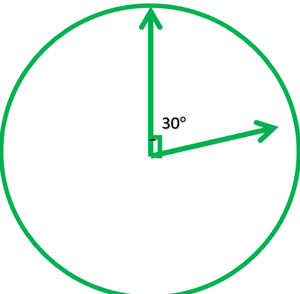
Let assume, Minute hand of clock acts as radius of the circle.
Angle rotated by min (hand in 5minutes)=∅=360/60*5=30°
Radius=r=14cm
Area of swept middle hand=
=∅/(360°) *πr2
=30/360*22/7*14*14
=154/3cm2
Area swept by the minute hand in 5min=154/3cm2
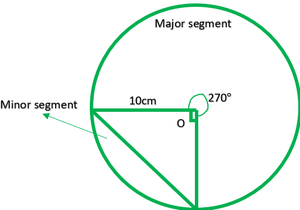
Solution:
Radius =r=10cm
Major segment is =360°-90°=270°
(i) Area of minor segment =Area of sector-Area of triangle
=∅/(360°) *πr2-1/2*h*b
=90/306*3.14*10*10-1/2*10*10
=314/4-50
=78.5-50
Area of minor segment =28.5cm2
(ii) Area of major sector=∅/(360°) *πr2
=270/360*3.14*10*10
=3*314/4=235.5cm2
Area of major segment=235.5cm2
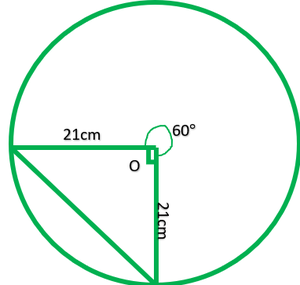
(i) the length of the arc
(ii) area of the sector formed by the arc
(iii) area of the segment formed by the corresponding chord
Solution:
(i) Radius=r=21cm
Length of arc=∅/(360°) *2πr
60/360*2*22/7*21
=22cm
(ii) Area of sector=∅/(360°) *πr2
60/360*22/7*21*21
11*21=231cm2
(iii) Area of segment =Area of sector -Area of triangle
=231-√3/4(side)2
=231-1.73/4*21*21
=231-762.93/4
=231-190.73
=40.27cm2
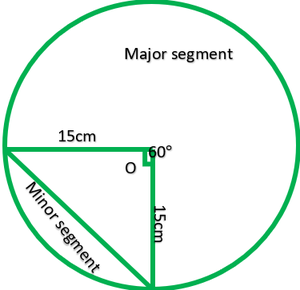
Solution:
Radius of circle=15cm
∆AOB is isosceles
∴∠A = ∠B
=∠A+∠B+C=180°
=2∠A=180°-60°
=∠A=120°/2
=∠A=60°
Area of minor segment =Area of sector-Area of triangle
=∅/(360°) *πr2-√3/4(side)2
=(60°)/360*3.14*15*15-1.73/4
=706.5/6-389.25/4
=117.75-97.31
=20.44cm2
Area of major segment-Area of circle-Area of minor segment
=πr2-20.44
=3.14*15*15-20.44
=686.06cm2
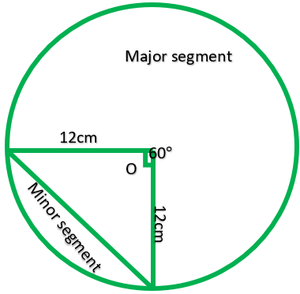
Solution:
Radius=r=12cm
Area of triangle=1/2*base*height
Area of segment=Area of sector -area of triangle
=∅/(360°)*π*r2-1/2(side)2*sin∅
=120°/360°*3.14-1/2(side)2*sin120°∅
=150.72-6*12*sin60°
=150.72-6*12*√3/2
=150.72-36*1.73
=150.72-62.28
=88.44cm2
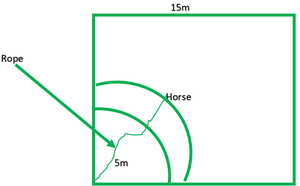
(i) the area of that part of the field in which the horse can graze.
(ii) the increase in the grazing area if the rope were 10 m long instead of 5 m. (Use π = 3.14)
Solution:
(i) Horse with graze=∅/(360°) × π × r2
= 90°/360° × 3.14 × 5 × 5
= 78.5/4
=19.625cm2
Area of circle the length of rope is increased to 10m
=∅/(360°) × π × r2
=90°/360° × 3.14 × 10 × 10
=314/4
=78.5cm2
(ii) Increasing in grazing area=78.5m2-19.635m2=58.875m2
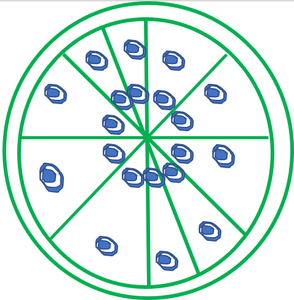
(i) the total length of the silver wire required.
(ii) the area of each sector of the brooch.
Solution:
(i) Total length of silver wire required=circumference of broach+5diameter
=5 × 35 mm × πd
=175+22/7 × 35
=175+110
=285mm
(ii) Area of each sector=1/10×Area of circle
=1/10×π×r2
=1/10×22/7×35/2×35×2
=11×35/4
=385/4mm2
Solution:
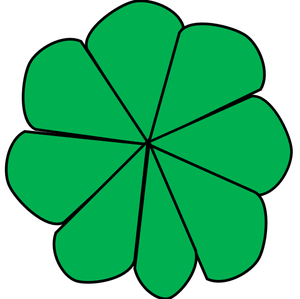
Total ribs in umbrella=8
Radius of umbrella is =45cm
Area between the two consecutive ribs=1/8π×r2
=1/8×22/7×45×45cm2
=22275/28
Solution:
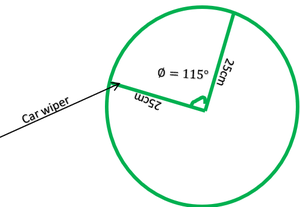
Angle made by sector=∅=115°
r=25cm
Total area clean at each sweep of the blades=2×Area of sector
=2×∅/(360°)×π×r2
=2×(115°)/(360°)×22/7×25×25cm2
=23×11×25×25cm2
=158125/126cm2
=1254.96cm2
The total area clean at each sweep of blades=1254.96cm2
Solution:
(Use π = 3.14)
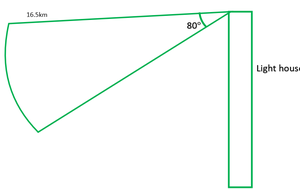
Distance over which light fall =r=16.5km
Angle made by the sector=∅=80°
Area of the sea over which the ships are warned=Area of sector
=∅/(360°)×π×r2
=(80°)/(360°)×3.14×16.5×16.5
=1709.73
=189.97km2
The area of ships is +warned =189.97km2
Solution:
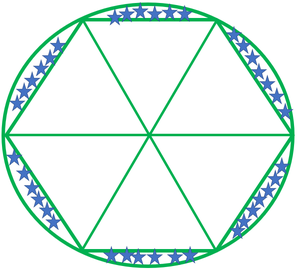
Total equal designs==6
Radius =28cm
Cost for making design=RS.035 per cm2
∠O=360°/6=60°
Area of 1 design =Area of sector-Area of triangle
=∅/(360°)×π×r2×-
Solution:
Area of sector angle p=p/360×2πr2
Therefore, option (D) is correct.
Solution:
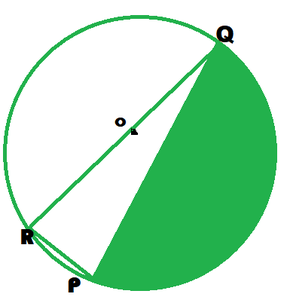
In fig. By Pythagoras theorem
RQ2=RP2+PQ2
RQ2=(7)2+(24)2
RQ2=625
RQ=√625
RQ=√5*5*5*5
RQ=5*5
=25
Radius of circle =25/2cm
Areas of shaded region=Area of semi circle -Area of ∆RPQ
=1/2πR2-1/2*b*h
=(1/2*22/7*25/2)-(1/2*7*24)
=-84
=161.53cm2
Solution:
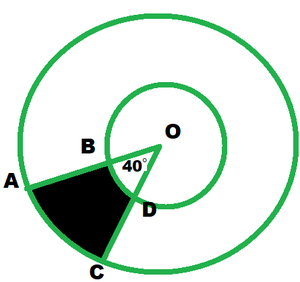
Area of shaded Region=Area of sector AOC - Area of sector BOD
∠AOC = θ
Radius of inner circle = r
Radius of outer circle = R
=θ/360 πR2 - θ/360 πr2
= θ/360 π(R2-r2)
=40/(360)*22/7(14*14-7*7)
=40/360*22/7(196-49)
=(22/63) * 147
=154/3
= cm2
Solution:
Radius =14/2=7
Area of shaded region=Area of square-Area of 2 semi-circles
=side*side-2*1/2πr2
=14*14 - 22/7*7*7
=196-154
=42 cm2
Solution:
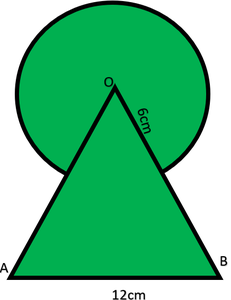
Area of shaded region=Area of big sector+ Area of equilateral
=θ/360 πr2+√3/4(side)2
=(300/360)*22/7*6*6+(√3/4)*12*12
=5/6*22/7*6*6+36*1.73
=660/7+62.28
=94.28+62.28
=156.56 cm2
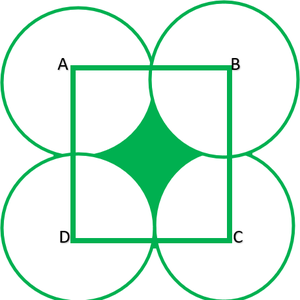
Solution:
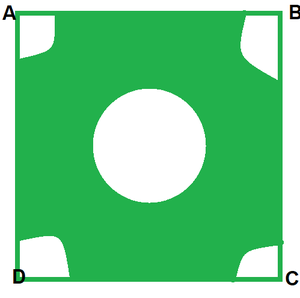
radius, r = 1cm
Area of remaining poison=Area of square - Area of 4 quadrants - Area of circle in the middle
=side*side - 4(90/360 πr2) - πr2
=4*4 - 2 πr2
=16-2*22/7*1*1
=16-44/7
=9.72cm2
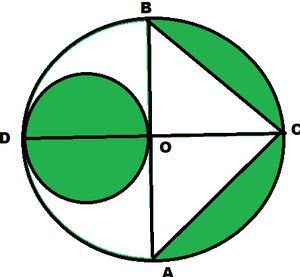
Solution:
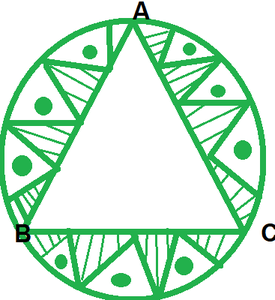
Area of circle= πr2=22/7*32*32=22528/7=3218.28cm2 -----1
Area of ∆ABC=3*Area of ∆BOC
=3*1/2*side*side*sin120°
=3/2*32*32*sin60°
=1536*√3/2
=768*1.73
=1328.64cm2 ---------2
Area of design =Area of circle - Area of ∆ABC
=321.28-1328.64
=1889.64 cm2
Solution:
Area of shaded region=Area of square - Area of 4 quarters
=side*side - 4(90/360 πr2)
=14*14-22/7*7*7
=196-154
=42cm2
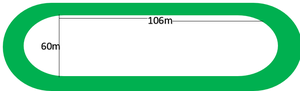
i) the distance around the track along its inner edge
ii) the area of the track
Solution:
i) A distance along inner edge=length of 2 parallel lines+ circumference of 2 circles
=106+106+2πr
=212+2*22/7*30
=212+188.57
=400.57m
ii) Area of track=Area of 2 rectangles+ semi rings
=106*10*2+π (R-r)2
=2120+22/7((40)2-(30)2)
=210+22/7(1600-900)
=210+2200
=4320 m2
Solution:
Area of smaller circle=πr2
=22/7*7/2*7/2
=78/2 =38.5m2
Area of segment=Area of quadrant-Area of ∆BOC
=1/4πR2-1/2*BO*OC
=1/4*22/7*7*7-1/2*7*7
=77/2-49/2
=77-49/2
=28/2
=14 cm2
Area of shaded region=Area of smaller circle+2*Area of segment
=38.5 + 2*14
=38.5+28
=66.5 cm2
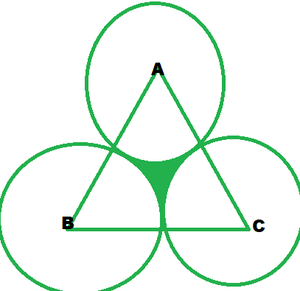
Solution:
Area of equilateral ∆ =1.73205
π=3.14
√3=1.73205
√3/4 (side)2=173205
1.73205/4*(side)2=1.73205
(side)2=173205*4/1.73205
(side)2=173205*100000/10*173205
=√1000*4
=√(100 *100*2*2)
=100*2
=200cm
∴Radius of each circle=200/2=100
Area of shaded region=Area of∆ ABC-3*Area of sector
=1.73205*60/360*3.14*100*100
=1.73205-31400/2
=17320.5-15700
=1620.5cm2
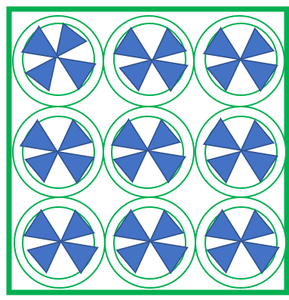
Solution:
Side of square=6*Radius
=6*7
=42 cm
Area of shaded region=Area of square - Area of 9 circles
=side*side - 9πr2
=42*42 - 9*22/7*7*7
=1764-1386
=378 cm2
The area of the remaining portion of the handkerchief =378 cm2
(i) quadrant OACB, (ii) shaded region.
Solution:
(i) Area of shaded region=Area of quadrant
=1/4πr2
=1/4*22/7*3.5*3.5
=38.5/4
=9.625 cm2
(ii) Area of shaded region=Area of quadrant -Area of ∆BOD
=9.625-1/2*BO*OD
=9.625-1/2*3.5*2
=9.625-3.5
=6.125 cm2
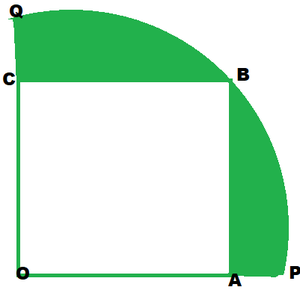
Solution:
By Pythagoras theorem,
OB2=DA2+AB2
BO2=(20)2+(20)2
OB2=400+400
OB2=800
OB=√800
OB=√(2*2*2*2*5*5)
OB=2*2*5√2
OB=20√2
Area of shaded region=Area of quadrant -Area of square
=1/4πr2 - side*side
=1/4*3.14*20√2*20√2-20*20
=1/4*3.14*800-400
=1*3.14
=22cm2
=1/4*3.14
The area of shaded region is =1/4*3.14
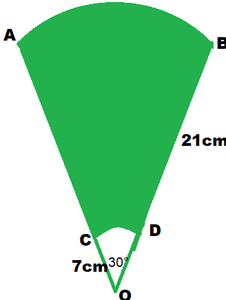
Solution:
Area of shaded region=Area of sector AOB-Area of sector COD
=θ/(360°) πR2-θ/(360°) πr2
=θ/(360°) π[R2-r2]
=30°/360*22/7[(21)2-(7)2]
=1/12*22/7*28*14
=308/3cm2
=102.66cm2
The area of shaded region 102.66cm2
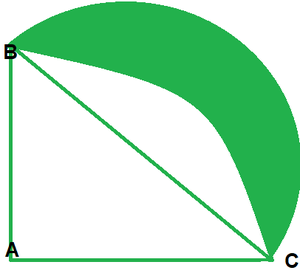
Solution:
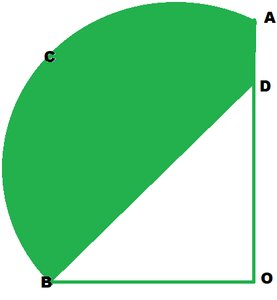
Area of segment=Area of quadrant -Area of ∆BAC
=1/4πr2-1/2*AC*AB
=1/4*22/7*14*14-1/2*14*14
=11*14-98
=154-98
=56 cm2
Semicircle R=?
In rt. ∆BAC, By Pythagoras theorem,
BC2=AB2+BC2
BC2= (14)2+(14)2
BC=√((14)2+(14)2)
BC=√((14)2[1+1] )
BC=14√2
∴Diameter of semicircle=14√2cm
then radius R of semicircle=14√2/2=7√2cm
Area of semicircle =1/2πR2
=1/2*22/7*7√2*7√2
=22*7
=154 cm2
Area of shaded region=Area of semicircle-Area of segment
=154-56 cm2
=98 cm2
The area of shaded region is =98cm2
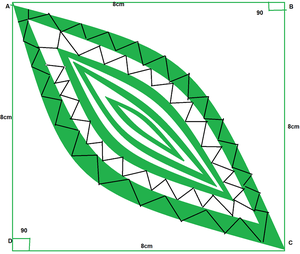
Solution:
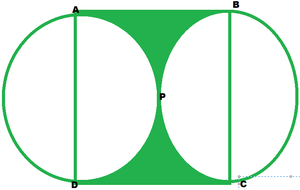
Area of design=Area of 2 quadrant -Area of square
=2*1/4πr2-side*side
=1/2*22/7*8*8-8*8
=704/7-64
=100.57-64
=36.57cm2
Area designed region in figure is 36.57cm2