|
VOOZH | about |
|
VOOZH | about |
NCERT Solutions for Class 10 Maths Chapter 3 Pair of Linear Equations in Two Variables- This article curated by the GeeksforGeeks experts, contains free NCERT Solutions for Class 10 Maths Chapter 3 Pair of Linear Equations in Two Variables to help students develop an easy approach to solving problems related to this chapter.
NCERT Class 10 Maths Chapter 3 Pair of Linear Equations in Two Variables, includes topics such as Introduction to linear equations, Pair of linear equations, Graphical representation of Linear equations, Equations reducible to linear form, and Application of linear equations in real-life problems.
Solution:
Present age of Aftab = x
And, the present age of his daughter = y
,
Age of Aftab = x-7
Age of his daughter = y-7
Age of Aftab = x+3
Age of his daughter = y+7
Here, According to the given condition,
x−7 = 7(y−7)
x−7 = 7y−49
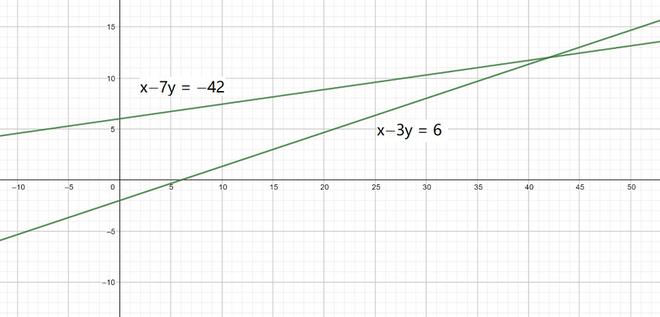
x−7y = −42 ………………………(I)
To draw the line for Eqn. (I), we need at least two solutions of the equation, So, we can use the following table to draw the graph:
x y 0 6 -42 0 And, According to the another given condition,
x+3 = 3(y+3)
x+3 = 3y+9
x−3y = 6 …………..…………………(II)
To draw the line for Eqn. (II), we need at least two solutions of the equation, So, we can use the following table to draw the graph:
x y 0 -2 6 0 The graphical representation of Eqn. (I) and Eqn. (II) is:
👁 NCERT Solutions for Class 10 Maths Chapter 3 Pair of Linear Equations in Two Variables
Solution:
The cost of a bat = ₹ x
And, the cost of a ball = ₹ y
Here, According to the Given condition,
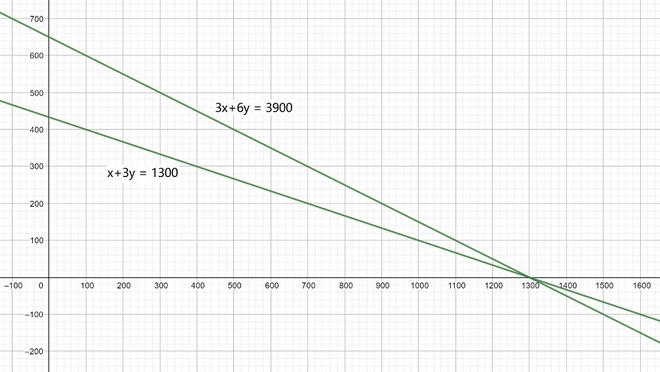
3x+6y = 3900 .........................(I)
x+3y = 1300 .........................(II)
To draw the line for Eqn. (I), we need at least two solutions of the equation, So, we can use the following table to draw the graph:
x y 0 650 1300 0 To draw the line for Eqn. (II), we need at least two solutions of the equation, So, we can use the following table to draw the graph:
x y 100 400 1300 0 The graphical representation of Eqn. (I) and Eqn. (II) is:
👁 NCERT Solutions for Class 10 Maths Chapter 3 Pair of Linear Equations in Two Variables
Solution:
The cost of 1 kg of apples = ₹ x
And, cost of 1 kg of grapes = ₹ y
Here, According to the given conditions,
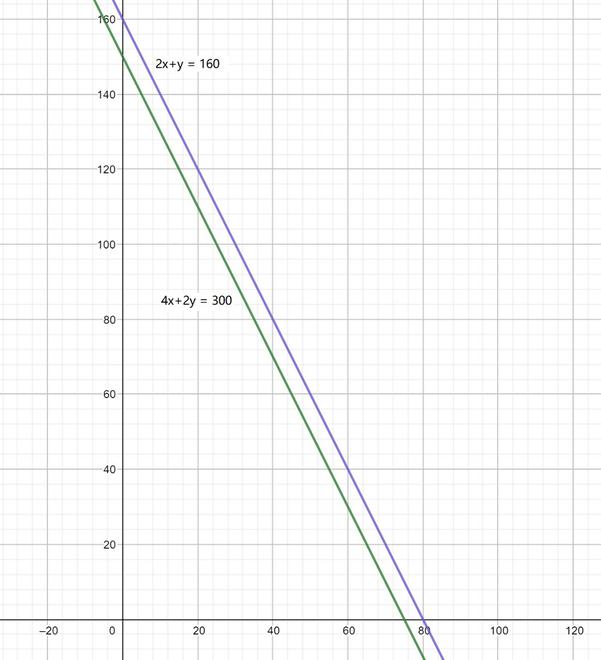
2x+y = 160 ...........................(I)
4x+2y = 300 ...........................(II)
To draw the line for Eqn. (I), we need at least two solutions of the equation, So, we can use the following table to draw the graph:
x y 0 160 80 0 To draw the line for Eqn. (II), we need at least two solutions of the equation, So, we can use the following table to draw the graph:
x y 0 150 75 0 The graphical representation of Eqn. (I) and Eqn. (II) is:
👁 NCERT Solutions for Class 10 Maths Chapter 3 Pair of Linear Equations in Two Variables
Solution:
Let's take,
Number of girls = x
Number of boys = y
According to the given conditions,
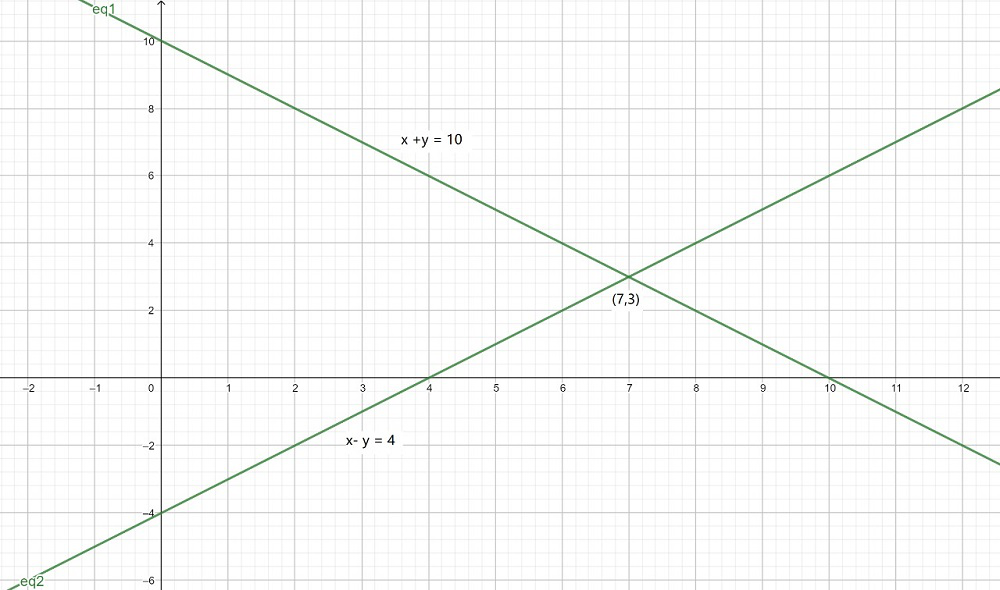
x + y = 10 -(1)
x – y = 4 -(2)
So, to construct a graph, we need to find at least two solutions of the given equation.
For equation (1)
x + y = 10, So, we can use the following table to draw the graph:
x y 0 10 10 0 For equation (2)
x - y = 4, So, we can use the following table to draw the graph:
x y 0 -4 4 0 The graph will be as follows for Equation (1) and (2):
👁 NCERT Solutions for Class 10 Maths Chapter 3 Pair of Linear Equations in Two Variables
Now, from the graph, we can conclude the given lines intersect each other at point (7, 3).
Hence, the number of girls are 7 and number of boys are 3 in a class.
Solution:
Let's take,
Cost for one pencil = x
Cost for one pencil = y
According to the given conditions,
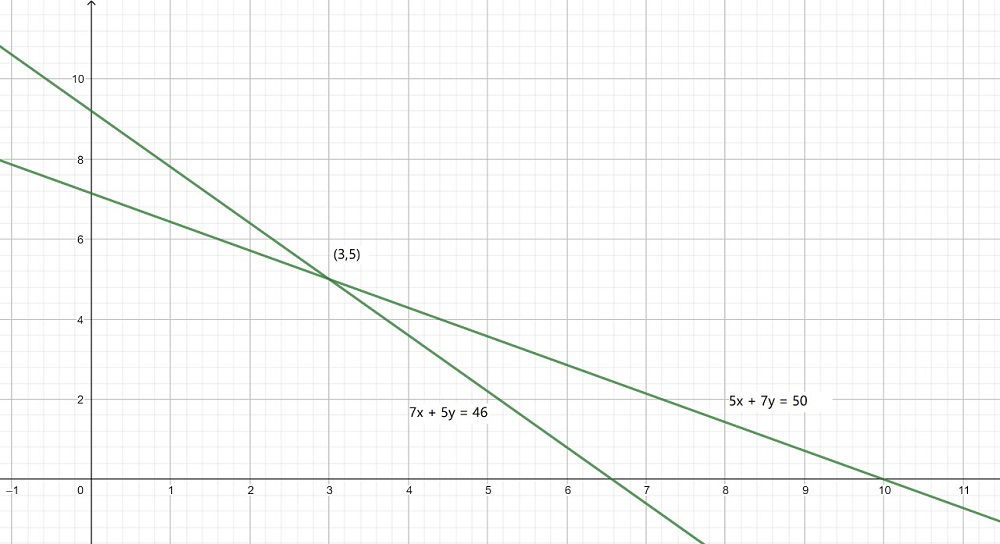
5x + 7y = 50 -(1)
7x + 5y = 46 -(2)
So, to construct a graph, we need to find at least two solutions of the given equation.
For equation (1)
5x + 7y = 50, So, we can use the following table to draw the graph:
x y 3 5 10 0 For equation (2)
7x + 5y = 46, So, we can use the following table to draw the graph:
x y 3 5 8 -2 The graph will be as follows for Equation (1) and (2):
👁 NCERT Solutions for Class 10 Maths Chapter 3 Pair of Linear Equations in Two Variables
Now, from the graph, we can conclude the given lines intersect each other at point (3, 5).
Hence, the cost of a pencil is ₹ 3 and cost of a pen is ₹ 5.
Solution:
In the given equations,
a1 = 5
a2 = 7
b1 = -4
b2 = 6
c1 = 8
c2 = -9
Now, here
a1/a2 = 5/7
b1/b2 = -4/6 = -2/3
c1/c2 = 8/-9
As, here
Hence, the given pairs of equations have a unique solution and the lines intersect each other at exactly one point.
Solution:
In the given equations,
a1 = 9
a2 = 18
b1 = 3
b2 = 6
c1 = 12
c2 = 24
Now, here
a1/a2 = 9/18 = 1/2
b1/b2 = 3/6 = 1/2
c1/c2 = 12/24 = 1/2
As, here
Hence, the given pairs of equations have infinite many solutions and the lines are coincident.
Solution:
In the given equations,
a1 = 6
a2 = 2
b1 = -3
b2 = -1
c1 = 10
c2 = 9
Now, here
a1/a2 = 6/2 = 3
b1/b2 = -3/-1 = 3
c1/c2 = 10/9
As, here
Hence, the given pairs of equations have no solution and the lines are parallel and never intersect each other.
Solution:
In the given equations,
a1 = 3
a2 = 2
b1 = 2
b2 = -3
c1 = -5
c2 = -7
Now, here
a1/a2 = 3/2
b1/b2 = 2/-3
c1/c2 = -5/-7
As, here
Hence, the given pairs of equations have a unique solution and the lines intersect each other at exactly one point.
Pair of linear equations are CONSISTENT.
Solution:
In the given equations,
a1 = 2
a2 = 4
b1 = -3
b2 = -6
c1 = -8
c2 = -9
Now, here
a1/a2 = 2/4 = 1/2
b1/b2 = -3/-6 = 1/2
c1/c2 = -8/-9 = 8/9
As, here
Hence, the given pairs of equations have no solution and the lines are parallel and never intersect each other.
Pair of linear equations are INCONSISTENT.
Solution:
In the given equations,
a1 = 3/2
a2 = 9
b1 = 5/3
b2 = -10
c1 = -7
c2 = -14
Now, here
c1/c2 = -7/-14 = 1/2
As, here
Hence, the given pairs of equations have a unique solution and the lines intersect each other at exactly one point.
Pair of linear equations are CONSISTENT.
Solution:
In the given equations,
a1 = 5
a2 = -10
b1 = -3
b2 = 6
c1 = -11
c2 = 22
Now, here
a1/a2 = 5/-10 = -1/2
b1/b2 = -3/6 = -1/2
c1/c2 = -11/22 = -1/2
As, here
Hence, the given pairs of equations have infinite many solutions and the lines are coincident.
Pair of linear equations are CONSISTENT.
Solution:
In the given equations,
a1 = 4/3
a2 = 2
b1 = 2
b2 = 3
c1 = -8
c2 = -12
Now, here
b1/b2 = 2/3
c1/c2 = -8/-12 = 2/3
As, here
Hence, the given pairs of equations have infinite many solutions and the lines are coincident.
Pair of linear equations are CONSISTENT.
Solution:
In the given equations,
a1 = 1
a2 = 2
b1 = 1
b2 = 2
c1 = -5
c2 = -10
Now, here
a1/a2 = 1/2
b1/b2 = 1/2
c1/c2 = -5/-10 = 1/2
As, here
Hence, the given pairs of equations have infinite many solutions and the lines are coincident.
Pair of linear equations are CONSISTENT.
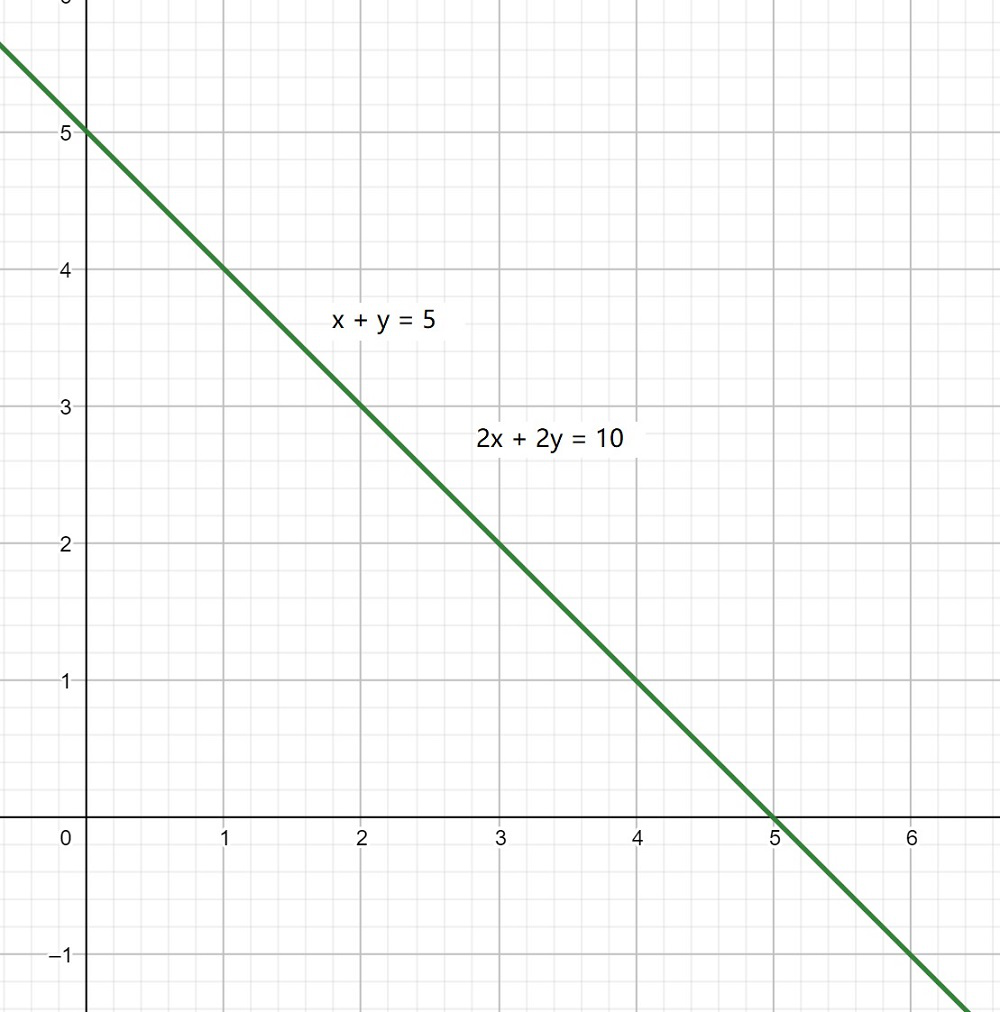
x + y = 5-(1)
2x + 2y = 10-(2)
So, to construct a graph, we need to find at least two solutions of the given equation.
For equation (1)
x + y = 5, So, we can use the following table to draw the graph:
x y 0 5 5 0 For equation (2)
2x + 2y = 10, So, we can use the following table to draw the graph:
x y 0 5 5 0 The graph will be as follows for Equation (1) and (2):
👁 NCERT Solutions for Class 10 Maths Chapter 3 Pair of Linear Equations in Two Variables
Solution:
In the given equations,
a1 = 1
a2 = 3
b1 = -1
b2 = -3
c1 = -8
c2 = -16
Now, here
a1/a2 = 1/3
b1/b2 = 1/3
c1/c2 = -8/-16 = 1/2
As, here
Hence, the given pairs of equations have no solution and the lines are parallel and never intersect each other.
Pair of linear equations are INCONSISTENT.
Solution:
In the given equations,
a1 = 2
a2 = 4
b1 = 1
b2 = -2
c1 = -6
c2 = -4
Now, here
a1/a2 = 2/4 = 1/2
b1/b2 = 1/-2
c1/c2 = -6/-4 = 3/2
As, here
Hence, the given pairs of equations have a unique solution and the lines intersect each other at exactly one point.
Pair of linear equations are CONSISTENT.
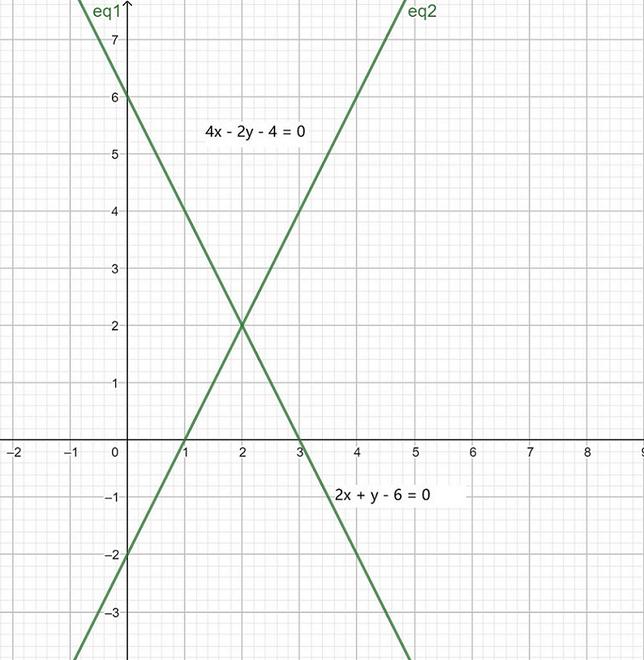
2x + y – 6 = 0-(1)
4x – 2y – 4 = 0-(2)
So, to construct a graph, we need to find at least two solutions of the given equation.
For equation (1)
2x + y – 6 = 0, So, we can use the following table to draw the graph:
x y 0 6 3 0 For equation (2)
4x – 2y – 4 = 0, So, we can use the following table to draw the graph:
x y 0 -2 1 0 The graph will be as follows for Equation (1) and (2):
👁 NCERT Solutions for Class 10 Maths Chapter 3 Pair of Linear Equations in Two Variables
Now, from the graph, we can conclude the given lines intersect each other at point (2, 2).
Solution:
In the given equations,
a1 = 2
a2 = 4
b1 = -2
b2 = -4
c1 = -2
c2 = -5
Now, here
a1/a2 = 2/4 = 1/2
b1/b2 = -2/-4 = 1/2
c1/c2 = -2/-5 = 2/5
As, here
Hence, the given pairs of equations have no solution and the lines are parallel and never intersect each other.
Pair of linear equations are INCONSISTENT.
Solution:
Let's take,
length = x
breadth = y
Half the perimeter of a rectangular garden = = x + y
According to the given conditions,
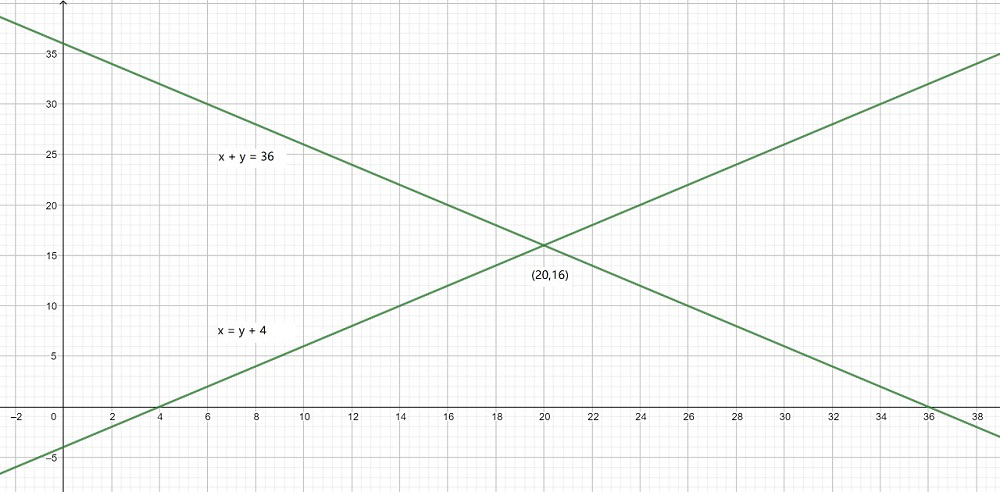
x = y + 4---(1)
x + y = 36---(2)
So, to construct a graph, we need to find at least two solutions of the given equation.
For equation (1)
x = y + 4, So, we can use the following table to draw the graph:
x y 0 -4 4 0 For equation (2)
x + y = 36, So, we can use the following table to draw the graph:
x y 0 36 36 0 The graph will be as follows for Equation (1) and (2):
👁 NCERT Solutions for Class 10 Maths Chapter 3 Pair of Linear Equations in Two Variables
Now, from the graph, we can conclude the given lines intersect each other at point (20, 16).
Hence, length is 20 m and breadth is 16 m of rectangle.
Solution:
Linear equation in two variables such that pair so formed is intersecting lines, so it should satisfy the given conditions
By rearranging, we get
Hence, the required equation should not be in ratio of 2/3
Hence, another equation can be 2x – 9y + 9 = 0
where the ratio is 2/-9
and,
Solution:
Linear equation in two variables such that pair so formed is parallel lines, so it should satisfy the given conditions
By rearranging, we get
Hence, the required equation a2/b2 should be in ratio of 2/3 and b2/c2 should not be equal to 3/-8
Hence, another equation can be 4x + 6y + 9 = 0
where the ratio a2/b2 is 2/3
and,
Solution:
Linear equation in two variables such that pair so formed is parallel lines, so it should satisfy the given conditions
By rearranging, we get
Hence, the required equation a2/b2 should be in ratio of 2/3 and b2/c2 should be equal to 3/-8
Hence, another equation can be 4x + 6y -16 = 0
where the ratio a2/b2 is 2/3
and, b2/c2 = 3/-8
Solution:
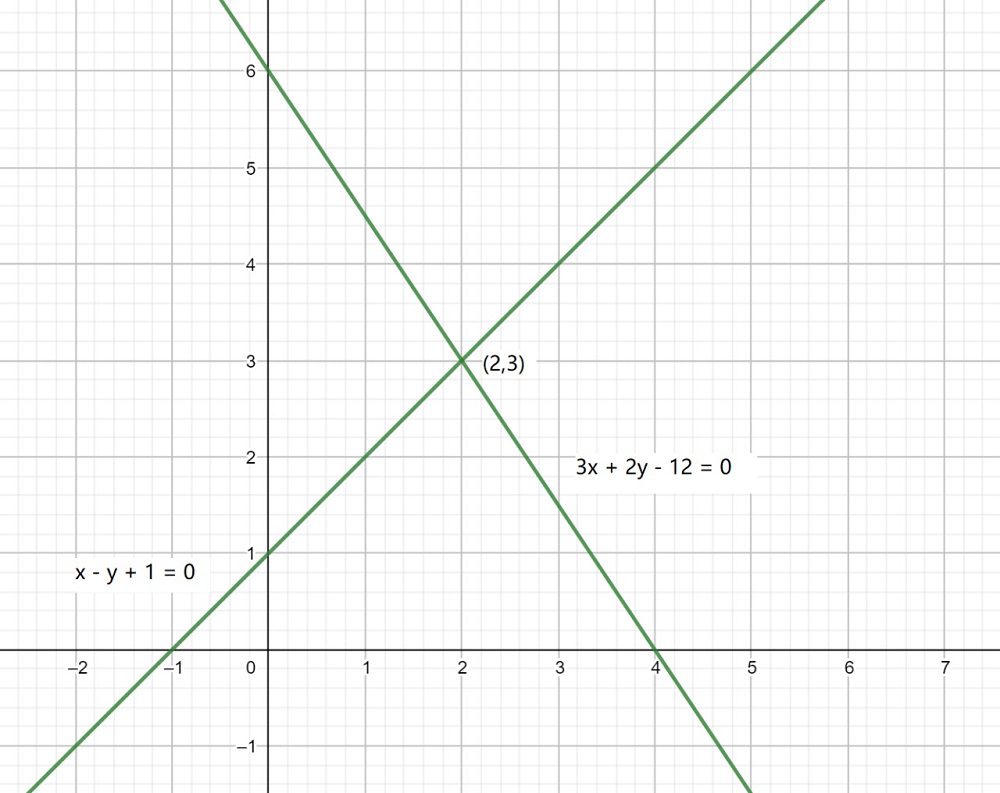
x – y + 1 = 0 -(1)
3x + 2y – 12 = 0 -(2)
So, to construct a graph, we need to find at least two solutions of the given equation.
For equation (1)
x – y + 1 = 0, So, we can use the following table to draw the graph:
x y 0 -1 1 0 For equation (2)
3x + 2y – 12 = 0, So, we can use the following table to draw the graph:
x y 0 6 4 0 The graph will be as follows for Equation (1) and (2):
👁 NCERT Solutions for Class 10 Maths Chapter 3 Pair of Linear Equations in Two Variables
Now, from the graph, we can conclude the given lines intersect each other at point (2, 3), and x-axis at (−1, 0) and (4, 0).
Hence, the vertices of the triangle are (2, 3), (−1, 0), and (4, 0).
Solution:
x + y = 14 ........... (1)
x – y = 4 .............. (2)
x = 14 – y
Substitute x in (2)
(14 – y) – y = 4
14 – 2y = 4
2y = 10
Transposing 2
y = 10/2
y = 5
x = 14 – y
x = 9
Therefore, x = 9 and y = 5.
Solution:
s – t = 3 ........ (1)
(s/3) + (t/2) = 6 ............. (2)
s = 3 + t
Now, substitute the value of s in (2)
(3 + t) / 3 + (t/2) = 6
Taking 6 as LCM
(2(3 + t) + 3t) / 6 = 6
(6 + 2t + 3t) / 6 = 6
(6 + 5t) = 36
5t = 30
t = 6
s = 3 + 6 = 9
Therefore, s = 9 and t = 6.
Solution:
3x – y = 3 ........... (1)
9x – 3y = 9 ..........(2)
From (1)
x = (3 + y) / 3
Substitute x in (2)
9(3 + y) / 3 – 3y = 9
9 + 3y - 3y = 9
0 = 0
Therefore, y has infinite values and x = (3 + y)/3 also has infinite values.
Solution:
0.2x + 0.3y = 1.3 ......... (1)
0.4x + 0.5y = 2.3 ........ (2)
From (1)
x = (1.3 - 0.3y) / 0.2
Putting x in (2)
0.4(1.3 - 0.3y) / 0.2 + 0.5y = 2.3
2(1.3 – 0.3y) + 0.5y = 2.3
2.6 – 0.6y + 0.5y = 2.3
2.6 – 0.1 y = 2.3
0.1 y = 0.3
y = 3
Substitute y in (1)
x = (1.3 - 0.3(3)) / 0.2 = (1.3 - 0.9) / 0.2 = 0.4/0.2 = 2
Therefore, x = 2 and y = 3.
Solution:
√2 x + √3 y = 0 ............... (1)
√3 x – √8 y = 0 .............. (2)
From (1)
x = – (√3/√2)y
Putting x in (2)
√3(-√3/√2)y – √8y = 0
(-3/√2)y - √8y = 0
-3y - 4y = 0
-7y = 0
y = 0
Therefore
x = 0
Therefore, x = 0 and y = 0.
Solution:
(3x/2) - (5y/3) = -2 ................ (1)
(x/3) + (y/2) = 13/6 .......... (2)
From (1)
(3/2)x = -2 + (5y/3)
(3/2)x = (-6 + 5y) / 3
x = ((-6 + 5y) / 3) * 2/3
⇒ x = 2(-6 + 5y) / 9 = (-12 + 10y) / 9
Putting x in (2)
((-12 +10y)/9)/3 + y/2 = 13/6
(-12 + 10y)/27 + y/2 = 13/6
Taking 54 as LCM
-24 + 20y + 27y = 117
47y = 117 + 24
47y = 141
y = 3
x = (-12 + 30) / 9
x = 18/9
x = 2
Therefore, x = 2 and y = 3.
Solution:
2x + 3y = 11…………………………..(1)
2x – 4y = -24………………………… (2)
From (1)
x = (11 - 3y) / 2
Substituting x in equation (2)
2(11 - 3y) / 2 – 4y =- 24
11 – 3y – 4y = -24
-7y = -24 - 11
-7y = -35
y = 5
Putting y in (1)
x = (11 - 3 × 5) / 2 = -4/2 = -2
x = -2, y = 5
y = mx + 3
5 = -2m +3
-2m = 2
m = -1
Therefore, the value of m is -1.
Solution:
Let the two numbers be x and y
y = 3x ……………… (1)
y – x = 26 …………..(2)
Substituting the value of y
3x – x = 26
2x = 26
x = 13
y = 39
Therefore, the numbers are 13 and 39.
Solution:
Let the larger angle by xo and smaller angle be yo.
Sum of two supplementary pair of angles is 180o.
x + y = 180o……………. (1)
x – y = 18o ……………..(2)
From (1)
x = 180 - y
Substituting in (2)
180– y – y = 18
-2y = -162
162 = 2y
y = 81o
x = 180 - y
x = 180 - 81
= 99
Therefore, the angles are 99o and 81o.
Solution:
Let the cost of a bat be Rs. x and cost of a ball be Rs. y.
7x + 6y = 3800 ………………. (i)
3x + 5y = 1750 ………………. (ii)
From (i)
y = (3800 - 7x) / 6………………..(iii)
Substituting (iii) in (ii)
3x + 5(3800 - 7x) / 6 =1750
Taking 6 as LCM
18x + 19000 - 7x = 10500
11x = 10500 - 19000
⇒ -17x = -8500
x = 500 ……………………….. (IV)
Substituting the value of x in (III), we get
y = (3800 - 7 × 500)/6 = 300/6 = 50
Hence, the cost of a bat is Rs 500 and cost of a ball is Rs 50.
Solution:
Let the fixed charge be Rs x and per km charge be Rs y.
x + 10y = 105 …………….. (1)
x + 15y = 155 …………….. (2)
From (1)
x = 105 – 10y ………………. (3)
Substituting the value of x in (2)
105 – 10y + 15y = 155
5y = 50
y = 10
Putting the value of y in (3)
x = 105 – 10 × 10
x = 105 - 100
x = 5
Hence, fixed charge is Rs 5 and per km charge = Rs 10
Charge for 25 km = x + 25y = 5 + 250 = Rs 255
Solution:
Let the fraction be x/y.
(x + 2)/(y + 2) = 9/11
By cross multiplication
11x + 22 = 9y + 18
11x – 9y = -4 …………….. (1)
By cross multiplication
(x + 3)/(y + 3) = 5/6
6x + 18 = 5y + 15
6x – 5y = -3 ………………. (2)
From (1)
x = (-4 + 9y)/11 …………….. (3)
Substituting the value of x in (2)
6(-4 + 9y)/11 -5y = -3
Taking 11 as the LCM
-24 + 54y – 55y = -33
-24 - y = -33
-y = -33 + 24
-y = -9
y = 9
Substituting the value of y in (3)
x = (-4 + 9 × 9)/11
x = (-4 + 81)/11
x = 77/11
x = 7
Hence, the fraction is 7/9.
Solutions:
Let the age of Jacob = x years and that of son be y years.
(x + 5) = 3(y + 5) ..................... (i)
(x – 5) = 7(y – 5) ....................... (ii)
From (i)
x + 5 = 3y + 15
x - 3y = 10................ (iii)
From (ii)
x - 5 = 7y - 35
x - 7y = -30.................(iv)
Subtracting (iv) from (iii)
-3y + 7y = 40
4y = 40
Transposing 4
y = 40/4
y = 10
Putting y = 10 in (iii)
x - 30 = 10
x = 40
Therefore, present age of Jacob is 40 years and that of son is 10 years
Solution:
Here, the two given eqn. are as follows:
x + y = 5 ..........(I)
2x – 3y = 4 ...........(II)
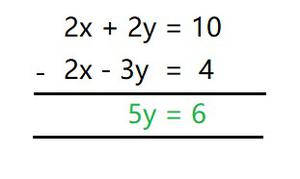
Multiply equation (I) by 2, and then subtract (II) from it, we get
👁 NCERT Solutions for Class 10 Maths Chapter 3 Pair of Linear Equations in Two Variables
5y = 6
y = 6/5
Now putting y=6/5 in eqn. (I), we get
x + 6/5 = 5
x = (5–(6/5))
x = 19/5
From (I), we get
y=5–x.......(III)
Now substituting the value of y in eqn. (II), we get
2x – 3(5–x) = 4
2x – 15+3x = 4
5x = 4+15
x = 19/5
As, putting x = 19/5, in eqn. (III), we get
y = 5 – 19/5
y = 6/5
Hence, by elimination method and substitution method we get,
x = 19/5 and y = 6/5.
Solution:
Here, the two given eqn. are as follows:
3x + 4y = 10 ..........(I)
2x – 2y = 2 ...........(II)
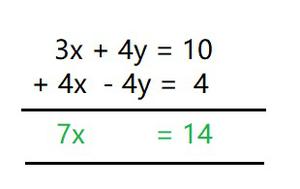
Multiply equation (II) by 2, and then add it to (I), we get
👁 NCERT Solutions for Class 10 Maths Chapter 3 Pair of Linear Equations in Two Variables
7x = 14
x = 14/7
x = 2
Now putting x = 2 in eqn. (I), we get
3(2) + 4y = 10
4y = 10 – 6
y = 4/4
y = 1
From (II), we get
x = (2+2y)/2
x = y+1 .......(III)
Now substituting the value of x in eqn. (I), we get
3(y+1) + 4y = 10
3y + 3 + 4y = 10
7y = 10 – 3
y = 7/7
y = 1
As, putting y = 1, in eqn. (III), we get
x = 1+1
x = 2
Hence, by elimination method and substitution method we get,
x = 2 and y = 1.
Solution:
Here, the two given eqn. are as follows:
3x – 5y – 4 = 0
9x = 2y + 7
By rearranging we get,
3x – 5y = 4 ..........(I)
9x – 2y = 7 ...........(II)
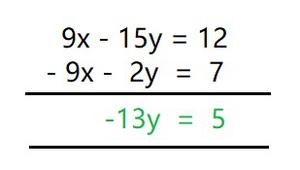
Multiply equation (I) by 3, and then subtract (II) from it, we get
👁 NCERT Solutions for Class 10 Maths Chapter 3 Pair of Linear Equations in Two Variables
–13y = 5
y = -5/13
Now putting y = – 5/13 in eqn. (I), we get
3x – 5(– 5/13) = 4
3x = 4 – (25/13)
3x = 27/13
x = 9/13
From (I), we get
3x – 5y = 4
x = (4+5y)/3 .......(III)
Now substituting the value of x in eqn. (II), we get
9((4+5y)/3) – 2y = 7
3(4+5y) – 2y = 7
12+15y – 2y = 7
13y = – 5
y = – 5/13
As, putting y = – 5/13, in eqn. (III), we get
x=(4+5(– 5/13))/3
x = 9/13
Hence, by elimination method and substitution method we get,
x=9/13 and y=– 5/13.
Solution:
Here, the two given eqn. are as follows:
x/2 + 2y/3 = –1 ...........(A)
x – y/3 = 3 ...................(B)
by rearranging (multiply (A) by 6 and multiply (B) by 3) we get,
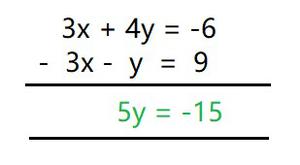
3x + 4y = – 6 ..........(I)
3x – y = 9 ...........(II)
Subtract (II) from (I), we get
👁 NCERT Solutions for Class 10 Maths Chapter 3 Pair of Linear Equations in Two Variables
5y = – 15
y = – 3
Now putting y = -3 in eqn. (II), we get
3x – (– 3) = 9
3x = 9 – 3
x = 6/3
x = 2
From (II), we get
3x – y = 9
y = 3x – 9 .......(III)
Now substituting the value of y in eqn. (I), we get
3x + 4(3x – 9) = – 6
3x + 12x – 36 = – 6
15x = – 6 + 36
x = 30/15
x = 2
As, putting x = 2, in eqn. (III), we get
y = 3(2) – 9
y = – 3
Hence, by elimination method and substitution method we get,
x=2 and y=– 3.
Solution:
Let the fraction be p/q, where p is numerator and q is denominator.
Here, According to the given condition,
(p+1)/(q – 1) = 1 ....................(A)
and,
p/(q+1) = 1/2 .......................(B)
Solving (A), we get
(p+1) = q – 1
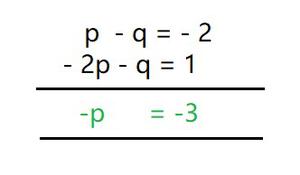
p – q = – 2 ............................(I)
Now, solving (B), we get
2p = (q+1)
2p – q = 1............................(II)
When equation (I) is subtracted from equation (II) we get,
👁 NCERT Solutions for Class 10 Maths Chapter 3 Pair of Linear Equations in Two Variables
p = 3
Now putting p = 3 in eqn. (I), we get
3 – q = – 2
q = 3+2
q = 5
So, p = 3 and q = 5.
Hence, the fraction p/q is 3/5.
Solution:
Let us assume, present age of Nuri is x
And present age of Sonu is y.
Here, According to the given condition, the equation formed will be as follows :
x – 5 = 3(y – 5)
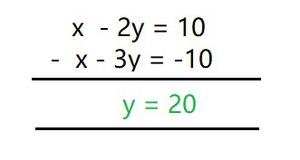
x – 3y = – 10 …………………………………..(I)
Now,
x + 10 = 2(y +10)
x – 2y = 10 …………………………………….(II)
Subtract eqn. (I) from (II), we get
👁 NCERT Solutions for Class 10 Maths Chapter 3 Pair of Linear Equations in Two Variables
y = 20
Now putting y = 20 in eqn. (II), we get
x – 2(20) = 10
x = 10+40
x = 50
Hence,
Age of Nuri is 50 years
Age of Sonu is 20 years.
Solution:
Let the unit digit and tens digit of a number be x and y respectively.
Then, Number = 10y + x
And, reverse number = 10x + y
eg: 23
x = 3 and y = 2
So, 23 can be represented as = 10(2) + 3 = 23
Here, According to the given condition
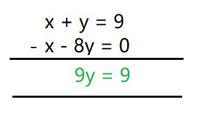
x + y = 9 …………………….(I)
and,
9(10y + x) = 2(10x + y)
90y + 9x = 20x + 2y
88y = 11x
x = 8y
x – 8y = 0 ………………………………………………………….. (II)
Subtract eqn. (II) from (I) we get,
👁 NCERT Solutions for Class 10 Maths Chapter 3 Pair of Linear Equations in Two Variables
9y = 9
y = 1
Now putting y = 1 in eqn. (II), we get
x - 8(1) = 0
x = 8
Hence, the number is 10y + x
=10 × 1 + 8
Number = 18
Solution:
Let the number of ₹ 50 notes be x and the number of ₹100 notes be y
Here, According to the given condition
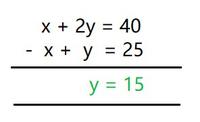
x + y = 25 ……………………………….. (I)
50x + 100y = 2000 ………………………………(II)
Divide (II) by 50 and then subtract (I) from it.
👁 NCERT Solutions for Class 10 Maths Chapter 3 Pair of Linear Equations in Two Variables
y = 15
Now putting y = 15 in eqn. (I), we get
x + 15 = 25
x = 10
Hence, Manna has 10 notes of ₹ 50 and 15 notes of ₹ 100.
Solution:
Let the fixed charge for the first three days be ₹ x and,
The charge for each day extra be ₹ y.
Here, According to the given condition,
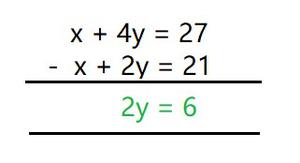
x + 4y = 27 …….…………………………. (I)
x + 2y = 21 ………………………………………….. (II)
Subtract (II) from (I), we get
👁 NCERT Solutions for Class 10 Maths Chapter 3 Pair of Linear Equations in Two Variables
2y = 6
y = 3
Now putting y = 3 in eqn. (II), we get
x + 4(3) = 27
x = 27 – 12
x = 15
Hence, the fixed charge is ₹15
And the Charge per day is ₹ 3
Solution:
Here,
a1 = 1, b1 = -3, c1 = -3
a2 = 3, b2 = -9, c2 = -2
So,
As,
Hence, the given pairs of equations have no solution.
Solution:
Rearranging equations, we get
2x + y -5 = 0
3x + 2y -8 = 0
Here,
a1 = 2, b1 = 1, c1 = -5
a2 = 3, b2 = 2, c2 = -8
So,
As,
Hence, the given pairs of equations have unique solution.
For cross multiplication,
= y = 1
Hence,
= 1
x = 2
and, y = 1
Hence, the required solution is x = 2 and y = 1.
Solution:
Rearranging equations, we get
3x – 5y - 20 = 0
6x – 10y - 40 = 0
Here,
a1 = 3, b1 = -5, c1 = -20
a2 = 6, b2 = -10, c2 = -40
So,
As,
Hence, the given pairs of equations have infinitely many solutions.
Solution:
Here,
a1 = 1, b1 = -3, c1 = -7
a2 = 3, b2 = -3, c2 = -15
So,
As,
Hence, the given pairs of equations have unique solution.
For cross multiplication,
Hence,
x =
x = 4
and, y =
y = -1
Hence, the required solution is x = 4 and y = -1.
Solution:
Here,
a1 = 2, b1 = 3, c1 = -7
a2 = a-b, b2 = a+b, c2 = -(3a+b-2)
For having infinite number of solutions, it has to satisfy below conditions:
Now, on comparing
2(a+b) = 3(a-b)
2a+2b = 3a - 3b
a - 5b = 0 .....................(1)
And, now on comparing
3(3a+b-2) = 7(a+b)
9a+3b-6 = 7a+7b
2a-4b-6=0
Reducing form, we get
a-2b-3=0 .....................(2)
Now, new values for
a1 = 1, b1 = -5, c1 = 0
a2 = 1, b2 = -2, c2 = -3
Solving Eq(1) and Eq(2), by cross multiplication,
Hence,
a =
a = 5
and, b =
b = 1
Hence, For values a = 5 and b = 1 pair of linear equations have an infinite number of solutions
Solution:
Here,
a1 = 3, b1 = 1, c1 = -1
a2 = (2k-1), b2 = k-1, c2 = -(2k+1)
For having no solution, it has to satisfy below conditions:
Now, on comparing
3(k-1) = 2k-1
3k-3 = 2k-1
k = 2
And, now on comparing
2k+1 ≠ k-1
k ≠ -2
Hence, for k = 2 and k ≠ -2 the pair of linear equations have no solution.
Solution:
8x + 5y - 9 = 0 .....................(1)
3x + 2y - 4 = 0 .....................(2)
Substitution Method
From Eq(2), we get
x = 4-2y/3
Now, substituting it in Eq(1), we get
8(4-2y/3) + 5y - 9 = 0
32-16y/3 + 5y - 9 = 0
32 - 16y + 15y - 27 = 0
y = 5
Now, substituting y = 5 in Eq(2), we get
3x + 2(5) - 4 = 0
3x = -6
x = -2
Cross Multiplication Method
Here,
a1 = 8, b1 = 5, c1 = -9
a2 = 3, b2 = 2, c2 = -4
So,
As,
Hence, the given pairs of equations have unique solution.
For cross multiplication,
= 1
Hence,
= 1
x = -2
and, = 1
y = 5
Hence, the required solution is x = -2 and y = 5.
Solution:
Let's take,
Fixed charge = x
Charge of food per day = y
According to the given question,
x + 20y = 1000 ……………….. (1)
x + 26y = 1180 ………………..(2)
Subtracting Eq(1) from Eq(2) we get
6y = 180
y = 30
Now, substituting y = 30 in Eq(2), we get
x + 20(30) = 1000
x = 1000 - 600
x= 400.
Hence, fixed charges is ₹ 400 and charge per day is ₹ 30.
Solution:
Let the fraction be .
So, as per the question given,
3x – y = 3 …………………(1)
4x –y =8 ………………..(2)
Subtracting Eq(1) from Eq(2) , we get
x = 5
Now, substituting x = 5 in Eq(2), we get
4(5)– y = 8
y = 12
Hence, the fraction is .
Solution:
Let's take
Number of right answers = x
Number of wrong answers = y
According to the given question;
3x−y=40 ..........……..(1)
4x−2y=50
2x−y=25 ............…….(2)
Subtracting Eq(2) from Eq(1), we get
x = 15
Now, substituting x = 15 in Eq(2), we get
2(15) – y = 25
y = 30-25
y = 5
Hence, number of right answers = 15 and number of wrong answers = 5
Hence, total number of questions = 20
Solution:
Let's take
Speed of car from point A = x km/he
Speed of car from point B = y km/h
When car travels in the same direction,
5x – 5y = 100
x – y = 20 ………………(1)
When car travels in the opposite direction,
x + y = 100 ………………..(2)
Subtracting Eq(1) from Eq(2), we get
2y = 80
y = 40
Now, substituting y = 40 in Eq(1), we get
x – 40 = 20
x = 60
Hence, the speed of car from point A = 60 km/h
Speed of car from point B = 40 km/h.
Solution:
Let's take
Length of rectangle = x unit
Breadth of the rectangle = y unit
Area of rectangle will be = xy sq. units
According to the given conditions,
(x – 5) (y + 3) = xy -9
3x – 5y – 6 = 0 ……………………(1)
(x + 3) (y + 2) = xy + 67
2x + 3y – 61 = 0 ……………………..(2)
Using cross multiplication method, we get,
Hence,
x = 17
and,
y = 9
Hence, the required solution is x = 17 and y = 9.
Length of rectangle = 17 units
Breadth of the rectangle = 9 units
Solution:
Lets, take 1/x = a and 1/y = b
Here, the two given equation will be as follows:
+ = 2
Multiply it by 6, we get
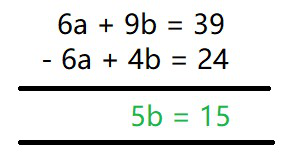
3a + 2b = 12 -(1)
and,
+ =
Multiply it by 6, we get
2a + 3b = 13 -(2)
Now, by using Elimination method,
Multiply eq(1) by 2 and multiply eq(2) by 3, and then subtract them
👁 Class 10 NCERT Chapter 3 Exercise 3.6 solution
5b = 15
b = 3
Now putting b = 3 in eq(1), we get
3a + 2(3) = 12
a = 6/3
a = 2
So, Now As
a = 1/x = 2
x = 1/2
b = 1/y = 3
y = 1/3
Solution:
Lets, take 2/√x = a and 3/√y = b
Here, the two given equation will be as follows:
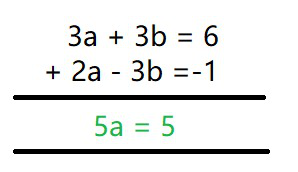
a + b = 2 -(1)
and,
2a - 3b =-1 -(2)
Now, by using Elimination method,
Multiply eq(1) by 3, and then add them
👁 Class 10 NCERT Chapter 3 Exercise 3.6 solution
5a = 5
a = 1
Now putting a = 1 in eq(1), we get
1 + b = 2
b = 1
So, Now As
a = 2/√x = 1
√x = 2
x = 4
b = 3/√y = 1
√x = 3
y = 9
Solution:
Lets, take 1/x = a
Here, the two given equation will be as follows:
4a + 3y = 14 -(1)
and,
3a - 4y = 23 -(2)
Now, by using Elimination method,
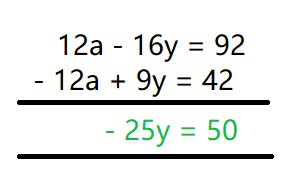
Multiply eq(1) by 3 and multiply eq(2) by 4, and then subtract them
👁 Class 10 NCERT Chapter 3 Exercise 3.6 solution
-25y = 50
y = -2
Now putting y = -2 in eq(1), we get
4a + 3(-2) = 14
4a = 20
a = 5
So, Now As
a = 1/x = 5
x = 1/5
y = -2
Solution:
Lets, take = a and, = b
Here, the two given equation will be as follows:
5a + b = 2 -(1)
and,
6a - 3b = 1 -(2)
Now, by using Elimination method,
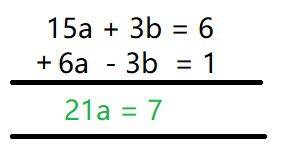
Multiply eq(1) by 3, and then add them
👁 Class 10 NCERT Chapter 3 Exercise 3.6 solution
21a = 7
a = 1/3
Now putting a = 1/3 in eq(1), we get
5(1/3) + b = 2
b = 2 - 5/3
b = 1/3
So, Now As
a =
x - 1 = 3
x = 4
b =
y - 2 = 3
y = 5
Solution:
= 5
= 15
Lets, take 1/x = a and 1/y = b
Here, the two given equation will be as follows:
7b - 2a = 5 -(1)
and,
8b + 7a = 15 -(2)
Now, by using Elimination method,
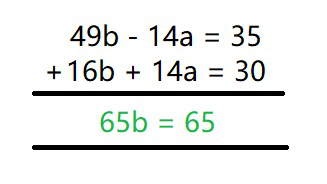
Multiply eq(1) by 7, multiply eq(2) by 2 and then add them
👁 Class 10 NCERT Chapter 3 Exercise 3.6 solution
65b = 65
b = 1
Now putting b = 1 in eq(1), we get
7(1) - 2a = 5
2a = 7 - 5
a = 1
So, Now As
a = 1/x = 1
x = 1
b = 1/y = 1
y = 1
Solution:
Divide both the equations by xy, we get
= 6
= 5
Lets, take 1/x = a and, 1/y = b
Here, the two given equation will be as follows:
6b + 3a = 6
Divide the above equation by 2,
2b + a = 2 -(1)
and,
2b + 4a = 5 -(2)
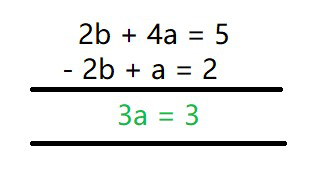
Now, by using Elimination method,
Subtract eq(1) from eq(2), we get
👁 Class 10 NCERT Chapter 3 Pair of Linear Equations in Two Variables Exercise 3.6 solution
3a = 3
a = 1
Now putting a = 1 in eq(1), we get
2b + 1 = 2
b = 1/2
So, Now As
a = 1/x = 1
x = 1
b = 1/y = 1/2
y = 2
Solution:
Lets, take = a and = b
Here, the two given equation will be as follows:
10a + 2b = 4
Divide the above equation by 2,
5a + b = 2 -(1)
and,
15a - 5b = -2 -(2)
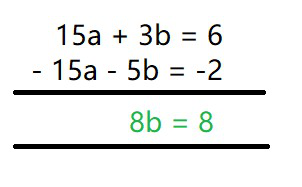
Now, by using Elimination method,
Multiply eq(1) by 3 and subtract them,
👁 Class 10 NCERT Chapter 3 Pair of Linear Equations in Two Variables Exercise 3.6 solution
8b = 8
b = 1
Now putting b = 1 in eq(1), we get
5a + 1 = 2
a = 1/5
So, Now As
a = =
x + y = 5 -(3)
b = = 1
x - y = 1 -(4)
By adding eq(3) and (4), we get
2x = 6
x = 3 and y = 2
Solution:
Lets, take = a
and, = b
Here, the two given equation will be as follows:
a + b = 3/4 -(1)
and,
Multiply it by 2, we get
a - b = -1/4 -(2)
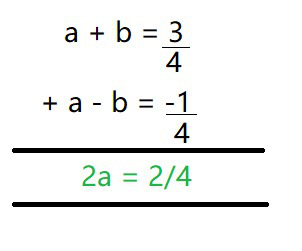
Now, by using Elimination method,
Add eq(1) and eq(1), we get
👁 Class 10 NCERT Chapter 3 Pair of Linear Equations in Two Variables Exercise 3.6 solution
2a = 1/2
a = 1/4
Now putting a = 1/4 in eq(1), we get
+ b =
b = 1/2
So, Now As
a =
3x + y = 4 -(3)
b =
3x - y = 2 -(4)
By adding eq(3) and eq(4), we get
6x = 6
x = 1 and y = 1
Solution:
Let us consider,
Speed of Ritu in still water = x km/hr
Speed of Stream = y km/hr
Now, speed of Ritu during,
Downstream = (x + y) km/h
Upstream = (x – y) km/h
As Speed =
According to the given question,
x + y = 20/2
x + y = 10 -(1)
and,
x - y = 4/2
x - y = 2 -(2)
Add eq(1) and eq(2), we get
2x = 12
x = 6 and y = 4
Hence, speed of Ritu rowing in still water = 6 km/hr
Speed of Stream = 4 km/hr
Solution:
Let's take,
The total number of days taken by women to finish the work = x
The total number of days taken by men to finish the work = y
Work done by women in one day will be = 1/x
Work done by women in one day will be = 1/y
So, according to the question
4() = 1
And, 3() = 1
Lets, take 1/x = a and, 1/y = b
Here, the two given equation will be as follows:
4(2a + 5b) = 1
8a + 20b = 1 -(1)
and,
3(3a + 6b) = 1
9a + 18b = 1 -(2)
Now, by using Cross multiplication method,
a =
b = 1/36
So, Now As
a =
x = 18
b =
y = 36
Hence, number of days taken by women to finish the work = 18 days
Number of days taken by men to finish the work = 36 days.
Solution:
Lets, take
Speed of the train = x km/h
Speed of the bus = y km/h
According to the given question,
= 4
Lets, take 1/x = a and 1/y = b
Here, the two given equation will be as follows:
60a + 240b = 4
Divide it by 4, we get
15a + 60b = 1 -(1)
and,
100a + 200b = 25/6
Divide it by 25/6, we get
24a + 48b = 1 -(2)
Now, by using Cross multiplication method,
a = =
b = =
So, Now As
a = =
x = 60
b = =
y = 80
Hence, speed of the train = 60 km/h
Speed of the bus = 80 km/h
Solution:
The age difference between Ani and Biju = 3 yrs.
Case 1: Either Biju is 3 years older than that of Ani,
y - x = 3
Case 2: or Ani is 3 years older than Biju.
x - y = 3
Given, Ani’s father’s age is 30 yrs more than that of Cathy’s age.
Let's take,
Ani's age = x
and Biju's age = y
So, Dharam's age will be = 2x
And the age of Biju sister (Cathy) will be =
CASE 1 (y > x)
According to the given condition,
y - x = 3 -(1)
and, 2x−y/2 = 30
Multiply it by 2, we get
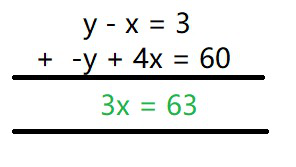
4x – y = 60 -(2)
Add eq(1) and (2)
👁 NCERT Solutions for Class 10 Maths Chapter 3 Pair of Linear Equations in Two Variables
3x = 63
x = 63/3
x = 21
Now putting x = 21 in eq(1), we get
y - 21 = 3
y = 24
Therefore, the age of Ani = 21 years
And the age of Biju is = 24 years.
CASE 2: (x > y)
According to the given condition,
x - y = 3 -(1)
and, 2x−y/2 = 30
Multiply it by 2, we get
4x – y = 60 -(2)
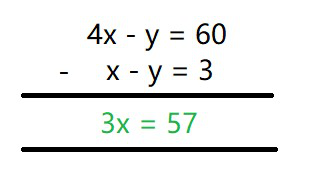
Now, by using Elimination method,
Subtract eq(1) from eq(2)
👁 NCERT Solutions for Class 10 Maths Chapter 3 Pair of Linear Equations in Two Variables
3x = 57
x = 57/3
x = 19
Now putting x = 19 in eq(1), we get
19 - y = 3
y = 19 - 3
y = 16
Therefore, the age of Ani = 19 years
And the age of Biju is = 16 years.
Solution:
Let there be two persons as A and B.
Let's take,
Money person A has = ₹ x
Money person B has = ₹ y
So, According to the given conditions, we have
x + 100 = 2(y - 100)
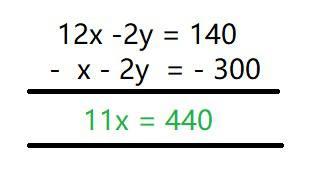
x - 2y = - 300 -(1)
And
6(x – 10) = (y + 10)
6x -y = 70 -(2)
Now, by using Elimination method,
Multiply eq(2) by 2 and subtract eq(1) from it
👁 NCERT Solutions for Class 10 Maths Chapter 3 Pair of Linear Equations in Two Variables
11x = 440
x = 40
Now putting x = 40 in eq(1), we get
40 - 2y = - 300
2y = 300 + 40
y = 340/2
y = 170
Hence,
Person A had Rs 40 and person B had Rs 170 with them.
Solution:
Let the speed of the train = x km/hr
The time taken by the train to travel a distance = t hours
The distance to travel = d km.
As we know,
Distance traveled by train = Speed of the train × Time taken to travel that distance
d = xt -(1)
According to the given equation,
d = (x + 10) × (t - 2)
d = xt + 10t – 2x – 20
as d = xt, we get
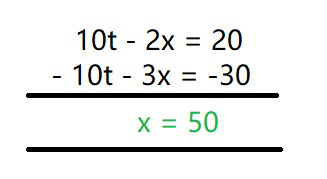
10t - 2x = 20 -(2)
and 2nd condition,
d = (x - 10) × (t + 3)
d = xt – 10t + 3x – 30
as d = xt, we get
10t - 3x = -30 -(3)
Now, by using Elimination method,
Subtract eq(3) from eq(2), we get
👁 NCERT Solutions for Class 10 Maths Chapter 3 Pair of Linear Equations in Two Variables
x = 50 km/h
Now putting x = 50 in eq(1), we get
10t - 2(50) = 20
10t = 120
t = 12 hours
Now, distance will be = 50 × 12 = 600 km
Hence, the distance covered by the train is 600 km.
Solution:
Let the number of rows = x
and, the number of students in a row = y.
Total number of students = Number of rows x Number of students in a row = xy -(1)
Here, total no. of student will be same always
According to the given condition,
Total number of students = (x – 1)(y + 3)
xy = (x – 1)(y + 3)
xy = xy – y + 3x – 3
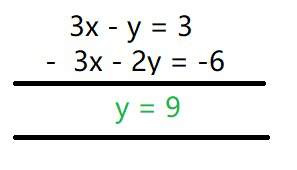
3x – y = 3 -(2)
and,
Total Number of students = (x + 2 ) ( y – 3 )
xy = xy + 2y – 3x – 6
3x – 2y = -6 -(3)
Now, by using Elimination method,
Subtract eq(3) from eq(2), we get
👁 NCERT Solutions for Class 10 Maths Chapter 3 Pair of Linear Equations in Two Variables
y = 9
Now putting y = 9 in eq(1), we get
3x – 9 = 3
3x = 12
x = 4
Number of total students in a class = xy
= 4 x 9
= 36
Hence, No. of students = 36
Solution:
Here, according to the given conditions
3 ∠B = 2 (∠A + ∠B)
3 ∠B = 2∠A + 2∠B
∠B = 2∠A -(1)
and, ∠C = 3∠B
∠C = 3 (2∠A)
∠C = 6∠A -(2)
As we know,
∠A + ∠B + ∠C = 180° (Angle sum property)
∠A + (2∠A) + (6∠A) = 180° -(From eq(1) and eq(2))
9∠A = 180
∠A = 20°
∠B = 2∠A = 2(20°) = 40°
∠C = 6∠A = 6(20°) = 120°
Hence, the three angles are 20°, 40° and 120°.
Solution:
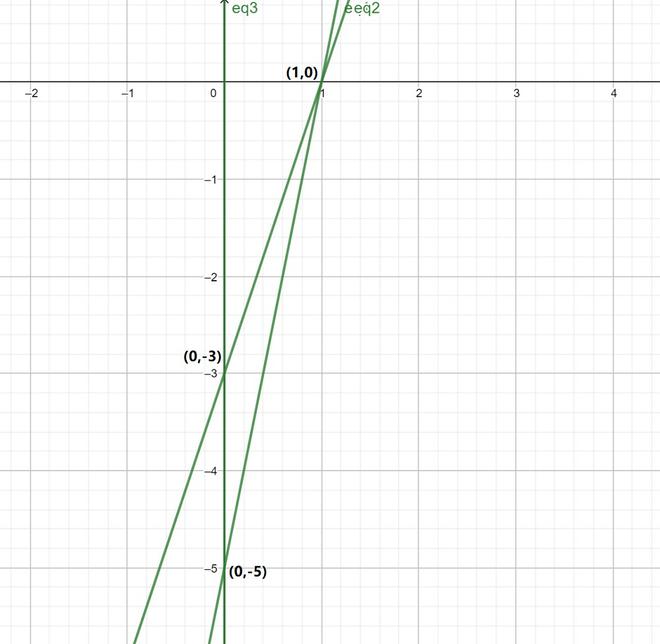
5x – y = 5 -(1)
3x – y = 3 -(2)
y-axis, x = 0 -(3)
To get the co-ordinates of the vertices of the triangle formed, lets get there intersection point,
Intersection of eq(1) and (2)
Now, by using Elimination method,
Subtract eq(2) from (1), we get
2x = 2
x = 1
Now putting x = 1 in eq(1), we get
5(1) – y = 5
y = 0
So, Intersection of eq(1) and (2) vertices are (1, 0)
Now, Intersection of eq(1) and (3)
As x =0 substitutes it in eq(1), we get
5(0) – y = 5
y = -5
So, Intersection of (I) and (III) vertices are (0, -5)
Now, Intersection of eq(2) and (3)
As x =0 substitutes it in eq(2), we get
3(0) – y = 3
y = -3
So, Intersection of eq(2) and (3) vertices are (0,-3)
👁 NCERT Solutions for Class 10 Maths Chapter 3 Pair of Linear Equations in Two Variables
Hence, the co-ordinates of the vertices of the triangle formed are (1, 0), (0, -5) and (0, -3)
Solution:
px + qy = p – q -(1)
qx – py = p + q -(2)
Multiplying p to equation (1) and q to equation (2), we get
p2x + pqy = p2 − pq -(3)
q2x − pqy = pq + q2 -(4)
Add eq(3) and (4), we get
p2x + q2 x = p2 + q2
(p2 + q2) x = p2 + q2
x =
x = 1
Now putting x = 1 in eq(1), we get
p(1) + qy = p – q
qy = p-q-p
qy = -q
y = -1
Solution:
ax + by = c -(1)
bx + ay = 1 + c -(2)
Multiplying a to equation (1) and b to equation (2), we get
a2x + aby = ac -(3)
b2x + aby = b + bc -(4)
Subtract equation eq(4) from equation (3),
(a2 – b2) x = ac − bc– b
x =
x =
Now putting the value of x in eq(1), we get
ax + by = c
+by = c
+by = c
by =
by =
y =
Solution:
-(1)
Multiplying equation (1) with ab, we get
bx − ay = 0 -(new 1)
Multiplying a and b to equation (1) and (2) respectively, we get
b2x − aby = 0 -(3)
a2x + aby = a3 + ab3 -(4)
Add eq(3) and (4), we get
b2x + a2x = a3 + ab2
x (b2 + a2) = a (a2 + b2)
x = a
Now putting x = a in eq(1), we get
b(a) − ay = 0
ab − ay = 0
ay = ab,
y = b
Solution:
(a – b)x + (a + b) y = a2– 2ab – b2 -(1)
(a + b)(x + y) = a2+ b2 -(2)
Subtract equation (2) from equation (1), we get
(a − b) x − (a + b) x = (a2 − 2ab − b2) − (a2 + b2)
x(a − b − a − b) = − 2ab − 2b2
− 2bx = − 2b (b + a)
x = b + a
Substituting, x = b + a in equation (1), we get
(a + b)(a − b) +y (a + b) = a2− 2ab – b2
a2 − b2 + y(a + b) = a2− 2ab – b2 -(Using the identity (a + b)(a - b) = a2 - b2)
(a + b) y = − 2ab
y =
Solution:
x = -(1)
− 378x + 152y = − 604
Dividing it by 2, we get
− 189x + 76y = − 302 -(2)
Substitute x in equation (2), we get
−189+76y=−302
− (189)2y + 189 × 37 + (76)2 y = − 302 × 76
189 × 37 + 302 × 76 = (189)2 y − (76)2y
6993 + 22952 = (189 − 76) (189 + 76) y
29945 = (113) (265) y
y = 1
Using equation(1), we get
x =
x = 152/76
x = 2
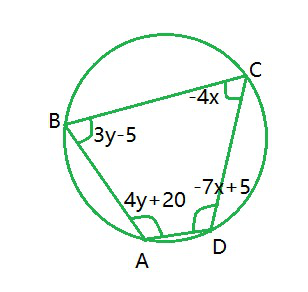
👁 NCERT Solutions for Class 10 Maths Chapter 3 Pair of Linear Equations in Two Variables
Solution:
It is known that the sum of the opposite angles of a cyclic quadrilateral is 180°
Thus, we have
∠C +∠A = 180
4y + 20− 4x = 180
− 4x + 4y = 160
x − y = − 40 -(1)
And, ∠B + ∠D = 180
3y − 5 − 7x + 5 = 180
− 7x + 3y = 180 -(2)
Multiplying 3 to equation (1), we get
3x − 3y = − 120 -(3)
Adding equation (2) to equation (3), we get
− 7x + 3x = 180 – 120
− 4x = 60
x = −15
Substituting this value in equation (1), we get
x − y = − 40
-y−15 = − 40
y = 40-15
y = 25
∠A = 4y + 20 = 20 + 4(25) = 120°
∠B = 3y − 5 = − 5 + 3(25) = 70°
∠C = − 4x = − 4(− 15) = 60°
∠D = 5 - 7x
∠D= 5 − 7(−15) = 110°
Hence, ∠A, ∠B, ∠C and ∠D are equal to 120°, 70°, 60° and 110° respectively.
Exercise 2.4 of Chapter 2 (Polynomials) in NCERT Class 10 Mathematics focuses on the division algorithm for polynomials. It covers topics such as dividing polynomials by linear expressions, finding quotients and remainders, and using the division algorithm to solve various polynomial-related problems. Students learn to apply the division algorithm to factor polynomials, find zeroes of polynomials, and verify the relationship between divisor, dividend, quotient, and remainder in polynomial division.