|
VOOZH | about |
|
VOOZH | about |
NCERT Solutions Class 10 Maths Chapter 7 Coordinate Geometry- The team of subject matter experts at GFG have made detailed NCERT Solutions for Class 10 Maths Chapter 7 Coordinate Geometry to make sure that every student can understand how to solve Coordinate Geometry problems in a stepwise manner.
Coordination of the point of a line divided into two halves, section formula, the distance between two points, and areas of the triangle are some examples of problems covered in Coordinate Geometry.
Class 10 Maths NCERT Chapter 7 Coordinate Geometry Exercises |
|---|
|
|
|
|
This article provides solutions to all the problems asked in Class 10 Maths Chapter 7 Coordinate Geometry of your NCERT textbook in a step-by-step manner. They are regularly revised to check errors and updated according to the latest CBSE Syllabus 2023-24 and guidelines.
All the exercises in Class 10 Maths Chapter 7 Coordinate Geometry of your NCERT textbook have been properly covered in NCERT Solutions for Class 10 Maths.
(i) (2,3), (4,1)
(ii) (-5, 7), (-1, 3)
(iii) (a, b), (-a, -b)
Solution:
Formula used in the above question is : √(x2 - x1)2 + (y2 - y1)2 (i.e., Distance Formula)
(i) Here, x1 = 2, y1= 3, x2 = 4, y2 = 1
Now, applying the distance formula :
= √(4-2)2 + (1-3)2
=√(2)2 + (-2)2
= √8
= 2√2 units
(ii) Here, x1= -5, y1= 7, x2 = -1, y2 = 3
Now, applying the distance formula :
= √(-1 - (-5))2 + (3 - 7)2
= √(4)2 + (-4)2
= 4√2
(iii) Here, x1 = a, y1 = b . x2 = -a, y2 = -b
Now, applying the distance formula :
= √(-a - a)2 +(-b - b)2
= √(-2a)2 + (-2b)2
= √4a2 + 4b2
= 2√a2 + b2
Solution:
Formula used in the above question is : √(x2 - x1)2 + (y2 - y1)2 (i.e, Distance Formula)
Considering, Point A as (0, 0) and Point B as (36, 15) and applying the distance formula we get :
Distance between the two points : √(36 - 0)2 + (15 - 0)2
= √(36)2 + (15)2
= √1296 + 225
= √1521
= 39 units
Hence, the distance between two towns A and B is 39 units.
Solution:
Let (1, 5), (2, 3) and (-2, -11) be points A, B and C respectively.
Collinear term means that these 3 points lie in the same line. So, to we' ll check it.
Using distance formula we will find the distance between these points.
AB = √(2 - 1)2 + (3 - 5)2
=√(1)2 + (-2)2 =√1 + 4 =√5
BC = √(-2 - 2)2 + (-11 - 3)2
= √(-4)2 + (-14)2 = √16 + 196 = √212
CA = √(-2 - 1)2 + (-11 - 5)2
= √(-3)2 + (-16)2 = √9 + 256 =√265
As, AB + BC ≠ AC (Since, one distance is not equal to sum of other two distances, we can say that they do not lie in the same line.)
Hence, points A, B and C are not collinear.
Solution:
Let (5, – 2), (6, 4) and (7, – 2) be the points A, B and C respectively.
Using distance formula :
AB = √(6 - 5)2 + (4 - (-2))2
= √(1 + 36) = √37
BC = √(7 - 6)2 + (-2 - 4)2
= √(1 + 36) = √37
AC = √(7 - 5)2 + (-2 - (-2))2
= √(4 + 0) = 2
As, AB = BC ≠ AC (Two distances equal and one distance is not equal to sum of other two)
So, we can say that they are vertices of an isosceles triangle.
Solution:
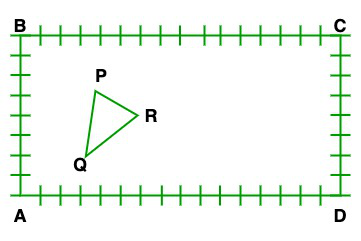
From the given fig, find the coordinates of the points
AB = √(6 - 3) + (7 - 4)
= √9+9 = √18 = 3√2
BC = √(9 - 6) + (4 - 7)
= √9+9 = √18 = 3√2
CD = √(6 - 9) + (1 - 4)
= √9 + 9 = √18 = 3√2
DA = √(6 - 3) + (1 - 4)
= √9+9 =√18 =3√2
AB = BC = CD = DA = 3√2
All sides are of equal length. Therefore, ABCD is a square and hence, Champa was correct.
(i) (- 1, – 2), (1, 0), (- 1, 2), (- 3, 0)
(ii) (- 3, 5), (3, 1), (0, 3), (- 1, – 4)
(iii) (4, 5), (7, 6), (4, 3), (1, 2)
Solution:
(i) Here, let the given points are P(-1, -2), Q(1, 0), R(-1, 2) and S(-3, 0) respectively.
PQ = √(1 - (-1))² + (0 - (-2))²
= √(1+1)²+(0+2)²
= √8 = 2 √2
QR = √(−1−1)²+(2−0)²
= √(−2)²+(2)²
= √8 = 2 √2
RS = √(−3−(−1))²+(0−2)²
= √8 = 2 √2
PS = √((−3−(−1))²+(0−(−2))²
= √8 = 2 √2
Here, we found that the length of all the sides are equal.
Diagonal PR = √(−1−(−1))²+(2−(−2))²
= √ 0+16
= 4
Diagonal QS = √(−3−1)²+(0−0)²
= √ 16 = 4
Finally, we also found that the length of diagonal are also same.
Here, PQ = QR = RS = PS = 2√2
and QS = PR = 4
This is the property of SQUARE. Hence, the given figure is SQUARE.
(ii) Let the points be P(-3, 5), Q(3, 1), R(0, 3) and S(-1, -4)
PQ = √(3−(−3))²+(1−5)²
= √(3+3)²+(−4)²
= √36+16 = √52 = 2 √13
QR = √(0−3)²+(3−1)²
= √(−3)²+(2)²
= √9 + 4 = √13
RS = √(−1−0)²+(−4−3)²
= √(−1)²+(−7)²
= √1+49 = √50 = 5 √2
PS = √(−1−(−3))²+(−4−5)²
= √(−1+3)²+(−9)²
= √4+81 = √85
Here, All the lengths of sides are unequal.
So, The given points will not create any quadrilateral.
(iii) Let the points be P(4, 5), Q(7, 6), R(4, 3) and S(1, 2)
PQ = √(7−4)²+(6−5)²
= √(3)²+(1)² = √9+1 = √10
QR = √(4−7)²+(3−6)²
= √(−3)²+(−3)² = √9+9 =3 √2
RS = √(1−4)²+(2−3)²
= √(−3)²+(−1)² = √9+1 = √10
PS = √(1−4)²+(2−5)²
= √(−3)²+(−3)² = √9+9 =3 √2
We see that the opposite sides are equal. Lets find the diagonal now.
Diagonal PR = √(4−4)²+(3−5)²
= √0+4 = 2
Diagonal QS = √(1−7)²+(2−6)²
= √36+16
= √52
Here, PQ = RS = √10
and QR = PS = 3√2
We see that the diagonals are not equal.
Hence, the formed quadrilateral is a PARALLELOGRAM.
Solution:
Let the point on the X axis be (x, 0)
Given, distance between the points (2, -5), (x, 0) = distance between points (-2, 9), (x, 0)
[ Applying Distance Formula ]
⇒ √(x - 2)²+(0 - (-5))² = √(x - (-2))²+(0 - 9)²
On squaring both the sides, we get
⇒ (x – 2)² + 5² = (x + 2)² + 9²
⇒ x² – 4x + 4 + 25 = x² + 4x + 4 + 81
⇒ -4x -4x = 85 – 29
⇒ -8x = 56
⇒ x = -7
Solution:
It is given that, the distance b/w two points is 10 units.
So, we'll find the distance and equate
PQ = √ (10 - 2)2 + (y - (-3))2
= √ (8)2 + (y +3)2
On squaring both the sides, we get :
64 +(y+3)2 = (10)2
(y+3)2 = 36
y + 3 = ±6
y + 3 = +6 or y + 3 = −6
Hence, y = 3 or -9.
Solution:
Given, PQ = QR
We will apply distance formula and find the distance between them,
PQ = √(5 - 0)2 + (-3 - 1)2
= √ (- 5)2 + (-4)2
= √ 25 + 16 = √41
QR = √ (0 - x)2 + (1 - 6)2
= √ (-x)2 + (-5)2
= √ x2 + 25
As they both are equal so on equating them, x2 + 25 = 41
x2 =16, x = ± 4
So, putting the value of x and obtaining the value of QR and PR through distance formula
For x = +4, PR = √ (4 - 5)2 + (6 - (-3))2
= √ (-1) 2+ (9)2
= √ 82
QR = √ (0 - 4)2 + (1 - 6)2
= √ 41
For x = -4, QR = √ (0 - (-4))2 + (1 - 6)2
= √ 16 + 25 = √ 41
PR = √ (5 + 4)2 + (-3 -6)2
= √ 81 + 81 = 9 √ 2
Solution:
Let, (x, y) be point P and (3, 6), (-3, 4) be pt A and B respectively.
It is given that their distance is equal, so we will equate the equations.
PA = PB (given)
⇒ √(x - 3)2 +(y - 6)2 = √(x-(-3))2+ (y - 4)2 [ By applying distance formula ]
On squaring both sides,
(x-3)2+(y-6)2 = (x +3)2 +(y-4)2
x2 +9-6x+y2+36-12y = x2 +9+6x+y2 +16-8y
36-16 = 6x+6x+12y-8y
20 = 12x+4y
3x+y = 5
3x+y-5 = 0
Solution:
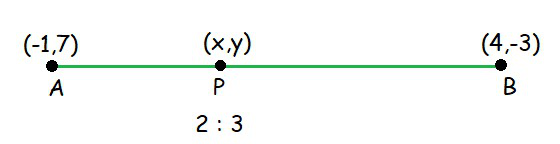
Let the point P (x,y) divides the line AB in the ratio 2:3
👁 NCERT Solutions for Class 10 Maths Chapter 7 Coordinate Geometry
where,
m = 2 and n = 3
x1 = -1 and y1 = 7
x2 = 4 and y2 = -3
so, the x coordinate of P will be,
x =
x =
x =
x = 1
and now, the y coordinate of P will be,
y =
y =
y =
y = 3
Hence, the coordinate of P(x,y) is(1,3)
Solution:
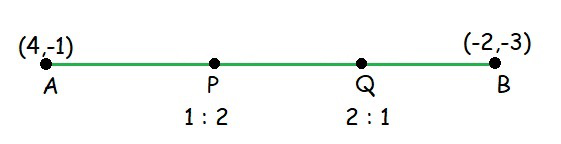
Let the point P (x1,y1) and Q(x2,y2) trisects the line.
So, we can conclude that
P divides the line AB in the ratio 1:2.
and Q divides the line AB in the ratio 2:1.
👁 NCERT Solutions for Class 10 Maths Chapter 7 Coordinate Geometry
m = 1 and n = 2
x1 = 4 and y1 =-1
x2 = -2 and y2 = -3
so, the x coordinate of P will be,
x =
x =
x = 2
and now, the y coordinate of P will be,
y =
y =
y =
Hence, the coordinate of P is (2,).
m = 2 and n = 1
x1 = 4 and y1 =-1
x2 = -2 and y2 = -3
so, the x coordinate of Q will be,
x =
x =
x = 0
and now, the y coordinate of Q will be,
y =
y =
y =
Hence, the coordinate of Q is (0,).
Solution:
As the given data,
AD = 100 m
Preet posted red flag at of the distance AD
= ( ×100) m
= 20m from the starting point of 8th line.
Therefore, the coordinates of this point will be (8, 20).
Similarly, Niharika posted the green flag at th of the distance AD
= ( ×100) m
= 25m from the starting point of 2nd line.
Therefore, the coordinates of this point will be (2, 25).
Distance between these flags can be calculated by using distance formula,
Distance between two points having coordinates (x1,y1) and (x2,y2) = √((x1-x2)2 + (y1-y2)2)
Distance between these flags = √((8-2)2 + (20-25)2)
= √(62 + 52)
Distance between these flags = √61 m
Now as, Rashmi has to post a blue flag exactly halfway between the two flags. Hence, she will post the blue flag in the mid- point of the line joining these points. where,
m = n =1
(x1,y1) = (8, 20)
(x2,y2) = (2, 25)
x =
x =
x =
x = 5
and now, the y coordinate of Q will be,
y =
y =
y =
y = 22.5
Hence, Rashmi should post her blue flag at 22.5m on 5th line.
Solution:
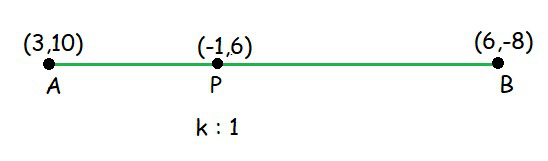
Lets consider the ratio in which the line segment joining (-3, 10) and (6, -8) is divided by point (-1, 6) be k :1.
👁 NCERT Solutions for Class 10 Maths Chapter 7 Coordinate Geometry
m = k and n =1
(x1,y1) = (3, 10) and (x2,y2) = (6,-8)
x = -1
x =
-1 =
-1(k+1) = 6k+3
k =
Hence, the required ratio is 2:7.
Solution:
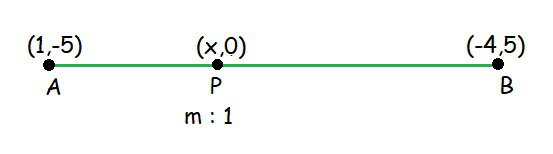
Let the point P divides the line segment joining A (1, – 5) and B (– 4, 5) in the ratio m : 1.
Therefore, the coordinates of the point of division, say P(x, y) and,
We know that y-coordinate of any point on x-axis is 0.
P(x, 0)
👁 NCERT Solutions for Class 10 Maths Chapter 7 Coordinate Geometry
m = m and n = 1
(x1,y1) = (1, -5)
(x2,y2) = (-4,5)
so, as the y coordinate of P is 0,
y =
0 =
5m-5=0
m = 1
So, x-axis divides the line segment in the ratio 1:1.
and, x =
x =
x =
Hence, the coordinate of P is (,0).
Solution:
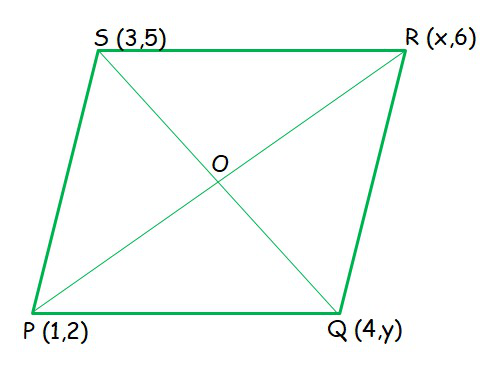
Let P, Q, R and S be the points of a parallelogram : P(1,2), Q(4,y), R(x,6) and S(3,5).
👁 NCERT Solutions for Class 10 Maths Chapter 7 Coordinate Geometry
Mid point of PR = Mid point of QS (The diagonals of a parallelogram bisect each other, the midpoint O is same)
- Mid point of PR
m = 1 and n = 1
(x1,y1) = (1, 2)
(x2,y2) = (x,6)
so, the x coordinate of O will be,
xo =
xo =
xo =
and now, the y coordinate of O will be,
yo =
yo =
yo = 4
So, the coordinate of O is ( , 4).................(1)
- For mid point QS
m = 1 and n = 1
(x1,y1) = (3,5)
(x2,y2) = (4,y)
so, the x coordinate of O will be,
xo=
xo =
xo =
and now, the y coordinate of O will be,
yo =
yo =
yo =
also , the coordinate of O is .................(2)
From (1) and (2)
and 4 =
x = 6 and y = 3
Solution:
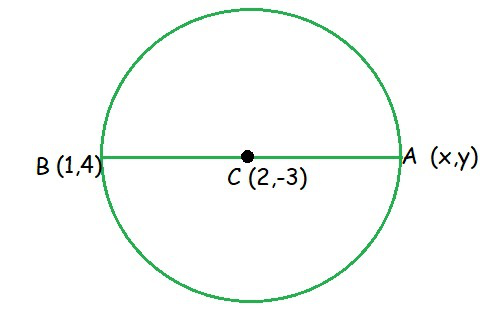
Let the coordinates of point A be (x, y).
Mid-point of AB is C(2, – 3), which is the centre of the circle.
and, Coordinate of B = (1, 4)
👁 NCERT Solutions for Class 10 Maths Chapter 7 Coordinate Geometry
For mid point of two points (x1,y1) and (x2,y2)
x =
y =
By using this formula, we get
(2, -3) = ,
= 2 and = -3
x + 1 = 4 and y + 4 = -6
x = 3 and y = -10
The coordinates of A (3,-10).
Solution:
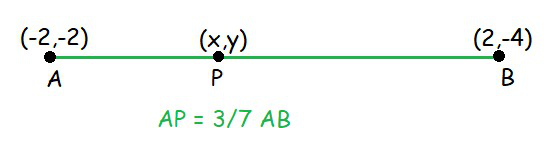
The coordinates of point A and B are (-2,-2) and (2,-4) respectively. Since AP = AB
👁 NCERT Solutions for Class 10 Maths Chapter 7 Coordinate Geometry
= --------(1)
subtract 1 from both sides,
- 1 = - 1
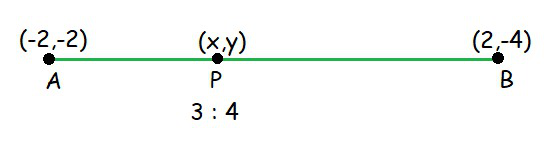
Therefore, AP: PB = 3:4
Point P divides the line segment AB in the ratio 3:4.
👁 NCERT Solutions for Class 10 Maths Chapter 7 Coordinate Geometry
Here,
m = 3 and n = 4
(x1,y1) = (-2,-2)
(x2,y2) = (2,-4)
so, the x coordinate of P will be,
x =
x =
x =
and now, the y coordinate of P will be,
y =
y =
y = \frac{-20}{7}
Hence, the coordinate of P(x,y) is .
Solution:
Line segment joining A(– 2, 2) and B(2, 8) divided into four equal parts.
👁 NCERT Solutions for Class 10 Maths Chapter 7 Coordinate Geometry
- We can say that Q is the mid point of AB
Here,
m = 1 and n = 1
(x1,y1) = (-2,2)
(x2,y2) = (2,8)
so, the x coordinate of Q will be,
x =
x =
x = 0
and now, the y coordinate of Q will be,
y = \mathbf{\frac{my_2 + ny_1}{m+n}}
y =
y = 5
Hence, the coordinate of Q is (0,5)...................................(1)
- We can say that P is the mid point of AQ
Here,
m = 1 and n = 1
(x1,y1) = (-2,2)
(x2,y2) = (0,5)
so, the x coordinate of P will be,
x =
x =
x = -1
and now, the y coordinate of P will be,
y =
y =
y =
Hence, the coordinate of P is (-1,)...................................(2)
- Now, we can say that R is the mid point of BQ
Here,
m = 1 and n = 1
(x1,y1) = (2,8)
(x2,y2) = (0,5)
so, the x coordinate of R will be,
x =
x =
x = 1
and now, the y coordinate of R will be,
y =
y =
y =
Hence, the coordinate of R is (1,)...................................(3)
From (1), (2) and (3) we conclude that
Three points between A and B are (-1,), (0,5) and (1,).
Solution:
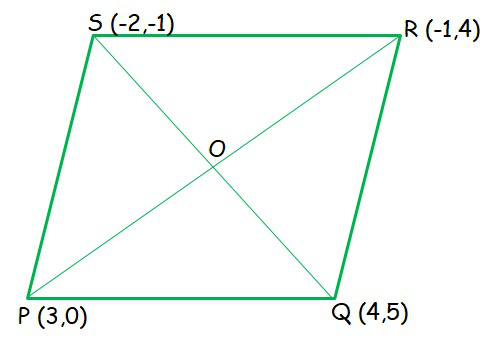
Let P(3, 0), Q (4, 5), R(– 1, 4) and S (– 2, – 1) are the vertices of a rhombus PQRS.
👁 NCERT Solutions for Class 10 Maths Chapter 7 Coordinate Geometry
Area of a rhombus = ½ (product of its diagonals)
Length of diagonal 1 (PR) = √((3-(-1))2+(0-4)2) = √32 = 4√2units
Length of diagonal 2 (QS) = √((4-(-2))2+(5-(-1))2) = √72 = 6√2 units
Area of a rhombus = ½ × 4√2 × 6√2
Area of a rhombus = 24 sq. units
Solution:
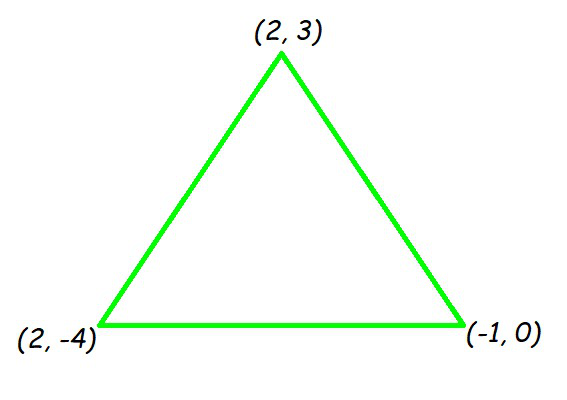
Area = 1/2 [x1(y2 - y3) + x2(y3 - y1) + x3(y1 - y2)]
👁 NCERT Solutions for Class 10 Maths Chapter 7 Coordinate Geometry
Now by putting all the values in the formula, we will get
Area of triangle = 1/2 [2(0 - (-4)) + (-1)((-4) - (3)) + 2(3 - 0)]
= 1/2 [8 + 7 + 6]
= 21/2
So, the area of triangle is 21/2 square units.
Solution:
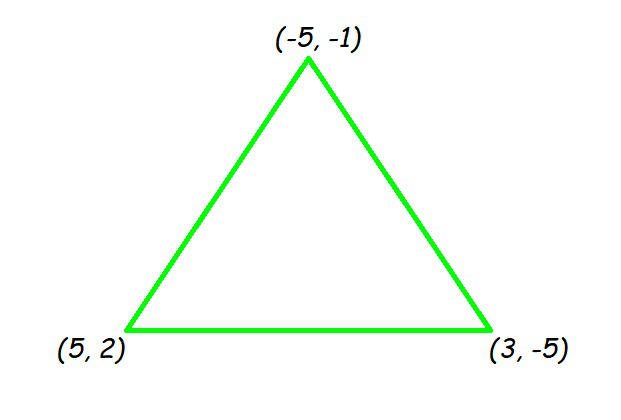
Area = 1/2 [x1(y2 - y3) + x2(y3 - y1) + x3(y1 - y2)]
👁 NCERT Solutions for Class 10 Maths Chapter 7 Coordinate Geometry
Area of the triangle = 1/2 [(-5)((-5) - (2)) + 3(2 - (-1)) + 5((-1) - (-5))]
= 1/2[35 + 9 + 20]
= 32
So, the area of the triangle is 32 square units.
Solution:
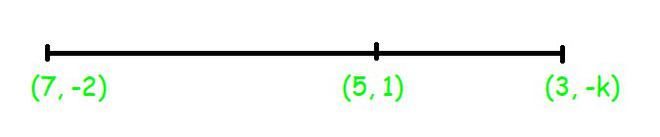
As we know the result, for collinear points, area of triangle formed by them is always zero.
👁 NCERT Solutions for Class 10 Maths Chapter 7 Coordinate Geometry
Let points (7, -2) (5, 1), and (3, k) are vertices of a triangle. (As given in the question)
Area of triangle = 1/2 [7(1 - k) + 5(k - (-2)) + 3((-2) - 1)] = 0
7 - 7k + 5k +10 -9 = 0
-2k + 8 = 0
k = 4
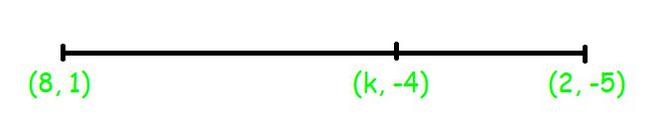
Solution:
As we know the result, for collinear points, area of triangle formed by them is zero.
👁 NCERT Solutions for Class 10 Maths Chapter 7 Coordinate Geometry
So we can say that for points (8, 1), (k, - 4), and (2, - 5), area = 0
1/2 [8((-4) - (-5)) + k((-5) - (1)) + 2(1 -(-4))] = 0
8 - 6k + 10 = 0
6k = 18
k = 3
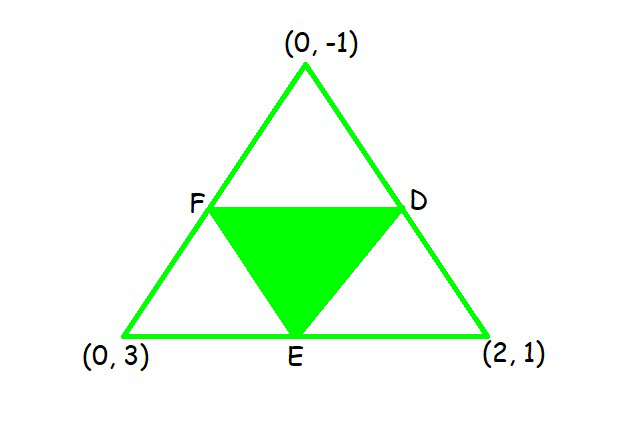
Solution:
Let us assume that vertices of the triangle be A(0, -1), B(2, 1), C(0, 3).
Let us assume that D, E, F be the mid-points of the sides of triangle.
👁 NCERT Solutions for Class 10 Maths Chapter 7 Coordinate Geometry
Coordinates of D, E, and F are
D = ((0 + 2)/2, (-1 + 1)/2) = (1, 0)
E = ((0+ 0)/2, (-1 + 3)/2) = (0, 1)
F = ((2+0)/2, (1 + 3)/2) = (1, 2)
Area(ΔDEF) = 1/2 [1(2 - 1) + 1(1 - 0) + 0(0 - 2)] = 1/2 (1+1) = 1
Area of ΔDEF is 1 square units
Area(ΔABC) = 1/2 [0(1 - 3) + 2(3 - (-1)) + 0((-1) - 1)] = 1/2 [8] = 4
Area of ΔABC is 4 square units
So, the required ratio is 1:4.
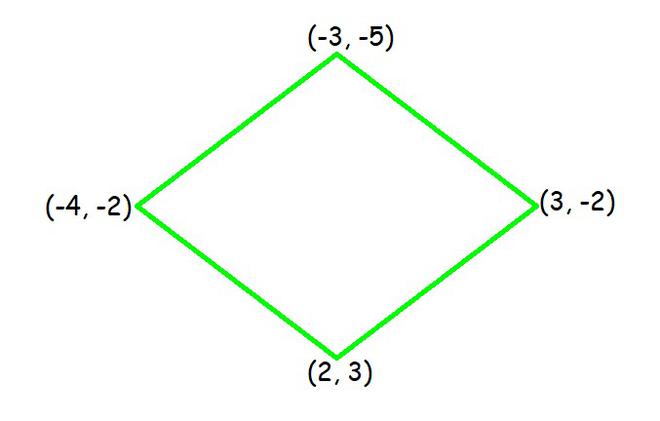
Solution:
Let the vertices of the quadrilateral be A(-4, -2), B(-3, -5), C(3, -2), and D(2, 3).
👁 NCERT Solutions for Class 10 Maths Chapter 7 Coordinate Geometry
Here, AC divide quadrilateral into two triangles.
Now, we have two triangles ΔABC and ΔACD.
Area of ΔABC = 1/2 [(-4)((-5) - (-2)) + (-3)((-2) - (-2)) + 3((-2) - (-5))]
= 1/2 [12 + 0 + 9]
= 21/2 square units
Area of ΔACD = 1/2 [(-4)((-2) - (3)) + 3((3) - (-2)) + 2((-2) - (-2))]
= 1/2 [20 + 15 + 0]
= 35/2 square units
Now we will add area of both triangle and resultant will give area of quadrilateral
Area of quadrilateral ABCD = Area of ΔABC + Area of ΔACD
= (21/2 + 35/2) square units = 28 square units
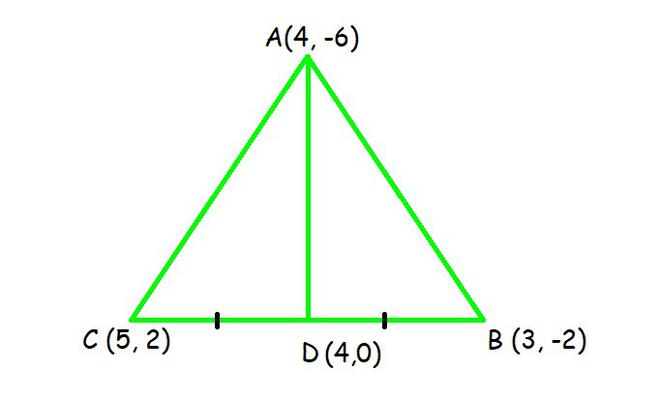
Solution:
Let the vertices of the triangle be A(4, -6), B(3, -2), and C(5, 2).
Let us assume that D be the mid-point of side BC of ΔABC. So, AD is the median in ΔABC.
Coordinates of point D = Midpoint of BC = (4, 0)
👁 NCERT Solutions for Class 10 Maths Chapter 7 Coordinate Geometry
Formula: Area = 1/2 [x1(y2 - y3) + x2(y3 - y1) + x3(y1 - y2)]
Now,
Area of ΔABD = 1/2 [(4)((-2) - (0)) + 3((0) - (-6)) + (4)((-6) - (-2))]
= 1/2 [-8 + 18 - 16]
= -3 square units
As we know that, area cannot be negative. So, the area of ΔABD is 3 square units.
Area of ΔACD = 1/2 [(4)(0 - (2)) + 4((2) - (-6)) + (5)((-6) - (0))]
= 1/2 [-8 + 32 - 30]
= -3 square units
As we know that, area cannot be negative. So, the area of ΔACD is 3 square units.
The area of both sides is same.
So we can say that, median AD has divided ΔABC in two triangles of equal areas.
Given: 2x + y – 4 = 0 line divides the line segment joining the points A(2, -2) and B(3, 7)
Find: Ratio in which the given line divides the line segment joining the points A and B
So, the co-ordinates of C is
Now, let us considered the ratio is k:1
=
=
But c lies on 2x+y-4=0
So,
2 - 4 = 0
9k = 2
k/1 = 2/9
Hence, the ratio is 2:9
Find: Here, we have to find a relation between x and y, if the points (x, y), (1, 2), and (7, 0) are collinear.
If the given points are collinear then the area of the triangle is 0(created using these points).
So,
Area of triangle = 1/2[x1(y2 - y3) + x2(y3 - y1) + x3(y1 - y2)] = 0
=> x(2 - 0) + 1(0 - y) + 7(y - 2) = 0
=> x(2)+ 1(-y) + 7y - 14 = 0
=> 2x - y + 7y - 14 = 0
=> 2x + 6y - 14 = 0
On dividing by 2 on both sides, we get
x + 3y - 7 = 0
Hence, the required relation is x + 3y - 7 = 0
Let us considered point A(6, -6), B(3, -7), and C(3, 3) and P(x, y) is the center of the circle.
So, AP = BP = CP(radii are equal)
Now first we take
AP = BP
√((x2 - x1)2 + (y2 - y1)2) = √((x2 - x1)2 + (y2 - y1)2)
(x - 6)2 + (y + 6)2 = (x - 3)2 + (y + 7)2
x2 + 36 - 12x + y2 + 36 + 12y = x2 + 9 - 6x + y2 + 49 + 14y
36 - 12x + 36 + 12y = 9 - 6x + 49 + 14y
-12x + bx + 12y - 14y + 72 - 58 = 0
-6x - 2y + 14 = 0
6x + 2y - 14 = 0
On divided by 2 on both side, we get
3x + y - 7 = 0 -(1)
Now, we take
BP = CP
√((x2 - x1)2 + (y2 - y1)2) = √((x2 - x1)2 + (y2 - y1)2)
(x - 3)2 + (y + 7)2 = (x - 3)2 + (y - 3)2
y2 + 72 + 2(y)(7) = y2 + 32 - 2(y)(3)
49 + 14y = 9 - 6y
14y + 6y = 9 - 49
20y = -40
y = -40/20
y = -2
Now, on putting value of y = -2 in eq(1), we get
3x - 2 - 7 = 0
3x - 9 = 0
3x = 9
X = 9/3 = 3
Hence, the center P(x, y) = (3, -2)
Let us considered ABDC is a square, and its two opposite vertices are A(-1, 2) and C(3, 2).
Let point O intersect line AC and BD.
Now, first we will find the coordinate of point O(x, y)
As we know that O is the mid point of line AC,
x = (3 - 1)/2 = 1
y = (2 + 2)/2 = 2
So, the coordinate of point O is (1, 2)
Now we will find the side of the Square
AC = √((3+ 1)2 + (2- 2)2)
AC = √16 = 4
So in triangle ACD, using hypotenuse theorem, we get
a = 2√2
So, each side of the square is 2√2
For the coordinate of D:
Let us assume that the coordinate of D is (x1, y1).
As we know that the sides of the squares are equal
so, AD = CD
√((x2 - x1)2 + (y2 - y1)2) = √((x2 - x1)2 + (y2 - y1)2)
√(x1 + 1)2 + (y1 - 2)2 = √(x1 - 3)2 + (y1 - 2)2
(x1 + 1)2 + (y1 - 2)2 = (x1 - 3)2 + (y1 - 2)2
(x1 + 1)2 = (x1 - 3)2
x12 + 1 + 2x1 = x12 + 9 - 6x1
1 + 2x1 = 9 - 6x1
2x1 + 6x1 = 9 - 1
8x1 = 8
x1 = 1
Now, CD2 = ((x2 - x1)2 + (y2 - y1)2)
8 = (x1 - 3)2 + (y1 - 2)2
8 = x12 + 9 - 6x1 + y12+ 4 - 4y1
y1 - 2 =2
y1 = 4
So the coordinate of D is (1, 4)
For the coordinate of B:
Let B(x2, y2) and as we know BOD is a line segment so,
1 = x2 + 1/2
x2 = 1
2 = y2 + 4/2
y2 = 0
So the coordinate of B = (1, 0)
👁 NCERT Solutions for Class 10 Maths Chapter 7 Coordinate Geometry
(i) Now taking A as an origin the coordinates of the vertices of the triangle are
P = (4, 6)
Q = (3, 2)
R = (6, 5)
(ii) Now taking C as an origin the coordinates of the vertices of the triangle are
P = (12, 2)
Q = (13, 6)
R = (10, 3)
Finding the area of triangle, when A as a origin the coordinates of the vertices
of the triangle are P(4, 6), Q(3, 2), and R(6, 5)
Area1 = 1/2[x1(y2 - y3) + x2(y3 - y1) + x3(y1 - y2)]
= [4(2 - 5) + 3(5 - 6) + 6(6 - 2)]/2
= [-12 - 3 + 24]/2
= [-15 + 24]/2
= 9/2 sq. unit
Finding the area of triangle, when C as a origin the coordinates of the vertices
of the triangle are P(12, 2), Q(13, 6), and R(10, 3)
Area2 = [12(6 - 3) + 13(3 - 2) + 10(2 - 6)]/2
= [12(3) + 13(1) + 10(-4)]/2
= [36 + 13 - 40]/2
= [49 - 40]/2
= 9/2 Sq.unit
So, here we observed that the Area1 = Area2
Solution:
Given: AD/AB = AE/AC = 1/4
To find: Area of ∆ADE
Since D and E divides AB and AC is the same ratio 1:4 then DE||BC -(Using theorem 6.2)
Now, In ∆ADE and ∆ABC
∠A = ∠A -(Common angle)
∠D = ∠B -(Corresponding angles)
∴∆ADE~∆ABC -(AA similarity)
ar.(ADE)/ar.(ABC) = (AD/AB)2 = 1/16
Area of ∆ABC = 1/2[x1(y2 - y3) + x2(y3 - y1) + x3(y1 - y2)]
= [4(5 - 2) + 1(2 - 6) + 7(6 - 5)]/2
= [4(3) + 1(-4) + 7(1)]/2
= [12 - 4 + 7]/2
= [19 - 4]/2
= 15/2 sq.unit
ar.(ADE)/ar.(ABC) = -(1/10)
ar.(ADE) = (1/16) × ar.(ABC)
ar.(ADE) = (1/16) × (15/2) = 15/32 sq.unit
So, we get
ar.(ADE):ar.(ABC) = 1:16
(i) The median from A meters BC at D. Find the coordinates of the point D.
(ii) Find the coordinates of the point P on the AD, such that AP: PD = 2: 1.
(iii) Find the coordinates of points Q and R on medians BE and CF respectively, such that BQ: QE = 2: 1 and CR: RF = 2: 1.
(iv) What do you observe?
[Note: The points which are common to all the three medians is called centroid and this point divides each median in the ratio 2: 1]
(v) If A(x1, y1), B(x2, y2), and C(x3, y3) are the vertices of ∆ABC, find the coordinates of the centroid of the triangles.
Solution:
Given: The vertices of ∆ABC are A(4, 2), B(6, 5) and C(1, 4)
(i) Co-ordinates of D = Midpoint of BC
=
=
= [7/2, 9/2]
= (3.5, 4.5)
(ii) Co-ordinates of P =
=
=
= [11/3, 11/3]
(iii) Co-ordinates E = Midpoint of AC
=
=
= (2.5, 3)
(iv) We observe that the points P, Q and R coincide, i.e the medians of AD, BE, and
concurrent at the point [11/3, 11/3]. This point is known as the centroid of the triangle.
(v) As AD is median, thus D is midpoint of BC
So the co-ordinates of D:
=
=
Co-ordinates of G:
= [\frac{x_2m_1+m_2x_1 }{m_1+m_2},\frac{y_2m_1+y_1m_12}{m_1+m_2}]
Solution:
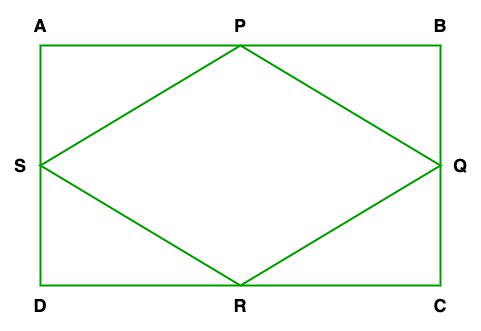
👁 NCERT Solutions for Class 10 Maths Chapter 7 Coordinate Geometry
Given: Points A(-1, -1), B(-1, 4), C(5, 4) and D(5, -1) and P, Q, R and S are the mid-points of AB, BC, CD, and DA
So,
= (-2/2, -1, 3/2)
= (4/2, 8/2) = (2, 4)
= (10/2, 8/2) = (5, 3/2)
= (4/2, -2/2) = (2, 1)
So, the length of
= √(61/4)
The length of
= √(61/4)
The length of
= √(61/4)
The length of
= √(61/4)
The length of the diagonal
= √25 = 5
The length of the diagonal
= √36 = 6
Hence, all fours sides are equal(i.e., PQ = QR = RS = SP) but the diagonals are
not equal to each other(i.e. QS ≠ PR).
Therefore, given quadrilateral PQRS is a rhombus.
Also Check: