|
VOOZH | about |
|
VOOZH | about |
This article provides you with detailed NCERT Solutions for Class 9 Maths Chapter 12-Heron's Formula. They have been solved by a team of experienced professionals at GFG, to make sure that every student can learn how to solve these questions with the easiest approach. This article provides solutions to all the problems asked in Class 9 Maths Chapter 12-Heron's Formula of the NCERT textbook in a step-by-step manner.
Heron's formula was given by the great mathematician cum engineer Heron of Alexandria, hence the name Heron's Formula. Class 9 Maths Chapter 12-Heron's Formula is the foundational chapter for getting a practical and smooth understanding of the concepts related to Heron's Formula.
NCERT Solutions Class 9 Maths Chapter 12 Heron's Formula Exercises: |
|---|
| NCERT Solutions Class 9 Maths Chapter 12 Heron's Formula Exercise 12.1 – 6 Questions & Solutions (2 Short Answers, 2 Long Answers, 2 Very Long Answers) |
| NCERT Solutions Class 9 Maths Chapter 12 Heron's Formula Exercise 12.2 – 9 Questions & Solutions (4 Long Answers, 5 Very Long Answers) |
Solutions to all the exercises in the chapter 12 Heron's Formula of NCERT textbook have been covered in the NCERT Solutions for Class 9 Maths. NCERT Solutions Class 9 Maths Chapter 12 Heron's Formula on this page are regularly revised to check errors and updated keeping the latest CBSE Syllabus 2023-2024 in mind.
Solution:
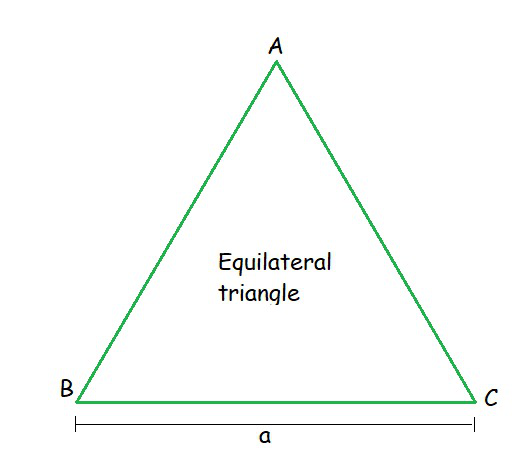
As it is mentioned here that, ΔABC is an equilateral triangle having side length = a.
So, here
AB =BC = AC = a
👁 NCERT Solutions Class 9 Maths Chapter 12 Heron's Formula
Perimeter of Equilateral triangle = 3× (Length of a side)
= 3×a = 3a
and perimeter = 180 cm (given)
So, 3a = 180
a = 60 cm.
Hence, length of each side is 60 cm.
Now, Area of △ABC can be calculated by Heron's Formula, where
AB = a = 60 cm
BC = b = 60 cm
AC = c = 60 cm
Semi Perimeter (s) = (a+b+c)/2
s = 180/2
s = 90 cm
ar(△ABC) = √s(s-a)(s-b)(s-c)
= √90(90-60)(90-60)(90-60)
= √90×(30)×(30)×(30)
= 900√3 cm2
Hence, the area of the signal board = 900√3 cm2
Solution:
👁 NCERT Solutions Class 9 Maths Chapter 12 Heron's Formula
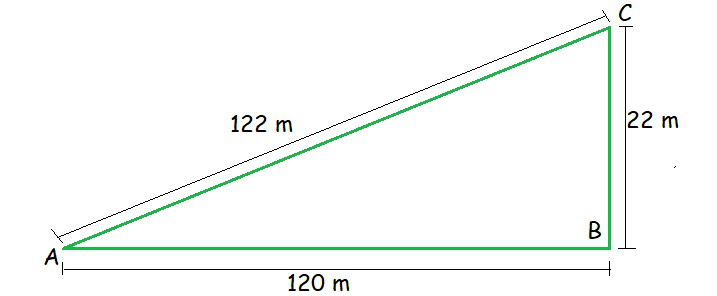
Here, Area of △ABC can be calculated by Heron's Formula, where
AB = a = 120 m
BC = b = 22 m
AC = c = 122 m
Semi Perimeter (s) = (a+b+c)/2
s = (120+22+122)/2
s = 132 m
ar(△ABC) = √s(s-a)(s-b)(s-c)
= √132(132-120)(132-22)(132-122)
= √132×(12)×(110)×(10)
= 1320 m2
As it is given that,
For 1 year we cost
1 m2 = ₹ 5000
So, for 3 months,
1 m2 = ₹ 5000 × (1/4)
For area of walls 1320 m2 = 5000×(1/4)×(1320)
= ₹ 16,50,000
Hence, ₹ 16,50,000 much rent company will pay for 3 months.
Solution:
👁 NCERT Solutions Class 9 Maths Chapter 12 Heron's Formula
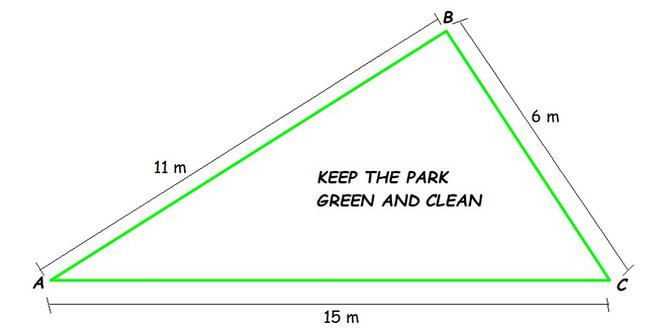
Here, Area of △ABC can be calculated by Heron's Formula, where
AB = a = 11 m
BC = b = 6 m
AC = c = 15 m
Semi Perimeter (s) = (a+b+c)/2
s = (11+6+15)/2
s = 16 m
ar(△ABC) = √s(s-a)(s-b)(s-c)
= √16(16-11)(16-6)(16-15)
= √16×(5)×(10)×(1)
= 20√2 m2
Hence, the area painted in colour is 20√2 m2
Solution:
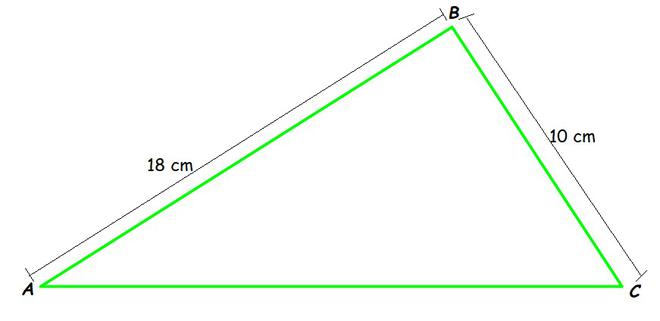
Here, length of two sides are given as 18 cm and 10 cm respectively.
and, perimeter = 42 cm.
Hence, length of third side = (Perimeter)-(length of two side)
= 42-(18+10)
AC = 14 cm
👁 NCERT Solutions Class 9 Maths Chapter 12 Heron's Formula
Here, Area of △ABC can be calculated by Heron's Formula, where
AB = a = 18 cm
BC = b = 10 cm
AC = c = 14 cm
Semi Perimeter (s) = (a+b+c)/2
s = (18+10+14)/2
s = 21 cm
ar(△ABC) = √s(s-a)(s-b)(s-c)
= √21(21-18)(21-10)(21-14)
= √21×(3)×(11)×(7)
= 21√11 cm2
Hence, the area of triangle is 21√11 cm2
Solution:
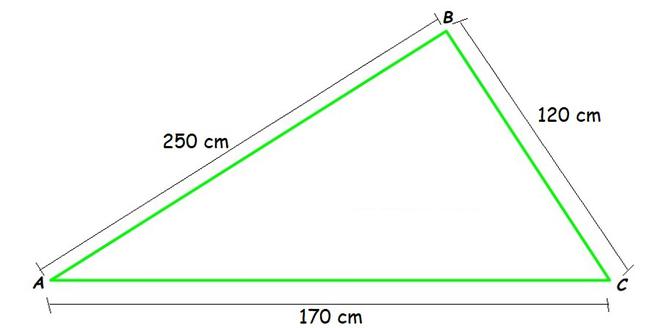
The ratio of the sides of the triangle are given as 12 : 17 : 25
Lets consider the common ratio between the sides of the triangle be p
Then, the sides are 12p, 17p and 25p
The perimeter of the triangle = 540 cm (Given)
12p+17p+25p = 540 cm
54p = 540cm
So, p = 10
Hence, the sides of triangle are 120 cm, 170 cm, 250 cm.
👁 NCERT Solutions Class 9 Maths Chapter 12 Heron's Formula
Here, Area of △ABC can be calculated by Heron's Formula, where
AB = a = 250 cm
BC = b = 120 cm
AC = c = 170 cm
Semi Perimeter (s) = (a+b+c)/2
s = (250+120+170)/2
s = 270 cm
ar(△ABC) = √s(s-a)(s-b)(s-c)
= √270(270-250)(270-120)(270-170)
= √270×(20)×(150)×(100)
= 9000 cm2
Hence, the area of triangle is 9000 cm2 .
Solution:
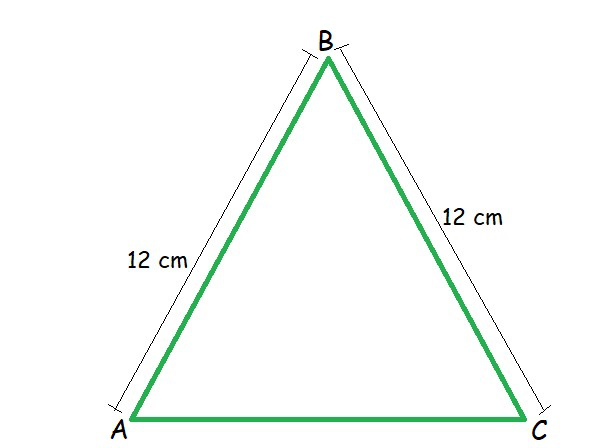
Here, length of two equal sides of isosceles triangle are given as 12 cm.
and, perimeter = 30 cm.
Hence, length of third side = (Perimeter)-(length of two side)
= 30-(12+12)
AC = 6 cm
👁 NCERT Solutions Class 9 Maths Chapter 12 Heron's Formula
Here, Area of △ABC can be calculated by Heron's Formula, where
AB = a = 12 cm
BC = b = 12 cm
AC = c = 6 cm
Semi Perimeter (s) = (a+b+c)/2
s = (12+12+6)/2
s = 15 cm
ar(△ABC) = √s(s-a)(s-b)(s-c)
= √15(15-12)(15-12)(15-6)
= √15×(3)×(3)×(9)
= 9√15 cm2
Hence, the area of triangle is 9√15 cm2
Solution:
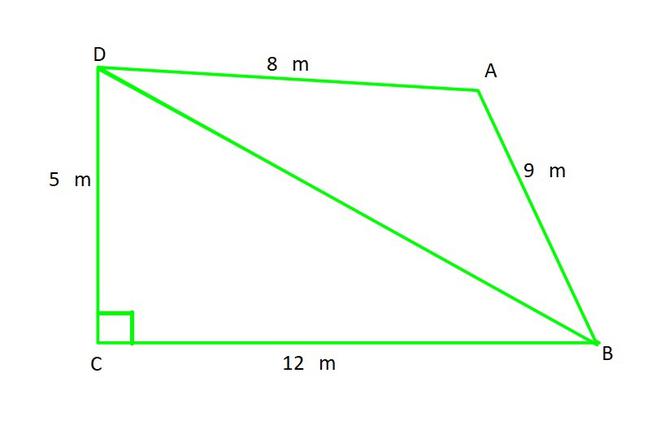
Given, a quadrilateral ABCD where ∠C = 90º.
Construction: Join diagonal BD.
👁 NCERT Solutions Class 9 Maths Chapter 12 Heron's Formula
As we can see that, △DCB is right-angled at C
Hence, BC is the base and CD is height of △DCB, so
ar(△DCB) = × Base × Height
= × 12 × 5
= 30 m2..........................................(1)
As △DCB is right angle triangle we can calculate third side by Pythagoras theorem
BD2 = CB2 + CD2
BD2 = 122 + 52
BD = √(144+25)
BD = √169
BD =13 m
Now, Area of △DAB can be calculated by Heron's Formula, where
AB = a = 9 m
AD = b = 8 m
BD = c = 13 m
Semi Perimeter (s) =
s =
s = 15 m
ar(△DAB) = √s(s-a)(s-b)(s-c)
= √15(15-9)(15-8)(15-13)
= √15×(6)×(7)×(2)
= 6√35 m2............................................(2)
From (1) and (2), we can conclude that,
ar(ABCD) = ar(△DCB)+ar(△DAB)
= (30 + 6√35)
= (30 + 35.5)
≈ 65.5 m2 (approx.)
Solution:
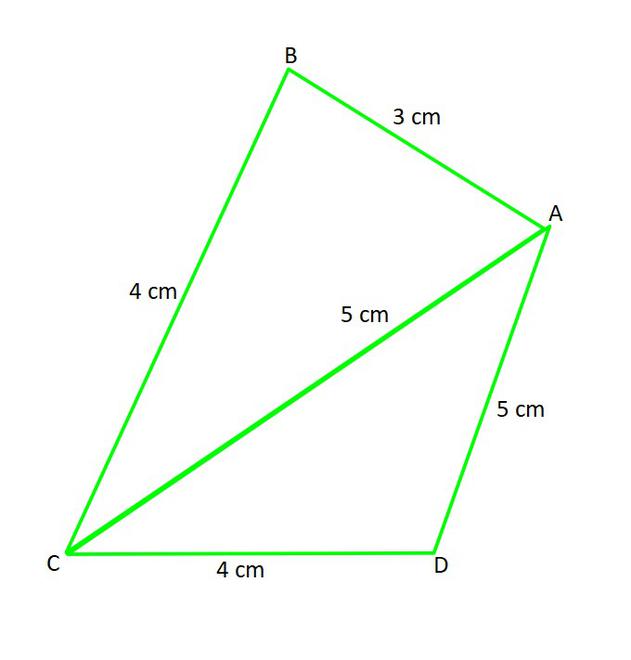
👁 NCERT Solutions Class 9 Maths Chapter 12 Heron's Formula
Here, we can notice that in △ABC
AC2 = AB2 + BC2
52 = 32 + 42
25 = 25
LHS = RHS
As this triangle is satisfying the Pythagoras theorem, Therefore, △ABC is a right angle triangle, 90° at B.
Hence, BC is the base and AB is height of △ABC. so
So, ar(△ABC) = × Base × Height
= × 4 × 3
= 6 cm2.....................................(1)
Now, Area of △DAC can be calculated by Heron's Formula, where
AD = a = 5 cm
DC = b = 4 cm
AC = c = 5 cm
Semi Perimeter (s) =
s =
s = 7 cm
ar(△DAC) = √s(s-a)(s-b)(s-c)
= √7(7-5)(7-4)(7-5)
= √7×(2)×(3)×(2)
= 2√21 cm2............................................(2)
From (1) and (2), we can conclude that,
ar(ABCD) = ar(△ABC)+ar(△DAC)
= (6 + 2√21)
= (6 + 9.2(approx.))
≈ 15.2 cm2 (approx.)
👁 NCERT Solutions Class 9 Maths Chapter 12 Heron's Formula
Solution:
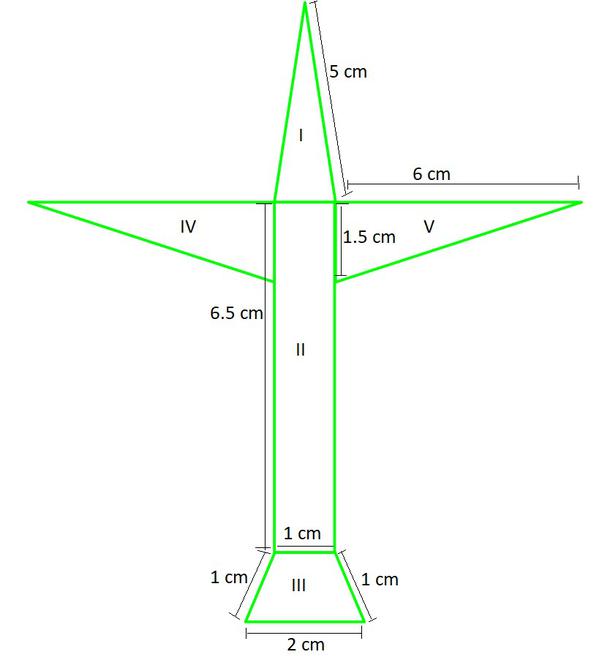
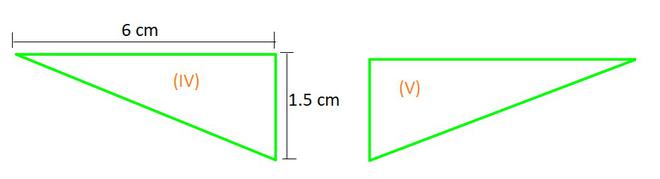
Total area of the paper used = (Area I + Area II + Area III + Area IV + Area V)
👁 NCERT Solutions Class 9 Maths Chapter 12 Heron's Formula
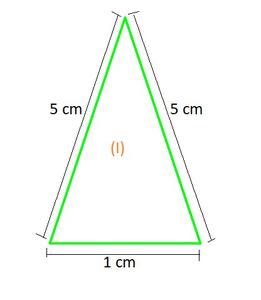
Now, Area of triangle can be calculated by Heron's Formula, where
a = 5 cm
b = 5 cm
c = 1 cm
Semi Perimeter (s) =
s =
s = 5.5 cm
ar(△) = √s(s-a)(s-b)(s-c)
= √5.5(5.5-5)(5.5-5)(5.5-1)
= √5.5×(0.5)×(0.5)×(4.5)
= 0.5×0.5×3√11
= 0.75√11
≈ 2.5 cm2 ............................................(1)
👁 NCERT Solutions Class 9 Maths Chapter 12 Heron's Formula
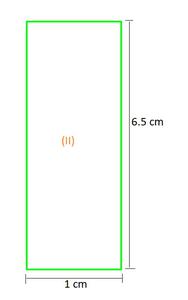
Area of Rectangle = length×Breadth
= 1 × 6.5 = 6.5 cm2.....................................(2)
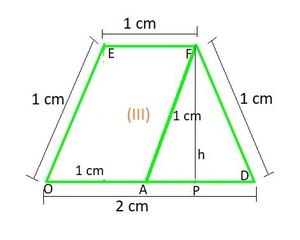
= Area of parallelogram EFAO + △ AFD
👁 NCERT Solutions Class 9 Maths Chapter 12 Heron's Formula
OD = 2cm
AD = OD-OA = 2-1 = 1 cm
Hence, △ AFD is equilateral.
PD = AD = cm
△ PFD is right angled at P, Pythagoras theorem is applicable
12=h2 +()2
h = √(1-)
h = √ cm
Area III:
= (Base × Height) + ( × Base × Height)
= (1 × ) + ( × 1 × )
=
= = 1.29 cm2.......................................(3)
👁 NCERT Solutions Class 9 Maths Chapter 12 Heron's Formula
ar(△) = × Base × Height
= × 6 × 1.5
= 4.5 cm2
Area IV + Area V = 2×ar(△)
= 2×4.5
= 9 cm2 .......................................(4)
Hence, Total area of the paper used = (Area I + Area II + Area III + Area IV + Area V)
= (1) + (2) + (3) + (4)
= 2.5 + 6.5 + 1.29 +9
= 19.29 cm2
Solution:
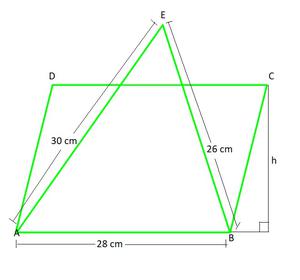
👁 NCERT Solutions Class 9 Maths Chapter 12 Heron's Formula
Now, Area of △AEB can be calculated by Heron's Formula, where
AE = a = 28 cm
EB = b = 30 cm
AB = c = 26 cm
Semi Perimeter (s) =
s = (28+30+26)/2
s = 42 cm
ar(△AEB) = √s(s-a)(s-b)(s-c)
= √42(42-28)(42-30)(42-26)
= √42×(14)×(12)×(16)
= 336 cm2
As it is given, ar(△AEB) = ar(parallelogram ABCD)
336 = Base × Height
336 = 28 × h
h =
h = 12 cm
Hence, the height of the parallelogram = 12 cm
Solution:
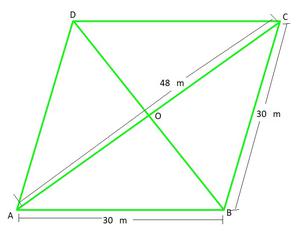
ABCD is a rhombus having diagonal AC = 48 cm
side AB=BC=CD=AD=30 cm
Diagonal of Rhombus divides the area into two equal parts.
👁 NCERT Solutions Class 9 Maths Chapter 12 Heron's Formula
Now, ar(△ABC) can be calculated by Heron's Formula, where
AB = a = 30 m
BC = b = 30 m
AC = c = 48 m
Semi Perimeter (s) =
s =
s = 54 m
ar(△ABC) = √s(s-a)(s-b)(s-c)
= √54(54-30)(54-30)(54-48)
= √54×(24)×(24)×(6)
= 432 m2
Hence, Area of rhombus = 2 × (ar(△))
= 2 × 432 = 864 m2
Area for 18 cows = 864 m2
Area for each cow = 864 / 18 = 48 m2
Solution:
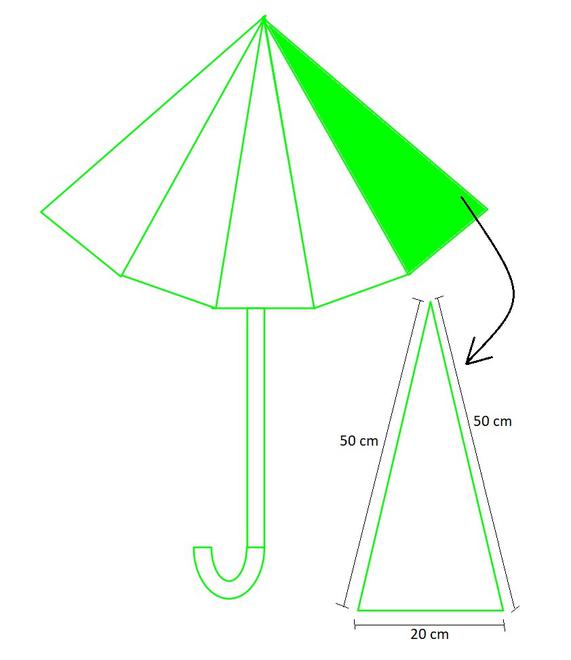
Let's consider for each triangle.
👁 NCERT Solutions Class 9 Maths Chapter 12 Heron's Formula
Now, for each ar(△)can be calculated by Heron's Formula, where
a = 50 cm
b = 50 cm
c = 20 cm
Semi Perimeter (s) =
s =
s = 60 cm
ar(△) = √s(s-a)(s-b)(s-c)
= √60(60-50)(60-50)(60-20)
= √60×(10)×(10)×(40)
= 200√6 cm2
Hence, the Total Area = 5×200√6
= 1000√6 cm2
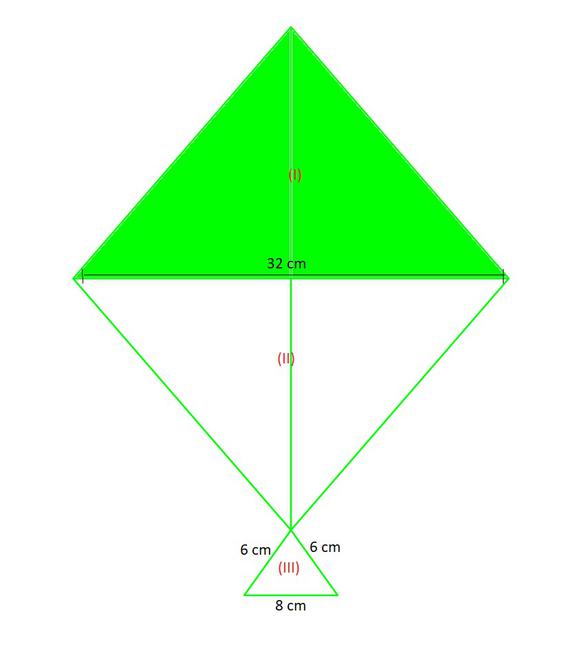
Solution:
👁 NCERT Solutions Class 9 Maths Chapter 12 Heron's Formula
As the area of kite is in the square, it area will be
Area of kite = ×(diagonal)2
= ×32×32
= 512 cm2
Diagonal divides area into equal areas.
512 = 2 × Area I
Area I =Area II = 256 cm2...................................(1)
Now, for each ar(△)can be calculated by Heron's Formula, where
a = 6 cm
b = 6 cm
c = 8 cm
Semi Perimeter (s) =
s =
s = 10 cm
ar(△) = √s(s-a)(s-b)(s-c)
= √10(10-6)(10-6)(10-8)
= √10×(4)×(4)×(2)
= 8√5 cm2....................................(2)
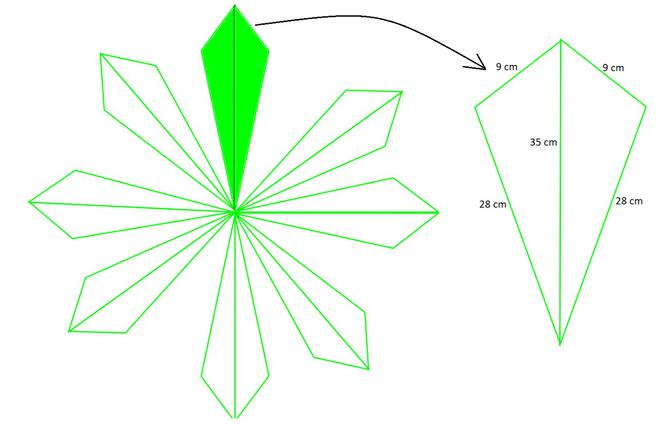
Solution:
👁 NCERT Solutions Class 9 Maths Chapter 12 Heron's Formula
Area for each triangle will be:
Now, for each ar(△)can be calculated by Heron's Formula, where
a = 9 cm
b = 28 cm
c = 35 cm
Semi Perimeter (s) =
s =
s = 36 cm
ar(△) = √s(s-a)(s-b)(s-c)
= √36(36-9)(36-28)(36-35)
= √36×(27)×(8)×(1)
= 36√6 cm2
As there are 16 tiles, so total area = 16 × 36√6
= 1410.906 cm2
As 1 cm2 = 50 p = ₹ 0.5
1410.906 cm2 = ₹ 0.5 ×1410.906
= ₹ 705.45
👁 NCERT Solutions Class 9 Maths Chapter 12 Heron's Formula
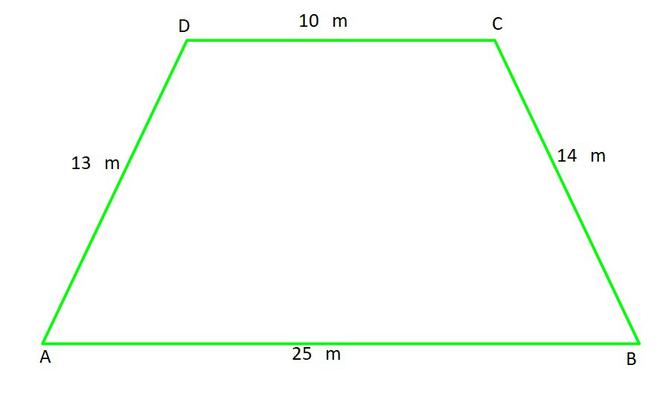
Solution:
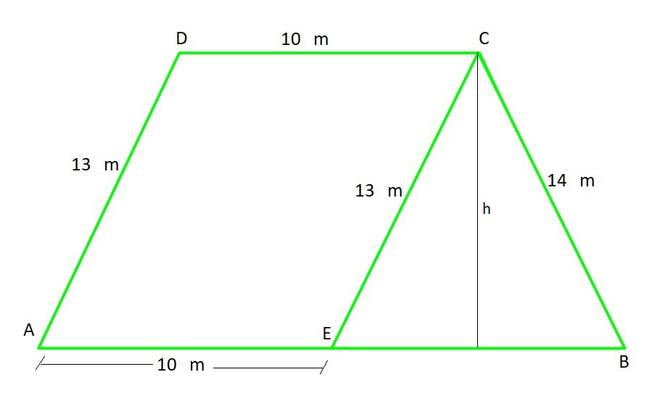
👁 NCERT Solutions Class 9 Maths Chapter 12 Heron's Formula
AB = 25 m
EB = AB-AE = 25-10 = 15 m
Now, for ar(△ECB) can be calculated by Heron's Formula, where
a = 13 m
b = 14 m
c = 15 m
Semi Perimeter (s) =
s =
s = 21 m
ar(△ECB) = √s(s-a)(s-b)(s-c)
= √21(21-3)(21-14)(21-15)
= √21×(18)×(7)×(6)
= 84 m2 ...............................(1)
ar(△ECB) = × Base × Height
84 m2= × 15 × h
h = m
h = 11.2 m
Total Area = Area of parallelogram AECD + ar(△ECB)
= (Base × Height) + 84m2
= 10 × 11.2 + 84
Total Area = 196 m2