|
VOOZH | about |
|
VOOZH | about |
Chapter 4 of the Class 9 NCERT Mathematics textbook, "Linear Equations in Two Variables," introduces students to the concept of linear equations involving two variables. This chapter explores the graphical representation of these equations, methods to find solutions, and the relationship between the algebraic and geometric representations. Students will learn to solve linear equations, understand their solutions, and apply these concepts to real-life situations.
This section provides detailed solutions to the problems in Chapter 4, "Linear Equations in Two Variables," from the Class 9 NCERT Mathematics textbook. The solutions help students understand the methods of solving linear equations graphically and algebraically and interpreting the results.
NCERT Solutions for Class 9 Maths Chapter 4 Linear Equations in Two Variables is created by a team of professionals in the field of academic content, to help students resolve their doubts in solving problems given in the NCERT textbook. Use the expert-crafted Class 9 Mathematics Chapter 4 Linear Equations in Two Variables NCERT Answers to gain insights into the context and effective problem-solving approaches for this chapter. Find accurate solutions to all the exercise questions effortlessly. All of the problems in this chapter's exercise from the NCERT textbook are covered in the NCERT Solutions for Class 9 Maths.
This chapter Linear Equations in Two Variables covers the introduction to linear equations, graphical representation of linear equations, techniques to solve them, formulating equations from real-life situations, and solving word problems. Students learn how to manipulate and solve linear equations in one variable using techniques such as simplification, isolation of the variable, and applying inverse operations.
Class 9 Maths NCERT Solutions Chapter 4 Exercises: |
|---|
| NCERT Maths Solutions Class 9 Exercise 4.1 – 2 Questions & Solutions (2 Short Answers) |
| NCERT Maths Solutions Class 9 Exercise 4.2 – 4 Questions & Solutions (3 Short Answers, 1 Long Answer) |
| NCERT Maths Solutions Class 9 Exercise 4.3– 8 Questions & Solutions (4 Short Answers, 4 Long Answers) |
| NCERT Maths Solutions Class 9 Exercise 4.4 – 2 Questions & Solutions (2 Long Answers) |
Solution:
Let's take the cost of a notebook as Rs. x and the cost of a pen as Rs. y.
Given that cost of a notebook (x) is twice the cost of a pen(y).
So, x = 2y.
x - 2y = 0
x - 2y = 0 is the linear equation in two variables that represent the statement.
(i) 2x + 3y = 9.35
Solution:
2x + 3y - 9.35 = 0 (Transposing 9.35 to LHS)
(2)x + (3)y + (-9.35) = 0 (converting it in the form ax + by + c = 0)
On comparing equation with ax + by + c = 0,
We get a = 2, b = 3, c = -9.35
(ii) x - y/5 -10 = 0
Solution:
(5x - y - 50)/5 = 0 (Multiply and divide the whole equation by 5)
5x - y - 50 = 0
(5)x + (-1)y + (-50) = 0 (converting it in the form ax + by + c = 0)
On comparing equation with ax + by +c =0,
We get a = 5, b = -1, c = -50
(iii) -2x + 3y = 6
Solution:
-2x + 3y - 6 = 0 (Transposing 6 to LHS)
(-2)x + (3)y+ (-6) = 0 (converting it in the form ax + by + c = 0)
On comparing equation with ax + by +c =0,
We get a = -2, b = 3, c = -6
(iv) x = 3y
Solution:
x - 3y = 0 (Transposing 3y to LHS)
(1)x + (-3)y + 0 = 0 (converting it in the form ax + by + c = 0)
On comparing equation with ax + by + c = 0,
We get a = 1, b = -3, c = 0
(v) 2x = -5y
Solution:
2x + 5y = 0 (Transposing 5y to LHS)
(2)x + (5)y + 0 = 0 (converting it in the form ax + by + c = 0)
On comparing equation with ax + by +c =0,
We get a = 2, b = 5, c = 0
(vi) x + 2 = 0
Solution:
(1)x + (0)y + 2 = 0 (converting it in the form ax + by + c = 0)
On comparing equation with ax + by +c =0,
We get a = 1, b = 0, c = 2
(vii) y - 2 = 0
Solution:
(0)x + (1)y + (-2) = 0 (converting it in the form ax + by + c = 0)
On comparing equation with ax + by +c =0,
We get a = 0, b = 1, c = -2
(viii) 5 = 2x
Solution:
5 - 2x = 0 (Transposing 2x to LHS)
(-2)x + (0)y + 5 = 0 (converting it in the form ax + by + c = 0)
On comparing equation with ax + by + c = 0,
We get a = -2, b = 0, c = 5
Solution:
Given linear equation: y = 3x + 5
Let x = 0, Therefore y = 3 × 0 + 5
= 0 + 5 = 5
Hence, (0, 5) is one solution
Now, let x = 1, Therefore y = 3 × 1 + 5
= 3 + 5 = 7
Hence, (1, 8) is another solution
Now, let y = 0, Therefore 0 = 3x + 5
x = 5/3
Hence, (5/3, 0) is one another solution.
This concludes that different values of x and y give the different values of y and x respectively.
As there is also no end to the different types of solution for the linear equation in two variables. Therefore, it can have infinitely many solutions.
Hence, option "(iii) infinitely many solutions" is the correct answer.
(i) 2x + y = 7
(ii) πx + y = 9
(iii) x = 4y
Solution:
(i) 2x + y = 7
Given: 2x + y = 7
To find the four solutions we have to substitute different values for x.
Let x = 0
Then,
2x+y = 7
(2 × 0) + y = 7
y = 7
Therefore, we get (x, y) = (0, 7)
Let x = 1
Then,
2x+y = 7
(2×1)+y = 7
2+y = 7
y = 7-2
y = 5
Therefore, we get (x, y) = (1, 5)
Let x = 2
Then,
2x + y = 7
(2×2) + y = 7
4 + y = 7
y = 7 - 4
y = 3
Therefore, we get (x, y) = (2, 3)
Let x = 3
Then,
2x + y = 7
(2×3) + y = 7
6 + y = 7
y = 7 - 6
y = 1
Therefore, we get (x, y) = (3, 1)
Finally, the four solutions are (0, 7), (1,5), (2,3), (3, 1)
(ii) πx + y = 9
Given: πx+y = 9
To find the four solutions we have to substitute different values for x.
Let x = 0
Then,
πx + y = 9
(π×0) + y = 9
y = 9
Therefore, we get (x, y) = (0, 9)
Let x = 1
Then,
πx +y = 9
(π×1) + y = 9
π + y = 9
y = 9 - π
Therefore, we get (x, y) = (1, 9 - π)
Let x = 2
Then,
πx +y = 9
(π×2) + y = 9
2π + y = 9
y = 9 - 2π
Therefore, we get (x, y) = (1, 9 - 2π)
Let x = 3
Then,
πx +y = 9
(π×3) + y = 9
3π + y = 9
y = 9 - 3π
Therefore, we get (x, y) = (1, 9 - 3π)
Finally, the four solutions are (0, 9), (1, 9 - π), (2, 9 - 2π), (3, 9 - 3π)
(iii) x = 4y
Given: x = 4y
To find the four solutions we have to substitute different values for x.
Let x = 0
Then,
x = 4y
0 = 4y
4y= 0
y = 0/4
y = 0
Therefore, we get (x, y) = (0,0)
Let x = 1
Then,
x = 4y
1 = 4y
4y = 1
y = 1/4
Therefore, we get (x, y) = (1,1/4)
Let x = 2
Then,
x = 4y
2 = 4y
4y = 2
y = 2/4
Therefore, we get (x, y) = (2, 1/2)
Let x = 3
Then,
x = 4y
3 = 4y
4y = 3
y = 3/4
Therefore, we get (x, y) = (2, 3/4)
Finally, the four solutions are (0, 0), (1,1/4), (2, 1/2), (2, 3/4)
(i) (0, 2)
(ii) (2, 0)
(iii) (4, 0)
(iv) (√2 , 4√2)
(v) (1, 1)
Solution:
(i) (0, 2)
Given: x - 2y = 4
As, x=0 and y=2
Hence, substituting the values of x and y in the equation, we get,
x – 2y = 4
0 – (2×2) = 4
-4 ≠ 4
L.H.S ≠ R.H.S
Therefore, (0, 2) is not a solution to the given equation x - 2y = 4.
(ii) (2, 0)
Given: x - 2y = 4
As, x = 2 and y = 0
Hence, substituting the values of x and y in the equation, we get,
x - 2y = 4
2 - (2×0) = 4
2 - 0 = 4
2 ≠ 4
L.H.S ≠ R.H.S
Therefore, (2, 0) is not a solution to the given equation x - 2y = 4.
(iii) (4, 0)
Given: x - 2y = 4
As, x= 4 and y=0
Hence, substituting the values of x and y in the equation, we get,
x - 2y = 4
4 - 2×0 = 4
4 - 0 = 4
4 = 4
L.H.S = R.H.S
Therefore, (4, 0) is a solution to the given equation x - 2y = 4.
(iv) (√2, 4√2)
Given: x - 2y = 4
As, x = √2 and y = 4√2
Hence, substituting the values of x and y in the equation, we get,
x - 2y = 4
√2 - (2×4√2) = 4
√2 - 8√2 = 4
-7√2 ≠ 4
L.H.S ≠ R.H.S
Therefore, (√2, 4√2) is not a solution to the given equation x - 2y = 4.
(v) (1, 1)
Given: x - 2y = 4
As, x= 1 and y= 1
Hence, substituting the values of x and y in the equation, we get,
x - 2y = 4
1 - (2×1) = 4
1 - 2 = 4
-1 ≠ 4
L.H.S ≠ R.H.S
Therefore, (1, 1) is not a solution to the given equation x - 2y = 4.
Solution:
Given: 2x + 3y = k
According to the question, x = 2 and y = 1 is solution of the given equation.
Hence, substituting the values of x and y in the equation 2x+3y = k, we get,
2x + 3y = k
(2×2) + (3×1) = k
4 + 3 = k
7 = k
k = 7
Therefore, the value of k is 7.
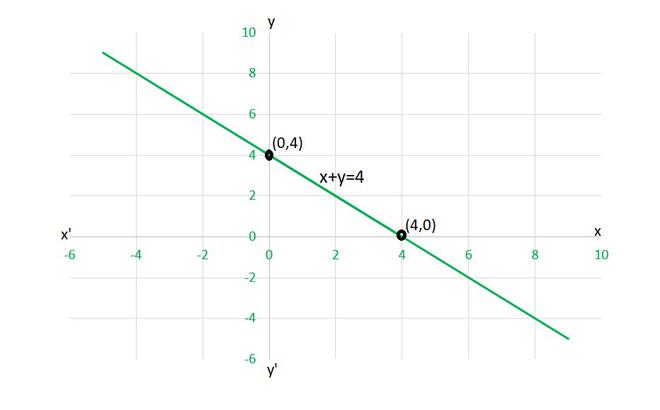
(i) x + y = 4
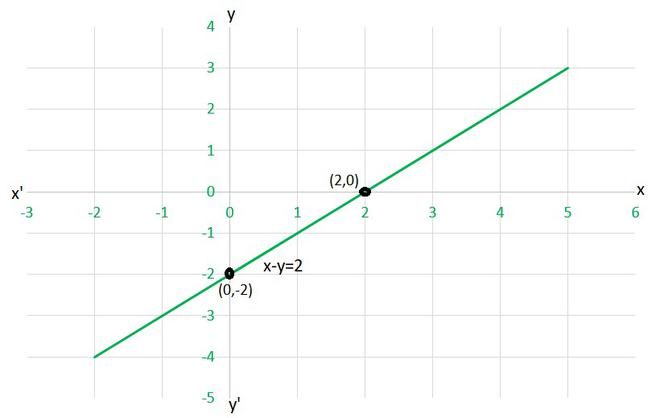
(ii) x – y = 2
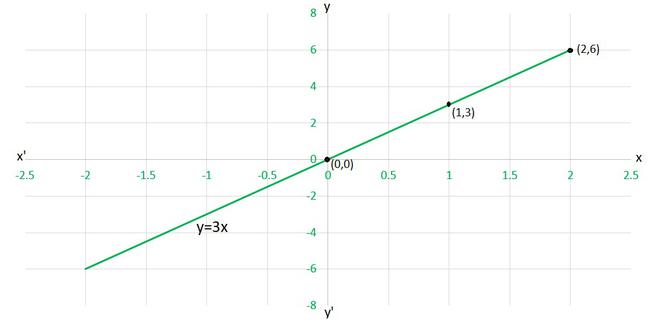
(iii) y = 3x
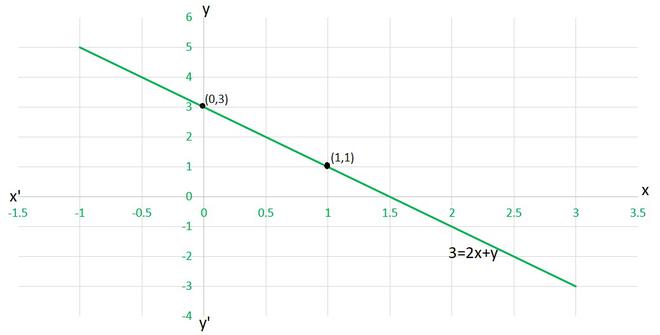
(iv) 3 = 2x + y
Solution:
(i) To draw the graph x+y=4, we need at least two solutions of the equation.
We can check that when, x = 0, y = 4,
and x = 4, y = 0
are solutions of the given equation. So, we can use the following table to draw the graph:
x y 0
4
4
0
(ii) To draw the graph x-y=2, we need at least two solutions of the equation.
We can check that when, x = 0, y = -2,
and x = 2, y = 0
are solutions of the given equation. So, we can use the following table to draw the graph:
x y 0
-2
2
0
(iii) To draw the graph y=3x, we need at least two solutions of the equation.
We can check that when, x = 0, y =0,
and x = 1, y = 3
are solutions of the given equation. So, we can use the following table to draw the graph :
x y 0
0
1
3
(iv) To draw the graph 3=2x+y, we need at least two solutions of the equation.
We can check that when, x = 0, y =3,
and x = 1, y = 1
are solutions of the given equation. So, we can use the following table to draw the graph :
x y 0
3
1
1
Solution:
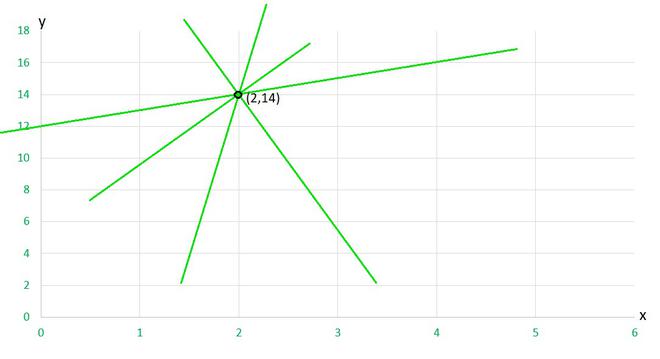
Here, as given point is (2,14) so
x=2 and y=14
We can form various equation such as,
y-x = 14-2 = 12
x+y = 2+14 =16
2x+y = 4+14 = 18
y-2x = 14-4 = 10
y = 14
x = 2
and many more........
In fact, there are infinitely many linear equations which are satisfied by the coordinates of the point (2, 14).
As it is stated that there can be infinite lines passing through a point. So here,
⟹
Solution:
The given equation is
3y = ax+7
According to the given point (3,4),
x = 3 and y = 4
As this point lie on this graph, then it will satisfy these points. So substituting the values
3y = ax+7
⟹ (3×4) = (a×3)+7
12 = 3a+7
3a = 12–7
3a = 5
a =
Hence, the value of a = .
Solution:
So, as given in the question, we will take
Distance covered as x km
and total fare as ₹ y
Fare for the first kilometer = 8 per km
Fare after the first 1km = ₹ 5 per km
Let x is the total distance, then the distance after one km will be = (x-1)km
Hence., Fare after the first km = 5(x-1)
So, in equation form we can conclude that,
The total fare = Fare of first km+ fare after the first km
y = 8+5(x-1)
y = 8+5(x-1)
y = 8+5x – 5
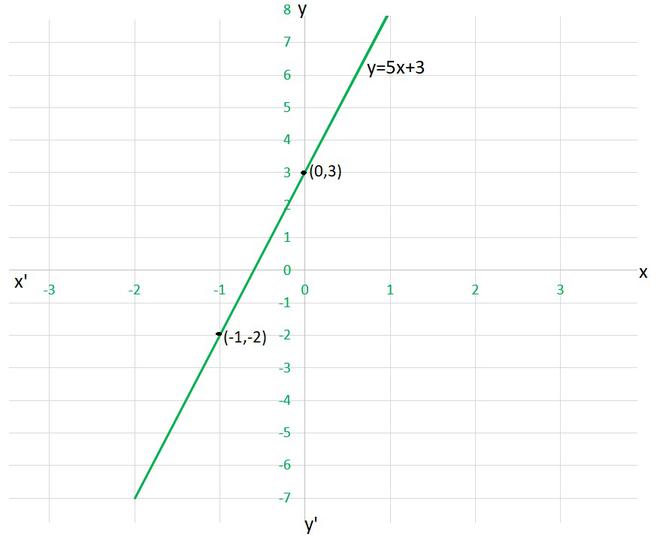
y = 5x+3
To draw the graph y=5x+3, we need at least two solutions of the equation.
We can check that when, x = 0, y =3,
and x = -1, y = -2
are solutions of the given equation. So, we can use the following table to draw the graph :
x y 0
3
-1
-2
For Fig. 4. 6
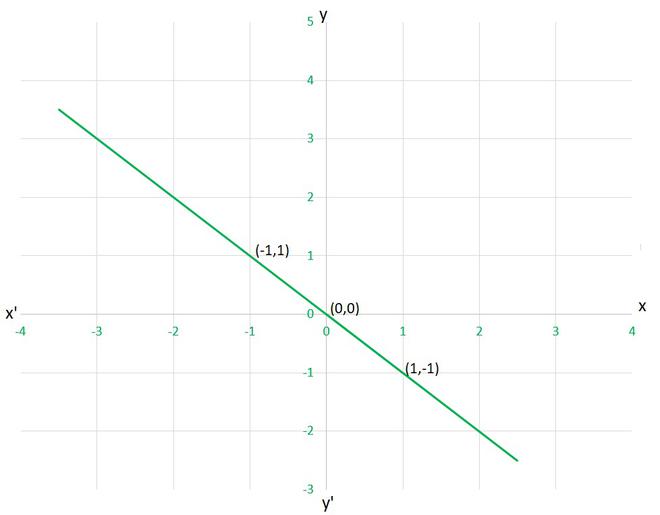
(i) y = x
(ii) x + y = 0
(iii) y = 2x
(iv) 2 + 3y = 7x
Solution:
Let's check each given cases, whether they are satisfying the solution given on graph or not,
(i) y=x
as given point (1,-1)
x=1 and y=-1 ⟹ x≠y
Hence, this equation is INCORRECT for this graph.
(ii) x+y=0
as given point (1,-1), (1,-1) and (0,0)
x=1 and y=-1 ⟹ x+y=0
x=-1 and y=1 ⟹ x+y=0
x=0 and y=0 ⟹ x+y=0
Hence, this equation is CORRECT for this graph.
(iii) y=2x
as given point (1,-1)
x=1 and y=-1 ⟹ y≠2x
Hence, this equation is INCORRECT for this graph.
(iii) 2+3y=7x
as given point (1,-1)
x=1 and y=-1 ⟹ 2+3y≠7x
Hence, this equation is INCORRECT for this graph.
For Fig. 4.7
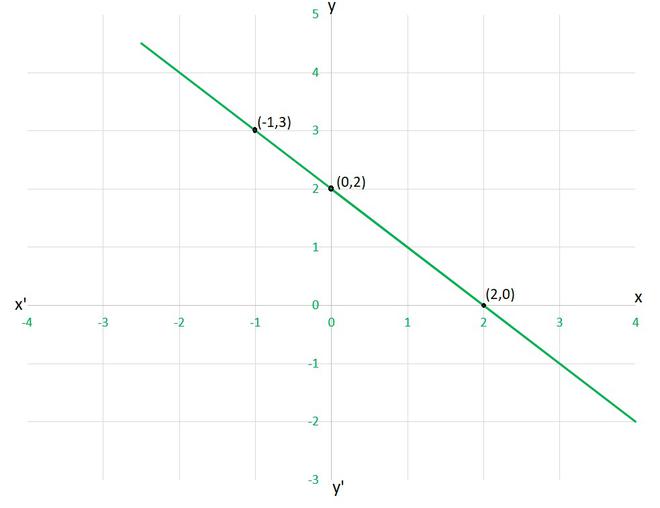
(i) y = x + 2
(ii) y = x – 2
(iii) y = –x + 2
(iv) x + 2y = 6
Solution:
Let's check each given cases, whether they are satisfying the solution given on graph or not,
(i) y=x+2
as given point (0,2), (2,0) and (-1,3)
x=0 and y=2 ⟹ y=x+2
x=2 and y=0 ⟹ y≠x+2
Hence, this equation is INCORRECT for this graph.
(ii) y=x-2
as given point (0,2)
x=0 and y=2 ⟹ y≠x-2
Hence, this equation is INCORRECT for this graph.
(iii) y=-x+2
as given point (0,2)
x=0 and y=2 ⟹ y=-x+2
x=2 and y=0 ⟹ y=-x+2
x=-1 and y=3 ⟹ y=-x+2
Hence, this equation is CORRECT for this graph.
(iii) x+2y=6
as given point (0,2)
x=0 and y=2 ⟹ x+2y≠6
Hence, this equation is INCORRECT for this graph.
(i) 2 units
(ii) 0 unit
Solution:
Given in question,
Work done = force × displacement
where constant force = 5 units
lets take work done as y units
and, distance travelled by the body x units
Hence, the equation can be expressed as,
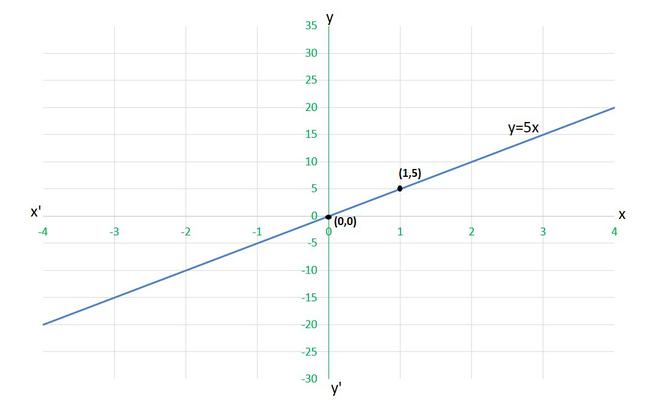
y=5x
To draw the graph y=5x, we need at least two solutions of the equation.
We can check that when, x = 0, y =0,
and x = 1, y = 5
are solutions of the given equation. So, we can use the following table to draw the graph :
x y 0
0
1
5
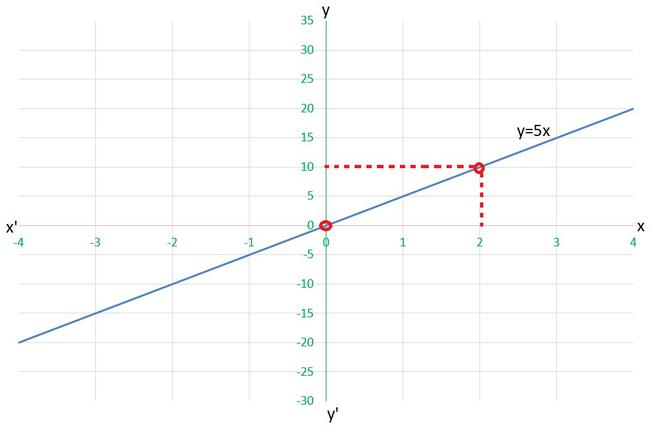
(i) for x= 2 units
y=5×2
work done = 10 units
(ii) for x= 0 units
y=5×0
work done = 0 units
Solution:
Let's take Yamini's contribution as ₹ x and Fatima's contribution as ₹ y.
As they together contributed ₹ 100, so the equation can be formed as,
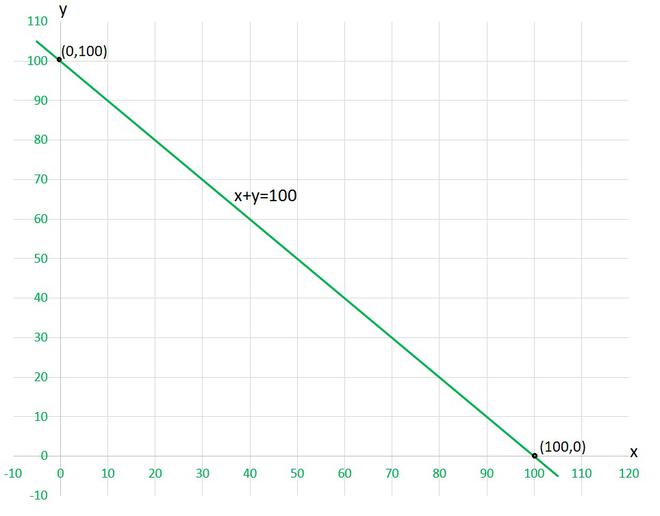
x+y=100
To draw the graph x+y=100, we need at least two solutions of the equation.
We can check that when, x = 0, y =100,
and x = 100, y = 0
are solutions of the given equation. So, we can use the following table to draw the graph :
x y 0
100
100
0
F = C + 32
(i) Draw the graph of the linear equation above using Celsius for x-axis and Fahrenheit for y-axis.
(ii) If the temperature is 30°C, what is the temperature in Fahrenheit?
(iii) If the temperature is 95°F, what is the temperature in Celsius?
(iv) If the temperature is 0°C, what is the temperature in Fahrenheit and if the temperature is 0°F, what is the temperature in Celsius?
(v) Is there a temperature which is numerically the same in both Fahrenheit and Celsius? If yes, find it.
Solution:
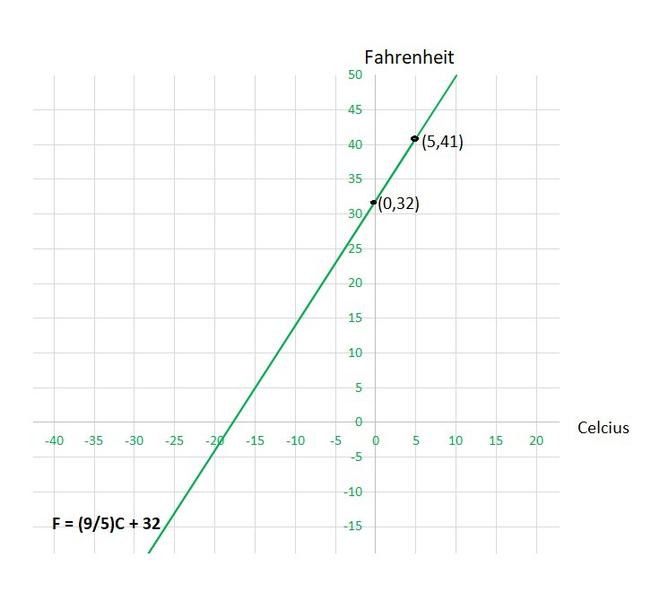
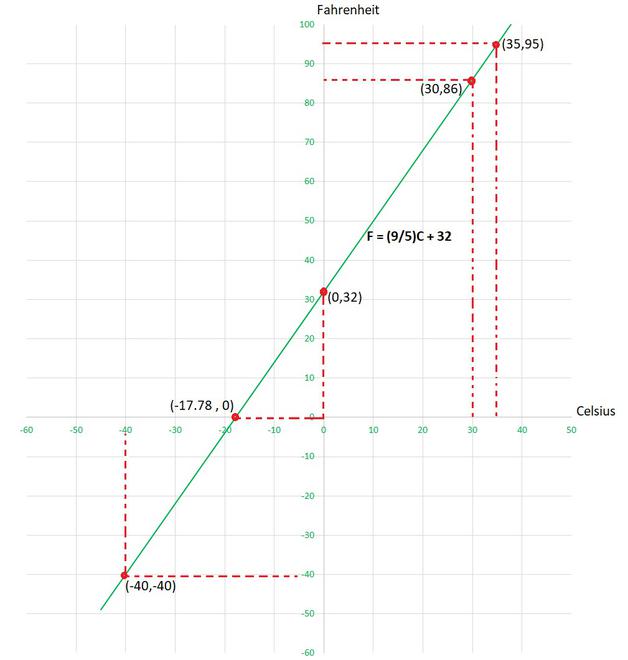
(i) Taking Celsius on x-axis and Fahrenheit on y-axis , so equation will be as follows:
y = x + 32
To draw the graph y = x + 32, we need at least two solutions of the equation.
We can check that when, x = 0, y =32,
and x = 5, y = 41
are solutions of the given equation. So, we can use the following table to draw the graph :
x y 0
32
5
41
(ii) When the temperature is 30°C then, using the equation
y = x + 32
by substituting, x=30, we get
y = ×30 + 32
y = 86
Hence, in Fahrenheit temperature will be 86°F
(iii) When the temperature is 95°F then, using the equation
y = x + 32
by substituting, y=95, we get
95 = x+ 32
x =
x = 35
Hence, in Celsius temperature will be 35°C
(iv)When the temperature is 0°C, using the equation
y = x + 32
by substituting, x=0, we get
y = ×0 + 32
y = 32
Hence, in Fahrenheit temperature will be 32°F
and, when the temperature is 0°F, using the equation and by substituting, y=0, we get
0 = x + 32
x =
x = -17.78
Hence, in Celsius temperature will be -17.78°C.
(v) Lets take both temperature same as x.
so, equation becomes as follows:
x = x + 32
x-x = -32
x = -32
x = -32×
x = -40
Hence, Celsius and Fahrenheit temperature will be -40°C and -40°F respectively.
(i) in one variable
(ii) in two variables
Solution:
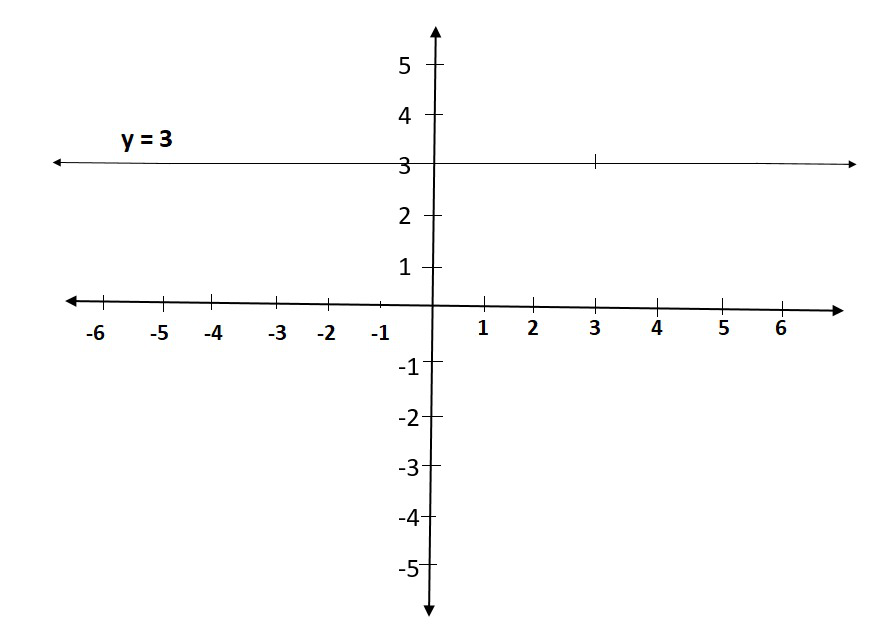
(i) If y = 3 is treated as a equation in one variable y only, then it has the unique solution
y = 3, which is a point on the number line
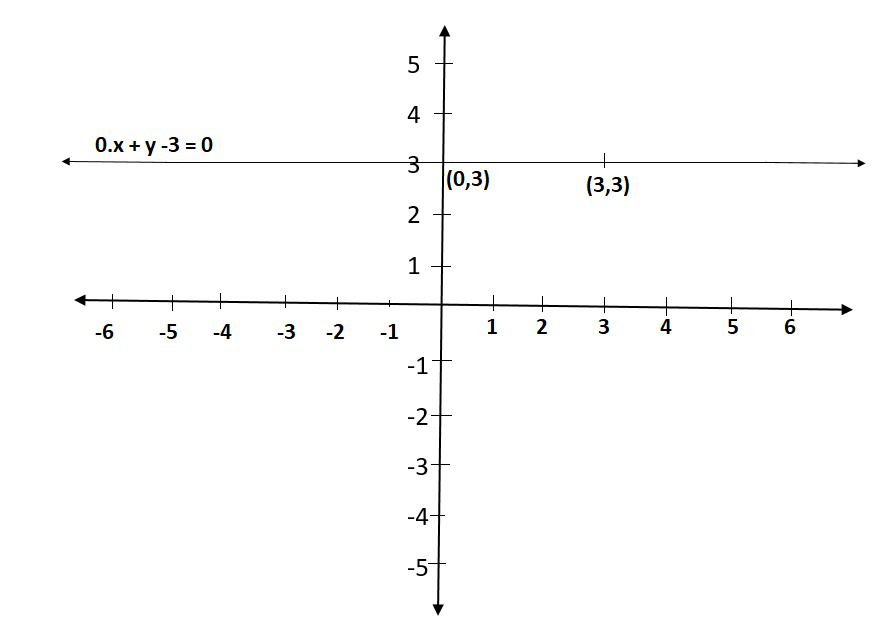
(ii) When an equation in two variables, it can be expressed as,
0.x + y - 3 = 0
which is a linear equation in the variables x and y. This is represented by a line. Now all the values of x are permissible because 0.x is always 0. However, y must satisfy the equation y = 3
This has infinitely many solutions. In fact, they are all of the form (r, 3), where r is any real number, so
We can have these two solutions for making line on a graph as:
x y 0 3 3 3
(i) in one variable
(ii) in two variables
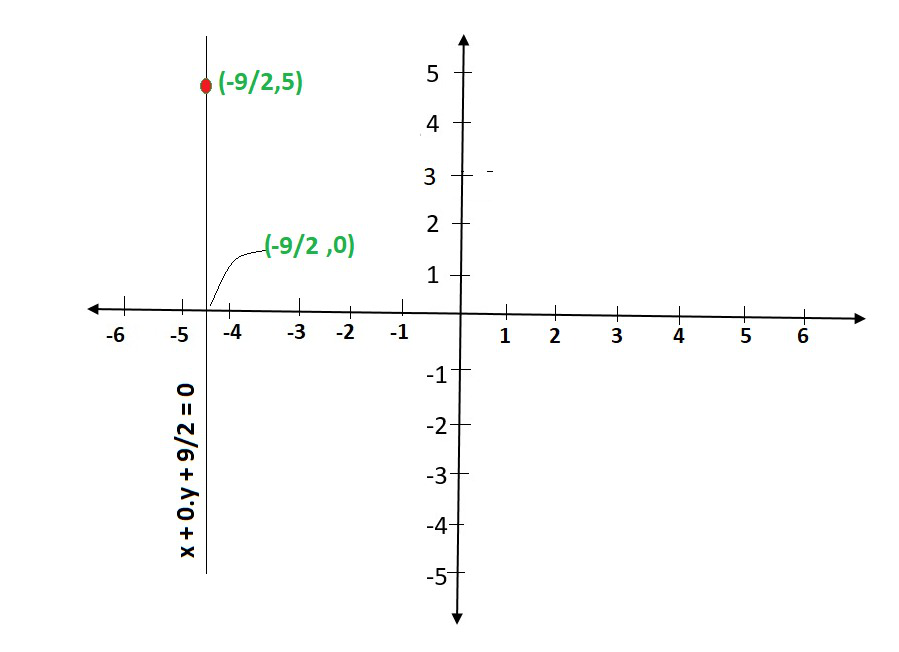
Solution:
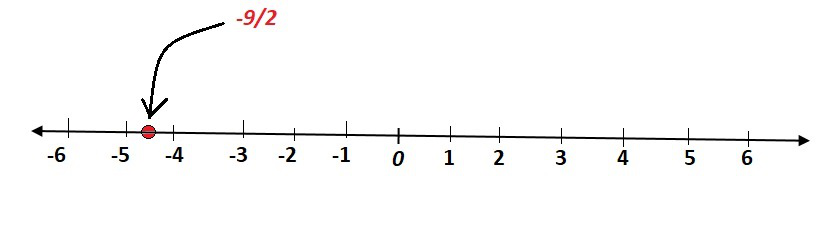
Firstly, we solve 2x + 9 = 0, to get
x = -9/2
(i) If x = -9/2 is treated as a equation in one variable x only, then it has the unique solution
x = -9/2, which is a point on the number line.
(ii) When an equation in two variables, it can be expressed as,
x + 0.y + 9/2 = 0
which is a linear equation in the variables x and y. This is represented by a line. Now all the values of y are permissible because 0.y is always 0. However, x must satisfy the equation x = -9/2
This has infinitely many solutions. In fact, they are all of the form (-9/2, r), where r is any real number, so
We can have these two solutions for making line on a graph as:
x y -9/2 0 -9/2 5
NCERT Grade 9 CBSE Chapter 4 Linear Equations in Two Variables, falls under the Algebra section. It introduces the concept of solving linear equations with two variables and their graphical representation on a Cartesian plane. The chapter covers essential considerations for solving linear problems and provides solutions for linear equations with two variables. Guided examples make learning more engaging, and exercises help assess understanding. Topics include graphing linear equations, lines parallel to the x-axis and y-axis, and solutions are presented step by step for gradual comprehension.
Access all exercise question answers in one convenient location. Gain insights into expertly solved solutions, available for download or online access, to enhance your effectiveness in tackling exercises. Utilize these solutions to hone your problem-solving abilities and grasp the mathematical principles applicable to linear equations with two variables.
Independently resolve doubts associated with exercise questions, ensuring no query goes unanswered and elevating your preparation. Learn from experts' unique problem-solving approaches for specific questions and apply these insights confidently.
Chapter 4 of the Class 9 NCERT Mathematics textbook, titled "Linear Equations in Two Variables," introduces students to the concept of linear equations with two variables and their graphical representation. The chapter covers how to solve these equations both algebraically and graphically, and how to interpret their solutions. Students learn to find the relationship between the algebraic expressions and their corresponding graphical representations. This chapter lays the foundation for understanding more complex systems of equations in higher classes.
Related Articles: