|
VOOZH | about |
|
VOOZH | about |
NCERT Solutions for Class 9 Maths Chapter 7 Triangles - This article contains detailed NCERT Solutions for Class 9 Maths Chapter 7 Triangles curated by the team of subject matter experts at GFG, to help students understand how to solve the NCERT problems easily.
Chapter 7 Triangles of NCERT for Class 9 Maths helps students understand the basic concepts of congruence of triangles and the rules of congruence. It is also helpful in understanding a few more properties of triangles and the inequalities in a triangle.
NCERT Chapter 7 Triangles in Class 9 covers topics such as :
This article provides solutions to all the problems asked in Class 9 Maths Chapter 7 Triangles of your NCERT textbook in a step-by-step manner as per the latest CBSE Syllabus 2023-24 and guidelines. Solutions to all the exercises in the NCERT Class 9 Maths Chapter 7 Triangles are regularly revised to check errors and updated according to the latest CBSE Syllabus 2023-24 and guidelines.
Class 9 Maths NCERT Solutions Chapter 7 Exercises: |
|---|
| NCERT Solutions for Class 9 Maths Chapter 7 TrianglesExercise 7.1 – 8 Questions & Solutions (6 Short Answers, 2 Long Answers) |
| NCERT Solutions for Class 9 Maths Chapter 7 Triangles Exercise 7.2– 8 Questions & Solutions (6 Short Answers, 2 Long Answers) |
| NCERT Solutions for Class 9 Maths Chapter 7 Triangles Exercise 7.3 – 5 Questions & Solutions (3 Short Answers, 2 Long Answers) |
| NCERT Solutions for Class 9 Maths Chapter 7 Triangles Exercise 7.4 – 6 Questions & Solutions (5 Short Answers, 1 Long Answer) |
| NCERT Solutions for Class 9 Maths Chapter 7 Triangles Exercise 7.5 – 4 Questions & Solutions (3 Short Answers, 1 Long Answer) |
Solution:
Given that AC and AD are equal
i.e. AC = AD and the line AB bisects ∠A.
Considering the two triangles ΔABC and ΔABD,
Where,
AC = AD { As given}................................................ (i)
∠CAB = ∠DAB ( As AB bisects of ∠A)................ (ii)
AB { Common side of both the triangle} ........ ...(iii)
From above three equation both the triangle satisfies "SAS" congruency criterion
So, ΔABC ≅ ΔABD.
Also,
BC and BD will be of equal lengths as they are corresponding parts of congruent triangles(CPCT).
So BC = BD.
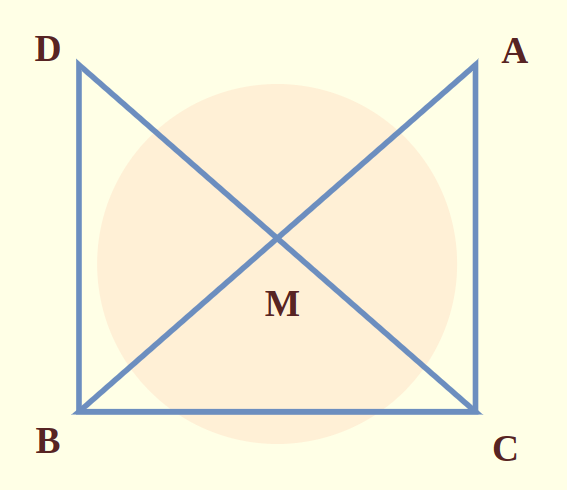
(i) ∆ ABD ≅ ∆ BAC
(ii) BD = AC
(iii) ∠ ABD = ∠ BAC.
Solution:
(i) Given that AD = BC,
And ∠ DAB = ∠ CBA.
Considering two triangles ΔABD and ΔBAC.
Where,
AD = BC { As given }.................................................. (i)
∠ DAB = ∠ CBA { As given also}............................. (ii)
AB {Common side of both the triangle)............. (iii)
From above three equation two triangles ABD and BAC satisfies "SAS" congruency criterion
So, ΔABD ≅ ΔBAC
(ii) Also,
BD and AC will be equal as they are corresponding parts of congruent triangles(CPCT).
So BD = AC
(iii) Similarly,
∠ABD and ∠BAC will be equal as they are corresponding parts of congruent triangles(CPCT).
So,
∠ABD = ∠BAC.
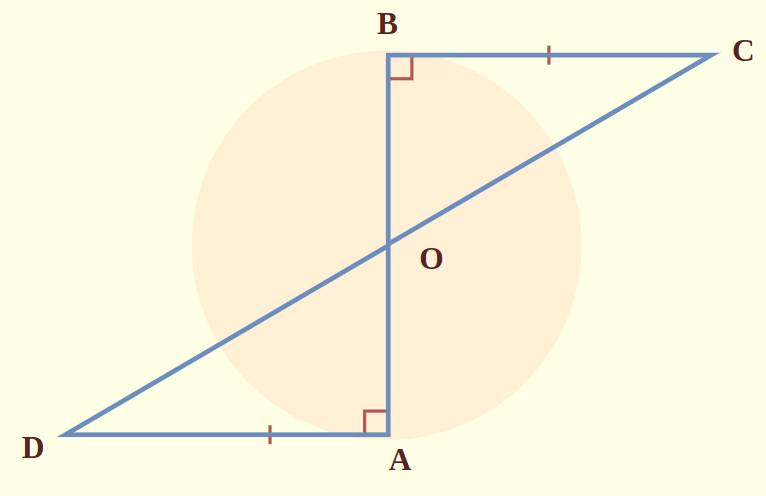
Solution:
Given that AD and BC are two equal perpendiculars to a line segment AB
Considering two triangles ΔAOD and ΔBOC
Where,
∠ AOD = ∠ BOC {Vertically opposite angles}................... (i)
∠ OAD = ∠ OBC {Given that they are perpendiculars}.... (ii)
AD = BC {As given}......................................................... (iii)
From above three equation both the triangle satisfies "AAS" congruency criterion
So, ΔAOD ≅ ΔBOC
AO and BO will be equal as they are corresponding parts of congruent triangles(CPCT).
So, AO = BO
Hence, CD bisects AB at O.
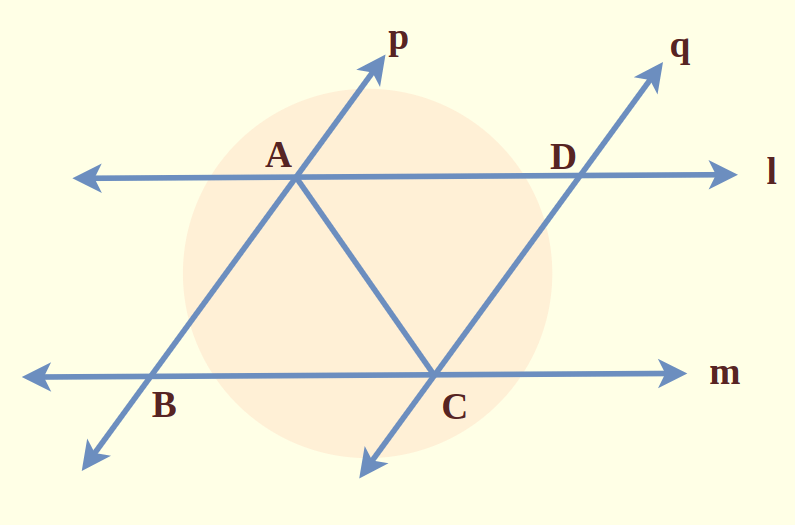
Solution:
Given that l and m are two parallel lines p and q are another pair of parallel lines
Considering two triangles ΔABC and ΔCDA
Where,
∠ BCA = ∠DAC {Alternate interior angles}.... (i)
∠ BAC = ∠ DCA {Alternate interior angles}.... (ii)
AC {Common side of two triangles}.............(iii)
From above three equation both the triangle satisfies "ASA" congruency criterion
So, ΔABC ≅ ΔCDA
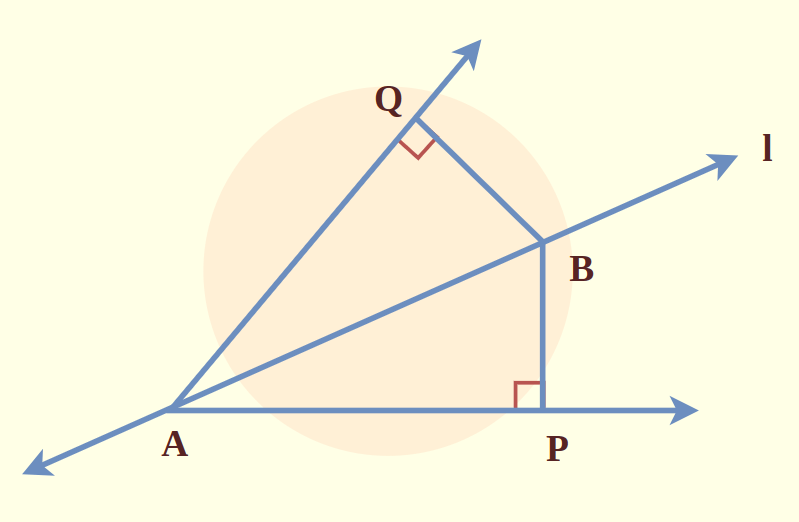
(i) ∆ APB ≅ ∆ AQB
(ii) BP = BQ or B is equidistant from the arms of ∠ A.
Solution:
Given that, Line l is the bisector of an angle ∠ A and B
BP and BQ are perpendiculars from angle A.
Considering two triangles ΔAPB and ΔAQB
Where,
∠ APB = ∠ AQB { Two right angles as given }...... (i)
∠BAP = ∠BAQ (As line l bisects angle A }......... (ii)
AB { Common sides of both the triangle }......... (iii)
From above three equation both the triangle satisfies "AAS" congruency criterion
So, ΔAPB≅ ΔAQB.
(ii) Also we can say BP and BQ are equal as they are corresponding parts of congruent triangles(CPCT).
So, BP = BQ
Solution:
Given that AC = AE, AB = AD
And ∠BAD = ∠EAC
As given that ∠BAD = ∠EAC
Adding ∠DAC on both the sides
We get,
∠BAD + ∠DAC = ∠EAC + ∠ DAC
∠BAC = ∠EAD
Considering two triangles ΔABC and ΔADE
Where,
AC = AE { As given }........................ (i)
∠BAC = ∠EAD { Hence proven }........ (ii)
AB = AD {As also given }.................... (iii)
From above three equation both the triangle satisfies "SAS" congruency criterion
So, ΔABC ≅ ΔADE
(ii) Also we can say BC and DE are equal as they are corresponding parts of congruent triangles(CPCT).
So that BC = DE.
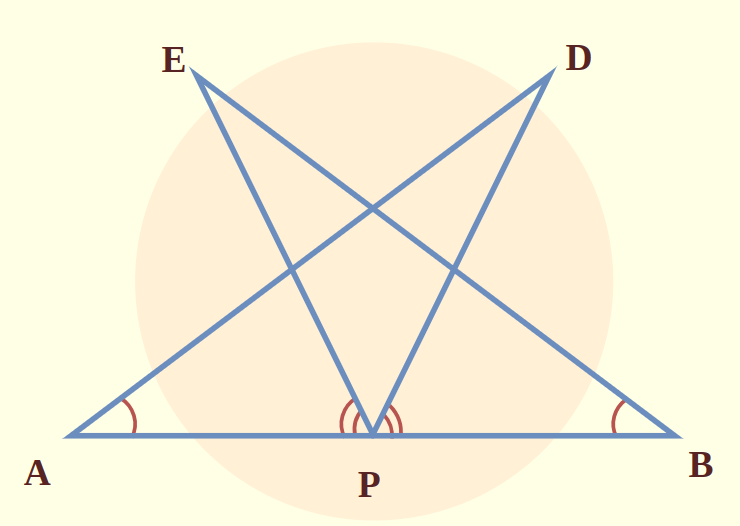
(i) ∆ DAP ≅ ∆ EBP
(ii) AD = BE
Solution:
Given that P is the mid-point of line AB, So AP = BP
Also, ∠ BAD = ∠ ABE and ∠ EPA = ∠ DPB
Now adding ∠DPE on both the sides of two equal angle ∠ EPA = ∠ DPB
∠ EPA + ∠ DPE = ∠ DPB + ∠DPE
Which implies that two angles ∠ DPA = ∠ EPB
Considering two triangles ∆ DAP and ∆ EBP
∠ DPA = ∠ EPB { Hence proven }...... (i)
AP = BP { Hence Given }.................. (ii)
∠ BAD = ∠ ABE { As given }..............(iii)
From above three equation both the triangle satisfies "ASA" congruency criterion
So, ΔDAP ≅ ΔEBP
(ii) Also we can say AD and BE are equal as they are corresponding parts of congruent triangles(CPCT).
So that, AD = BE
(i) ∆ AMC ≅ ∆ BMD
(ii) ∠ DBC is a right angle.
(iii) ∆ DBC ≅ ∆ ACB
(iv) CM = 1/2 AB
Solution:
Given that M is the mid-point of AB
So AM = BM
∠ ACB = 90°
and DM = CM
(i) Considering two triangles ΔAMC and ΔBMD:
AM = BM { As given }.............................................. (i)
∠ CMA = ∠ DMB { Vertically opposite angles }.... (ii)
CM = DM { As given also}...................................... (iii)
From above three equation both the triangle satisfies "SAS" congruency criterion
So, ΔAMC ≅ ΔBMD
(ii) From above congruency we can say
∠ ACD = ∠ BDC
Also alternate interior angles of two parallel lines AC and DB.
Since sum of two co-interiors angles results to 180°.
So, ∠ ACB + ∠ DBC = 180°
∠ DBC = 180° - ∠ ACB
∠ DBC = 90° { As ∠ACB =90° }
(iii) In ΔDBC and ΔACB,
BC { Common side of both the triangle }....... (i)
∠ ACB = ∠ DBC { As both are right angles }....(ii)
DB = AC (by CPCT)......................................... (iii)
From above three equation both the triangle satisfies "SAS" congruency criterion
So, ΔDBC ≅ ΔACB
(iv) As M is the mid point so we can say
DM = CM = AM = BM
Also we can say that AB = CD ( By CPCT )
As M is the mid point of CD we can write
CM + DM = AB
Hence, CM + CM = AB (As DM = CM )
Hence, CM = (½) AB
Solution:
👁 NCERT Solutions for Class 9 Maths Chapter 7 Triangles
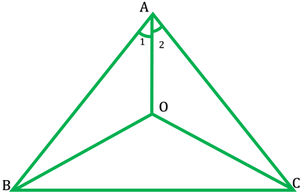
Given: (i) An isosceles ∆ABC in which AB=AC
(ii) bisects of ∠B and ∠C each other at O.
Show: (i) OB=OC
(ii) AO bisects ∠A (∠1=∠2)
(i) In ∆ABC,
AB = AC
∠B =∠C [angles opposite to equal sides are equal]
1/2 ∠B = 1/2∠C
∠OBC=∠OCB
∴OB = OC [sides opposite equal ∠ are equal]
(ii) In ∆AOB and ADC
AB = AC [given side]
1/2 ∠B = 1/2∠C
∠ABO = ∠ACO [Angle]
BO = OC [proved above side]
∴∆AOB ≅ AOC
Thus ∠1 = ∠2
Therefore, AO bisects ∠A
👁 NCERT Solutions for Class 9 Maths Chapter 7 Triangles
Solution:
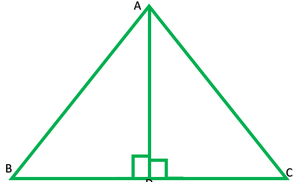
Given: AD is ⊥ bisector of BC
Show: AB=BC
In ∆ABD and ∆ACD
BD=DC [AD is ⊥ bisector side]
∠ADB=∠ADC [Each 90° angle]
AD=AD [common side]
∴∆ABD≅∆ACD [S.A.S]
AB=AC [C.P.C.T]
👁 NCERT Solutions for Class 9 Maths Chapter 7 Triangles
Solution:
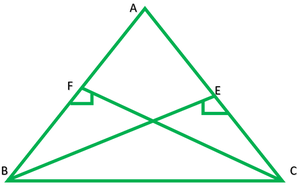
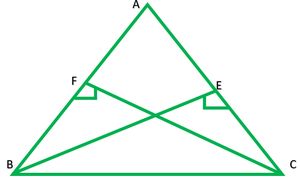
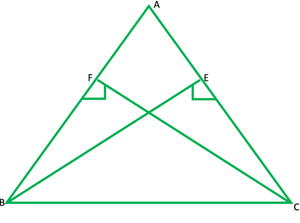
Given: AB=AC,BE and CF are altitudes
Show: BE=CF
In ∆AEB and ∆AFC,
∠E=∠F [Each 90° angle]
∠A=∠A [common angle]
AB=AC [given side]
∴∆AEB≅∆AFC [A.A.S]
BE=CF [C.P.C.T]
👁 NCERT Solutions for Class 9 Maths Chapter 7 Triangles
Solution:
Given: Altitudes BE and CF to sides AC and AB are equal
Show: (i) ΔABE ≅ ΔACF
(ii) AB = AC
(i) In ∆ABF and ∆ACF,
∠E=∠F [Each 90° angle]
∠A=∠A [common angle]
AB=AC [given] S
∴∆AEB≅∆AFC [A.A.S]
(ii) AB=AC [C.P.C.T]
👁 NCERT Solutions for Class 9 Maths Chapter 7 Triangles
Solution:
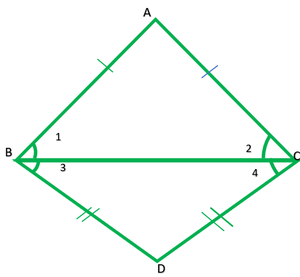
Given: AB=AC,BD=DC
Show: ∠ABD = ∠ACD
In ∆ABD,
AD=AC
∴∠1=∠2 [angle opposite to equal sides are equal] [1]
In ∆BDC,
BD=DC
∴∠3=∠4 [angle opposite to equal sides are equal] [2]
Adding 1 and 2
∠1+∠2= ∠2+∠4
∠ABD=∠ACD
👁 NCERT Solutions for Class 9 Maths Chapter 7 Triangles
Solution:
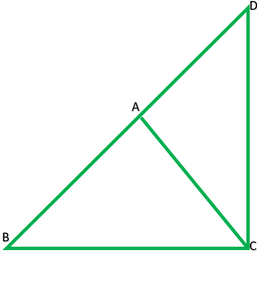
In ∆ABC,
AB=AC
∠ACB=∠ABC [1]
In ∆ACD,
AC=AD
∠ACD=∠ADC [2]
Adding 1 and 2
∠ACB+∠ACD=∠ABC+∠ADC
∠BCD=∠ABC+∠BDC
Adding ∠BCD on both side
∠BCD+∠BCD=∠ABC+∠BDC+∠BCD
2∠BCD=180°
∠BCD=(180°)/2=90°
Solution:
👁 NCERT Solutions for Class 9 Maths Chapter 7 Triangles
Find: ∠B=? and ∠C?
In ∆ABC,
AB=AC
∴∠B=∠C [angle opposite to equal side are equal]
∠A+∠B+∠C=180° [angle sum property of triangle]
90°+∠B+∠B=180°
2∠B=180°-90°
∠B=(90°)/2=45°
Therefore, ∠B=45° and ∠C =45°
Solution:
👁 NCERT Solutions for Class 9 Maths Chapter 7 Triangles
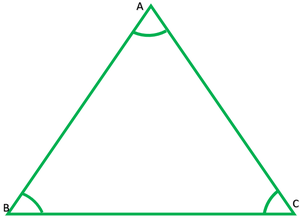
Given: Let ∆ABC is an equilateral ∆
Show: ∠A=∠B=∠C=60°
In ∆ABC,
AB=AC
∠B=∠C [1]
Also
AC=BC
∠B=∠A [2]
From 1,2 and 2
∠A=∠B=∠C
In ∆ABC,
∠A+∠B+∠C=180° [angle sum property of triangle]
∠A+∠A+∠A=180°
3∠A=180°
∠A=(180°)/3=60°
∠A=60°
∴∠B=60° and ∠C=60°
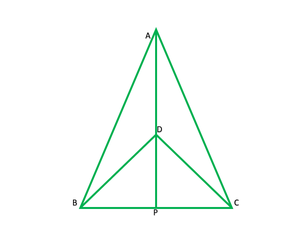
(i) ΔABD ≅ ΔACD
(ii) ΔABP ≅ ΔACP
(iii) AP bisects ∠A as well as ∠D.
(iv) AP is the perpendicular bisector of BC.
👁 NCERT Solutions for Class 9 Maths Chapter 7 Triangles
Solution:
Given: ∆ABC and ∆DCB are isosceles ∆on the same base BC.
To show:
- ΔABD ≅ ΔACD
- ΔABP ≅ ΔACP
- AP bisects ∠A as well as ∠D.
- AP is the perpendicular bisector of BC.
i) in ∆ABD and ∆ACB
AB=AC
BD=CD
AD=AD
∆ABD≅∆ACD -------------(S.S.S)
ii) in ∆ABP and ∆ACP
AB=AC
∠ BAP≅∠CAP [∆ABD≅∆ACD BY C.P.CT]
AP=AP ---------[common]
∴[∆ABD≅∆ACD -----------[S.A.S]
iii) [∆ABD≅∆ACD -----------[S.A.S]
∠BAD=∠CAD
AD, bisects ∠A
AP, bisects ∠A -----------------1
In ∆ BDP and ∆DPB
BD=CD ---------------(GIVEN)
DP=PC ----------[∆AB≅ ∆ACP C.P.C.T]
DP=DP -----------[common]
∴∆BDP≅∆CDP (S.S.S)
∠BDP=∠CDP (C.P.C.T)
DP bisects ∠D
AP bisects ∠D -------------------2
From 1 and 2, AP bisects ∠ A as well as ∠ D
iv) ∠ AP +∠APC =180° ------------[linear pair]
∠APB=∠APC -------------[∆ABP≅∆ACP C.P.CT]
∠APB + ∠APC=180°
2 ∠ APB=180°
∠APB=180/2=90°
BP=PC (FROM ii)
∴AP is ⊥ bisects of BC.
👁 NCERT Solutions for Class 9 Maths Chapter 7 Triangles
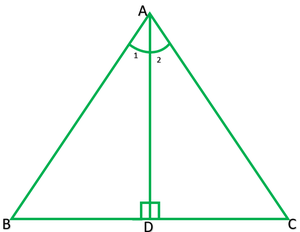
Solution:
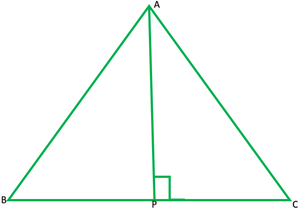
Given: AB=AC, AD altitude
To Show:
(i) AD bisects BC (ii) AD bisects ∠A.
In ∆ADB and ∆ADC
∠ADB=∠ADC -------- -----------[each 90°] R
AB=AC --------------------[given]S
AD=AD --------[common]S
∴ ∆ADB ≅∆ADC
BD=DC -------------[c.p.c.t]
∴AD bisects BC
∠1=∠2 -------------[c.p.c.t]
∴AD bisects ∠A
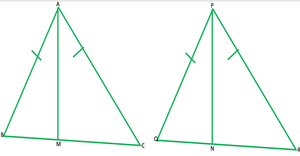
(i) ΔABM ≅ ΔPQN
(ii) ΔABC ≅ PQR
👁 NCERT Solutions for Class 9 Maths Chapter 7 Triangles
Solution:
Given:
AB=PQ
BC=QR
AM=PN
AM and PN are medians
To show:(i) ΔABM ≅ ΔPQN (ii) ΔABC ≅ PQR
Solution: In ΔABM and ΔPQN
AB=PQ
AM=PN
because AM and PN are medians BC=QR
therefore =1/2BC=1/2QR
∴BM=QN
∴) ΔABM ≅ ΔPQN ---------[S.S.S]
∠B=∠Q --------[c.p.c.t]
ii)now in ΔABC and ΔPQR
AB=PQ ----------[given]
∠B=∠Q from (i)
BC=QR ----------------[given]
∴ ΔABC ≅ PQR [S.A.S]
👁 NCERT Solutions for Class 9 Maths Chapter 7 Triangles
Solution:
Given: altitude BE and CF are equal
To prove: ΔABC is an isosceles Δ
In ΔBEC and ΔCEB
∠E=∠F ----------------[each 90°] R
BC=BC -----------------[common] H
BF=CF ----------------[given] S
# ΔBEC ≅ ΔCEB [R.H.S]
∠C=∠B -------------[C.P.C.T]
In ΔABC,
∠C=∠B
👁 NCERT Solutions for Class 9 Maths Chapter 7 Triangles
Solution:
Given:
In ∆ABC,
AB=BC
AP ⊥ BC
to show that: ∠B = ∠C.
Solution:
In ∆APB and ∆APC
∠APB = ∠APC ---------------[ each 90°] R
AB=AC -------------------[given] H
AP=AP --------------------[common] S
∴∆APB ≅ ∆APC ----------[R.H.S]
∠B = ∠C ---------------[C.P.C.T]
Solution:
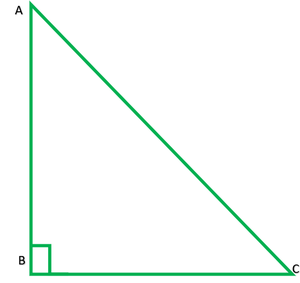
Given: Right angle triangle intersect ∠B=90°
To show: AC>AB and AC>BC
Solution:∠A+∠B+∠C=180° ----------------[angle sum property]
∠A+90°+∠C=180°
∠A+∠C=180°=90°
∠A+∠C=90°
∴∠A<90° and ∠C<90°
BC<AC AB<AC ----------[sides opposite to longer angle is greater]
∴Hypotenuse is the longest side.
Solution:
👁 NCERT Solutions for Class 9 Maths Chapter 7 Triangles
Given : ∠PBC < ∠QCB LET this be [∠1 < ∠2]
To Show : AD < BC
Solution: ∠1 < ∠2 --------[given]
-∠1 > -∠2
180-∠1>180-∠2
∠3>∠4 ---------[linear pair]
In ∆ABC,
∠3>∠4
AC>AB
Solution:
👁 NCERT Solutions for Class 9 Maths Chapter 7 Triangles
Given: ∠B < ∠A and ∠C < ∠D
To show: AD<BC
Solution: In ∆BOA
∠B < ∠A
∴AO<BO-------------1
In ∆COD
∠C < ∠D
∴OD<OC-------------2
Adding 1 and 2
AO+OD+<BO+OC
AD<BC
Solution:
👁 NCERT Solutions for Class 9 Maths Chapter 7 Triangles
Given: AB is smaller side
CD is longest side
To show: ∠A > ∠C and ∠B > ∠D.
Solution : In ∆ABC
BC>AB
∠1>∠2 ----------[angle opposite to greater side is greatest]-1
In ∆ABC
CD>AD
∠3>∠4 ---------[ angle opposite to greater side is greatest]-2
Adding 1 and 2
∠1+∠2+∠3+∠4
∠A>∠C
ii) In ∆ABD
AD>AB
∠5>∠6 -------------------[ angle opposite to greater side is greatest]-3
In ∆BCD
CD>BC
∠7>∠8 -------------------[ angle opposite to greater side is greatest]-4
Adding 3 and 4
∠5+∠6+∠7+∠8
∠B > ∠D
Solution:
👁 NCERT Solutions for Class 9 Maths Chapter 7 Triangles
Given: PR>PQ
PS is angle bisects ∠QPR
To show: ∠PSR > ∠PSQ
Solution: PR>PQ
∴∠3+∠4 ------------[angle opposite to greater side is larger]
∠3+∠1+x=180° -------------[angle sum property of ∆]
∠3=180°-∠1-x ------------1
In ∆PSR
4+∠2+x=180° -------------[angle sum property of ∆]
∠4=180°-∠2-x ------------2
Because ∠3>∠4
180°-∠1-x >180°-∠2-x
-∠1>-∠2
∠1<∠2
∠PSQ<∠PSR OR ∠PSR>∠PSQ
Solution:
👁 NCERT Solutions for Class 9 Maths Chapter 7 Triangles
Given: Let P be any point not lying on a line L.
PM ⊥ L
Now, ∠ is any point another than M lying on line=L
In ∆PMN
∠M90° ----------[ PM ⊥ L]
∠L<90° -------[∴∠M90° ∠L<90° ∠L<90°]
∠L<∠M
AM<PL ---------[side opposite to greater is greater ]
Solution:
👁 NCERT Solutions for Class 9 Maths Chapter 7 Triangles
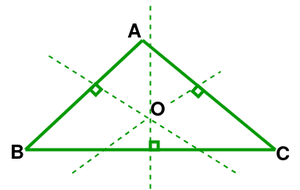
To obtain a point which is equidistant from all vertices of a triangle we construct perpendicular bisectors of all sides (AB, BC, CA) of the triangle (ΔABC). The point of intersection of these bisectors is known as Circumcenter(O) which is equidistant from all vertices.
Solution:
👁 NCERT Solutions for Class 9 Maths Chapter 7 Triangles
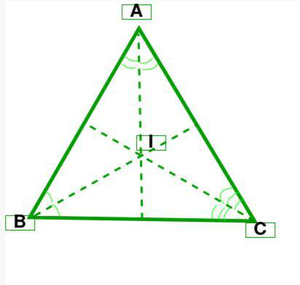
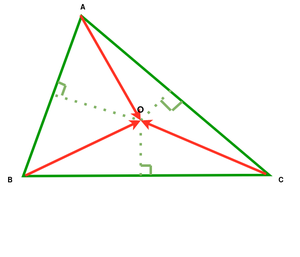
To obtain a point which is equidistant from all sides of a triangle we construct angle bisectors of all angles present in ΔABC i.e ∠BAC, ∠ABC, ∠ACB. The point of intersection of these bisectors is called Incentre(I) which is equidistant from all sides.
👁 NCERT Solutions for Class 9 Maths Chapter 7 Triangles
Solution:
👁 NCERT Solutions for Class 9 Maths Chapter 7 Triangles
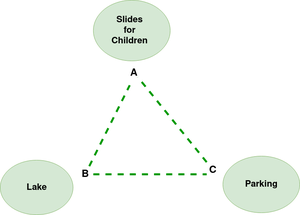
The ice-cream parlour must be set somewhere so that it's easily available for the public. So for such point it should be at a equal distance from point A, B, C & such point is termed as circumcenter.
👁 NCERT Solutions for Class 9 Maths Chapter 7 Triangles
Solution:
👁 NCERT Solutions for Class 9 Maths Chapter 7 Triangles
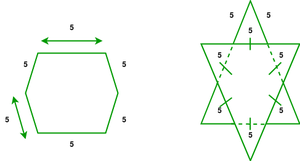
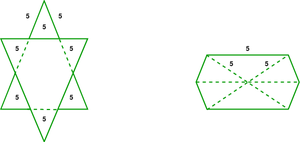
We need to find the number of triangles that can get fit the above figures i.e the hexagon and the star.
So,
Area of hexagon = (Area of small triangle inside hexagon) * 6
Area of small equilateral triangle = √3/4 * a2
= √3/4 * 52
= √3/4 * 25 = 25√3/4
So,
Area of hexagon = 25√3/4 * 6
= 150√3/4 cm2
Area of Star = Area of 6 triangles and 1 hexagon
= 6 * 25√3/4 + 150√3/4
= 300√3/4 cm2
Area of triangles of 1cm side that are to be fitted = √3/4 * 12
= √3/4 cm2
Number of triangles that can be accommodated inside hexagon and stars :
a. For Hexagon : Area of hexagon/ Area of 1cm side triangle
= 150√3/4 cm2 / √3/4 cm2
= 150 triangles
b. For Star : Area of star/ Area of 1cm triangle
= 300√3/4 cm2 / √3/4 cm2
= 300 triangles
Hence, the star can accommodate 150 more triangles than the hexagon.