|
VOOZH | about |
|
VOOZH | about |
Properties and Postulates of Geometric Figures: Geometric figures are shapes and forms that we study in geometry. They range from simple lines to complicated forms like circles and triangles. We need to know and understand these figures well because they often are of help when an aspect in numerous areas of math as well in real life needs solving. This paper teaches in great detail about the properties and postulates of these Geometric Figures.
Table of Content
A Geometric figure is a combined size of points, straight lines & curves in a plane or space. They are 2-D (flat) or 3-D components. There are some geometric figures that we all have learned about, such as triangles, squares, circles and cubes.
When attempting to prove certain problems and theorems, it is essential to know the basic properties of the given geometric figures. Here is a table exploiting the most basic properties:
| Property | Description |
|---|---|
| Congruence | When two figures are identical in shape and size. |
| Similarity | When two figures have the same shape but different sizes. |
| Symmetry | When a figure can be divided into identical halves. |
| Angles | The space between two intersecting lines measured in degrees. |
| Sides | The line segments that form the boundary of a figure. |
Congruence and similarity are perhaps some of the most important concepts in geometry. In its place say, Two figures are congruent if they have the square measure however doesn't need to be same size but has similar shapes means it is in like or equal dimension. These ideas are very valuable in comparing and contrasting geometric shapes.
Symmetry is when an image looks the same if there is a mirror line down the center. For example, there are four lines of symmetry in a square or an infinite number of symmetries in a circle.
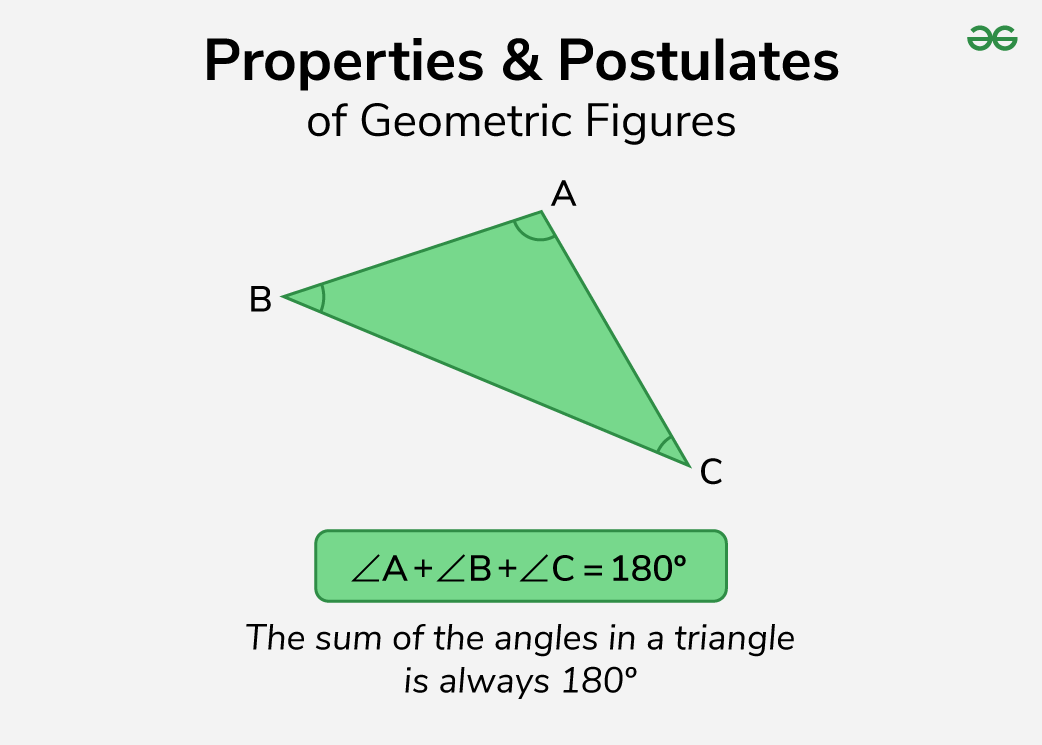
For a geometric figure, the most basic property that will define it is its angles and sides. An angle is a measure of the amount of turn between two sides meeting in coordinates and total value on all three angles, inside triangle shall be equal to 180 degrees.
Postulates are statements accepted as true without proof. They serve as the building blocks for more complex theorems in geometry.
Euclidean postulates, proposed by the ancient Greek mathematician Euclid, are the foundation of geometry. Some key postulates include:
The postulate of parallel lines states that one and only line can be drawn through a point not on a given line that will never intersect the original line. This postulate is important to understanding the behavior of parallel lines on a plane.
One of the Postulates of Triangles is the Angle Sum Postulate which states that the sum of the angles in a triangle is 180 degrees.
Thus, quite generally, the properties and postulates of the geometric figures find active applications in architectural, engineering, and other art fields. They are useful while designing a building, making computer graphics, and even in understanding many natural patterns.
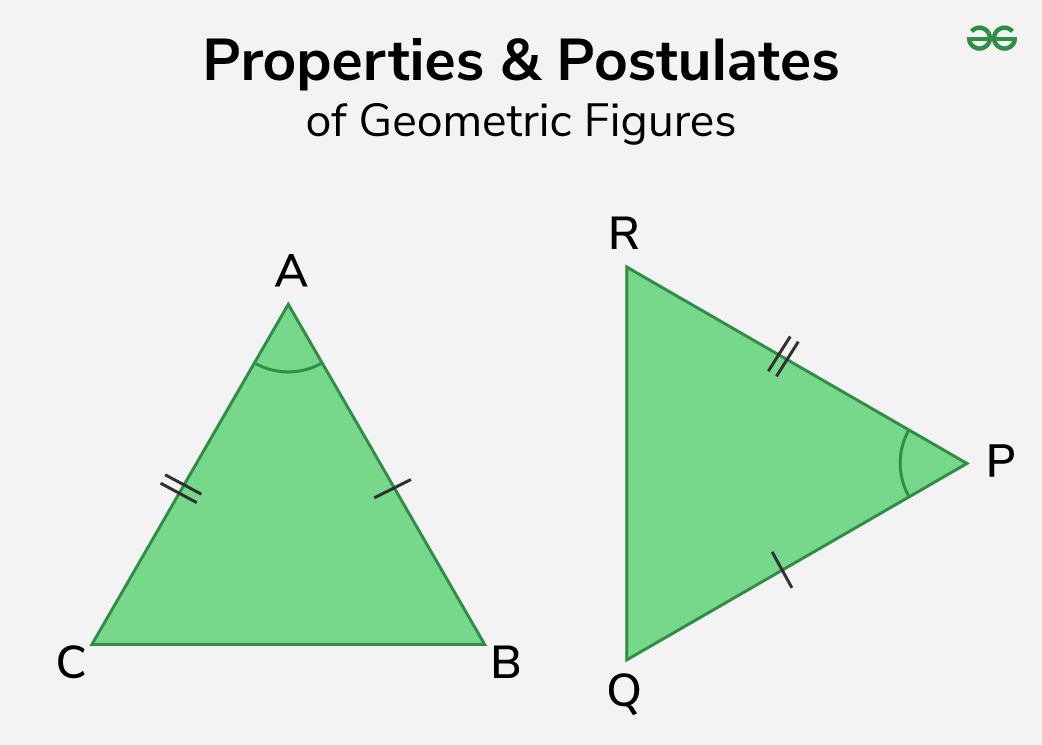
Example 1: Show that two given triangles are congruent by using the Side-Angle-Side (SAS) postulate.
Solution:
In above given figure, sides AB= PQ, AC=PR and angle between AC and AB equal to angle between PR and PQ i.e. ∠A = ∠P. Hence, Δ ABC ≅ Δ PQR.
Read More about Congruence of Triangles.
Example 2: Prove that the sum of the angles in a triangle is 180 degrees.
Solution:
1. Draw triangle ABC.
2. Draw a line parallel to side BC through vertex A.
3. The alternate interior angles formed are equal to the angles at B and C.
4. The sum of the angles on a straight line is 180 degrees.Therefore, the sum of the angles in triangle ABC is 180 degrees.
Read More about Angle Sum Property of Triangle.
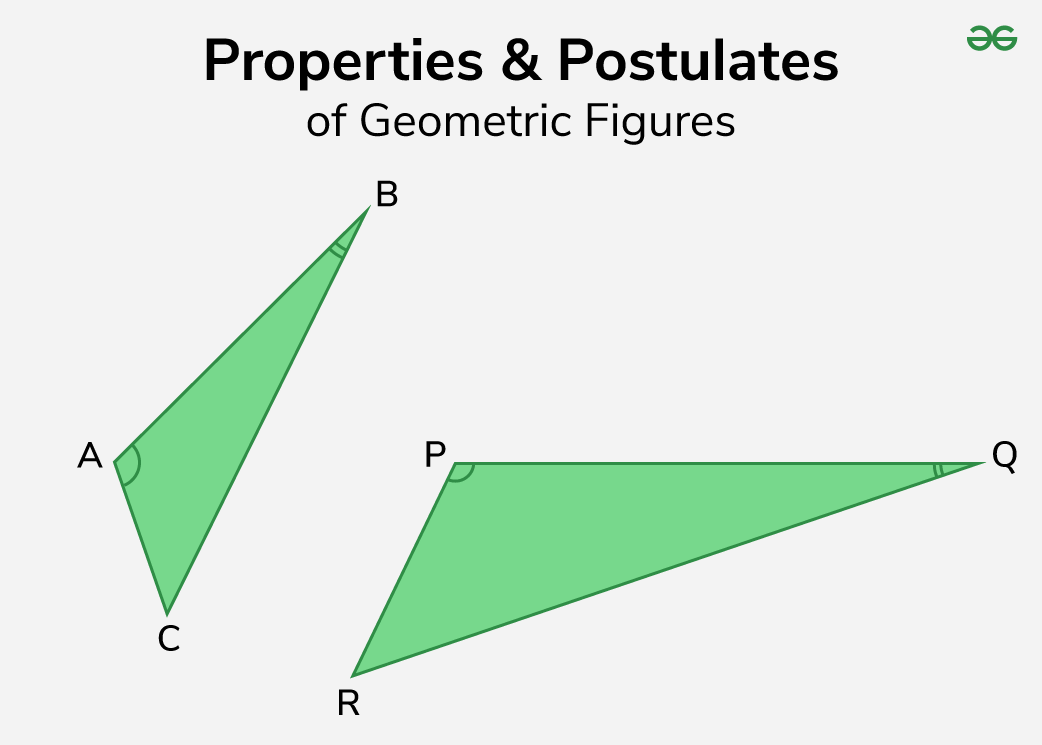
Example 3: Use the Angle-Angle (AA) postulate to show that two triangles are similar.
Solution:
- Given: Two triangles with angles ∠A = ∠P and ∠B = ∠Q.
- Since two angles are equal, the triangles are similar by the AA postulate.
Read More about Similarity of Triangles.
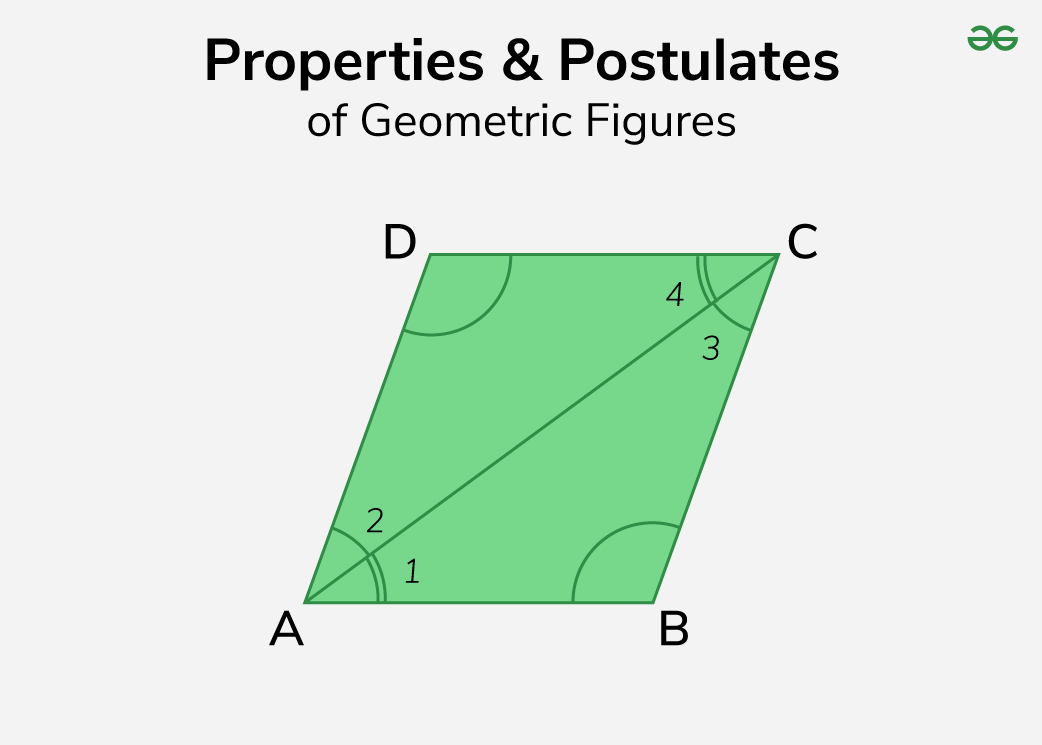
Example 4: Prove that the opposite angles of a parallelogram are equal.
Solution:
In the parallelogram ABCD, diagonal AC is dividing the parallelogram into two triangles. On comparing triangles ABC, and ADC. Here we have:
AC = AC (common sides)
∠1 = ∠4 (alternate interior angles)
∠2 = ∠3 (alternate interior angles)
Thus, the two triangles are congruent, △ABC ≅ △ADC
This gives ∠B = ∠D by CPCT (corresponding parts of congruent triangles).
Similarly, we can show that ∠A =∠C.
Hence proved, that opposite angles in any parallelogram are equal.
Read More about Properties of Parallelogram.
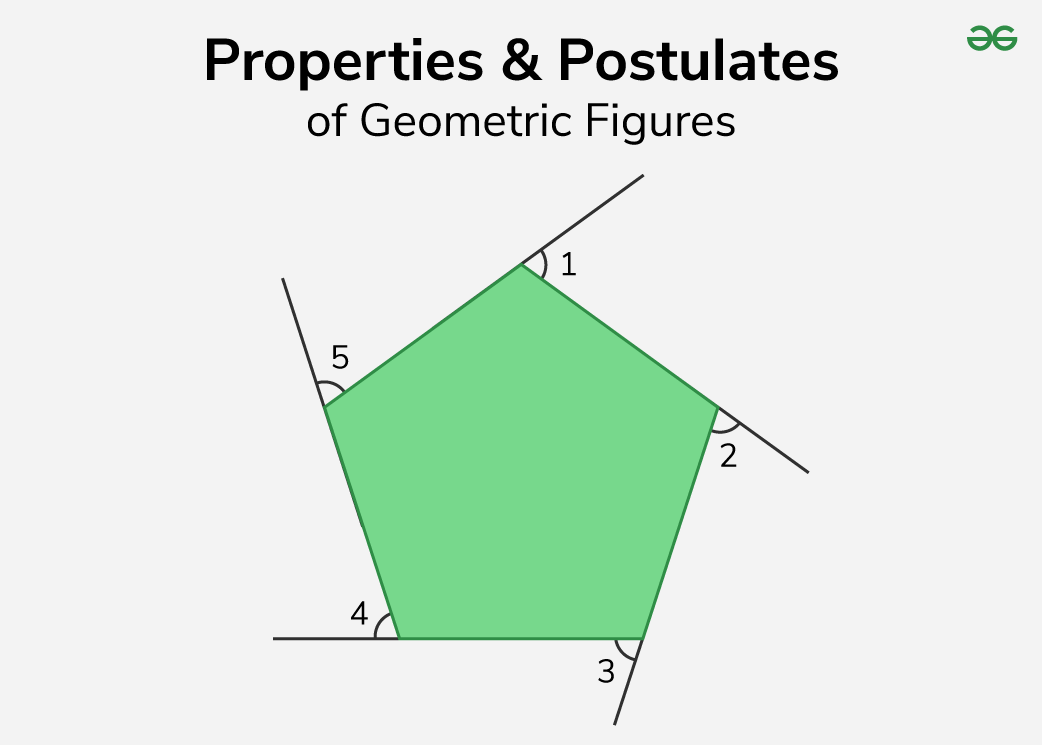
Example 5: Prove that the sum of the exterior angles of any polygon is 360 degrees.
Solution:
Consider a polygon with n number of sides or an n-gon. The sum of its exterior angles is N.
For any closed structure, formed by sides and vertex, the sum of the exterior angles is always equal to the sum of linear pairs and sum of interior angles. Therefore,
N = 180n – 180(n-2)
N = 180n – 180n + 360
N = 360
Hence, we got the sum of exterior angles of n vertex equal to 360 degrees.
Read More about Exterior Angles of Polygons.
Problems 1: Prove that two given quadrilaterals are similar using the concept of similarity.
Problems 2: Find the missing angle in a triangle given two angles.
Problems 3: Show that a given line is parallel to another using the Parallel Line Postulate.
Problems 4: Prove that the diagonals of a rectangle are congruent.
Problems 5: Use the Pythagorean Theorem to find the length of a side in a right triangle.
Problem 6: Prove that two given triangles are congruent using the Side-Angle-Side (SAS) postulate.
Problem 7: Show that a given quadrilateral is a parallelogram using the opposite sides postulate.
Problem 8: Use the Angle Sum Property to find the missing angle in a quadrilateral.
Understanding the properties and postulates of geometric figures is fundamental in geometry. These concepts not only help us solve problems but also provide a deeper insight into the structure and behavior of shapes. Whether you're working on simple triangles or complex polygons, mastering these basics will make geometry more approachable and enjoyable.
Also Read,