|
VOOZH | about |
|
VOOZH | about |
A determinant is a function with entries of a square matrix. For a matrix M = [aij], the determinant of the matrix is denoted as |M| or det M.
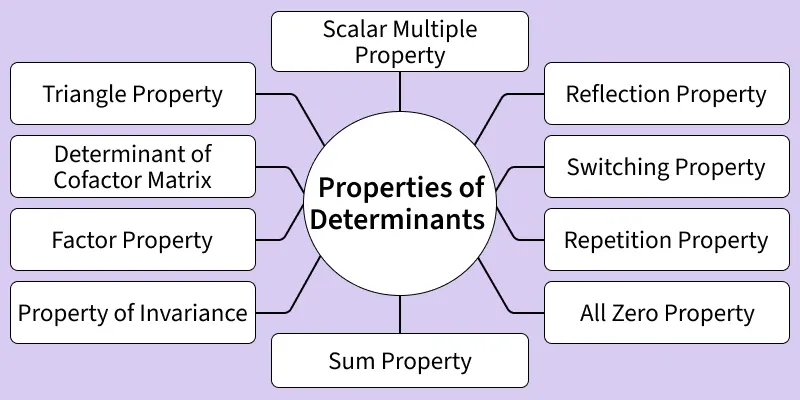
👁 properties_of_determinantsThese various properties of the determinant are based on the elements, rows, and columns of the determinant and are discussed below:
This property of the determinant states that if the elements above or below the main diagonal are zero, then the value of the determinant is equal to the product of the diagonal elements.
For any square matrix A such that,
A =
|A| =
Then, according to the Triangle Property of Determinant
|A| = a × e × i
Example:
A =
|A| =
|A| = 1[(3).(6) -(0)(5)] - 0 + 0
= 1[18 - 0] = 18
|A| = 1 × 3 × 6 = 18
Therefore, |A| = a × e × i
The determinant of the cofactor matrix of a matrix A is equal to the determinant of A raised to the power of (n-1), where n is the order of the matrix.
For any square matrix A of order n, the property is given by,
|C| = |A| n-1
Where,
Example:
A =
n = 2
|A| = (1)(4) − (2)(3) = 4 − 6 = −2
- C11 = |4| = 4
- C12 = - |3| = −3
- C21 = −|2| = −2
- C22 = |1| = 1
C =
|C| = (4)(1) - (-3)(-2) = 4 - 6 = -2
Therefore |A| = |C|2-1
For any square matrix A of variable 'x', if on putting x = a, the value of the determinant is zero, then (x - a) is a factor of the determinant.
Example:
A =
|A| = (x)(x-2) − 0 = x( x - 2)
At x = 2 : 2(x - 2) - 0 = x(x - 2)
(x - a) = (x - 2)
Therefore (x - 2) is a factor of determinant polynomial of x(x - 2)
Suppose we have a square matrix A of order 3
A =
Then adding a scalar multiple of any row or column to any row or column does not change the value of the determinant, i.e.
Ri→ Ri+ (q)Rj
OR
Ci→ Ci+ (q)Cj
where q represents the scalar constant, then the value of the determinant of the new matrix form does not change.
Then the determinants of matrix A and matrix B are equal, i.e.
|A| = |B|
Example:
|A| =
= (1)(2) - (2)(5) = 2 - 10 = -8
|B| =
= (1-15)(2) - (2-6)(5) = -28 + 20 = -8
Therefore |A| = |B|.
If any row or column of a determinant is multiplied by any scalar value, that is, a non-zero constant, the entire determinant gets multiplied by the same scalar; that is,
Case 1 - If any one row or column is multiplied by a constant k, the determinant value gets multiplied by k. Constants may be any real number.
det(Δ') = k det(Δ)
Case 2 - If all rows (or columns) of an n×n determinant are multiplied by k, then
det(Δ′) = kndet(Δ)
Example:
Its determinant is |A| = 8 - 2 = 6
Let us multiply all the elements in the above matrix by 2, say |A|'
|A|' =
|A|' = 32 - 8 = 24
Since both rows are multiplied by 2,
|A|' = 22 × |A| = 4 x 6 = 24
Transpose of a Matrix refers to the operations of interchanging rows and columns of the determinant. The rows become columns and columns become rows in order. It is denoted by |AT| for any determinant |A|.
The property says the determinant remains unchanged on its transpose, that is,
|AT| = |A|.
Example:
|A| =
= (1)(2) - (2)(3) = 2 - 6 = -4
|AT| =
= (1)(2) - (3)(2) = 2 - 6 = -4
Therefore |A| = |AT|.
If we interchange any two rows/columns of the determinant, the magnitude (i.e., the sign) changes, but the determinant value remains the same.
Now,
Value of Determinant = (-1)number of exchanges
For a matrix Δ, one row/column exchanged to get Δ', two rows\columns exchanged to get Δ'', then,
det(Δ") = -det(Δ') = det (Δ)
Example:
Δ =
det (Δ) = 1(-35) - 2(-3) - 4(-15) = -35 + 6 + 60 = 31
det (Δ) = 31
If we interchange C1 and C3, denoted by C1 ↔ C3
Δ' =
det(Δ') = -4(0 + 15) - 2(3) + 1(35) = -60 -6 + 35 = -31
det (Δ) = -det(Δ')
If we again interchange R1 and R2, denoted by R1 ↔ R2
Δ'' =
det(Δ'') = 7(0 - 5) - 0 -3(-20 - 2) = -35 + 66 = 31
det(Δ'') = det(Δ)
Therefore det(Δ") = -det(Δ') = det (Δ)
If any pair of rows or columns of a determinant is identical or proportioned by the same amount, then the determinant is zero.
Example:
A =
= (1)(3) - (3)(1) = 0
If all elements of any column or row are zero, then the determinant is zero
For any matrix,
A =
⇒ |A| = 0
Example:
A =
= (1)(0) - (2)(0) = 0
If all the elements of a row or column in a determinant are expressed as a summation of two or more numbers, then the determinant can be broken down as a sum of corresponding smaller determinants.
We have,
Then,
Example:
A
|A| = (5)(3) - (1)(13) = 15 - 13 = 2
|B| = (6 - 5) + (9 - 8) = 1 + 1 = 2
|A| = |B|
Example 1: Verify det(Δ') = k det(Δ) in,
Δ = k = 3/2
Solution:
Δ =
det(Δ) = 5[(4×7) - (8×5)] - 2[(2×7) - (5×1)] + 3[(2×8) - (4×1)]
det(Δ) = -60 - 18 + 36
det(Δ) = -42Now, on multiplying by k = 3/2, first column,
Δ' =
Δ' =
det (Δ') = -63Therefore,
det(Δ') = 3/2 det(Δ)⇒ det(Δ') = k det(Δ)
Example 2: Find the Determinant of
[A] =
Solution:
|A| =
det(Δ) = 0 (since R2 ⇢0)
Example 3: Find the Determinant of
[A] =
Solution:
|A| =
det(Δ) = 2 × 1 × 8 × 9
det(Δ) = 144
Question 1: Calculate the determinant of the following matrix and state how row swapping affects the determinant:
Swap the rows and then calculate the determinant again.
Question 2: Determine the determinant of the matrix below. Then, multiply the first row by 3 and find the new determinant:
Compare the original determinant with the new one to explain the effect of scalar multiplication on the determinant.
Question 3: Calculate the determinant before and after performing a row operation where you add twice the first row to the second row:
Question 4: Calculate the determinant of the following triangular matrix:
Discuss why the determinant of a triangular matrix is the product of its diagonal elements.
Question 5: Find the determinant of the matrix below, noting what happens when rows are proportional: