|
VOOZH | about |
|
VOOZH | about |
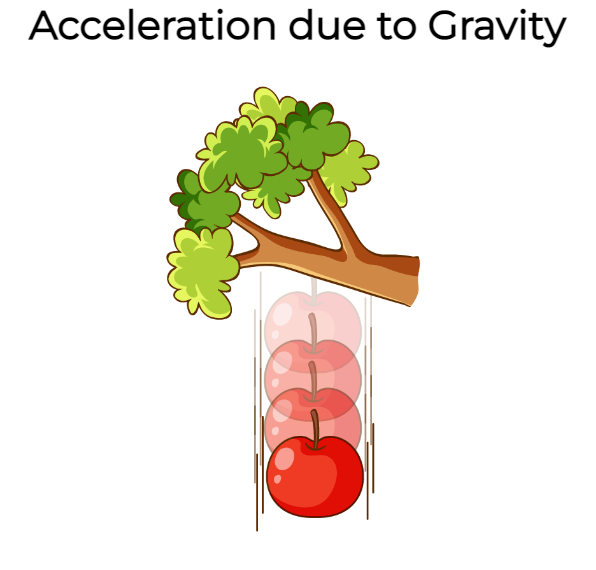
Acceleration due to Gravity is defined as the acceleration attained by an object due to the gravitational force of attraction. When a body falls toward the Earth, it experiences a change in its acceleration due to the gravitational pull (or force) of the Earth. This acceleration is called acceleration due to gravity. This is the acceleration that is attained by an object due to gravitational force.
The acceleration that an object experiences as a result of the gravitational force is known as acceleration due to gravity, and ms-2 is its SI unit. It has a direction and a magnitude, so it is a vector quantity as a result.
The symbol g represents the acceleration due to gravity. Its typical value at sea level on the surface of the earth is 9.8 ms-2. The second law of motion and the law of universal gravitation of Newton serve as the foundation for its calculation.
👁 Acceleration due to gravityMathematically, the acceleration due to gravity is directly proportional to the mass of the object and inversely proportional to the distance from the center of mass, so given as:
or
where,
- g is the acceleration due to gravity,
- G is the Gravitational constant,
- m is the mass of the body and
- r is the distance from the center.
According to the second law of motion:
F = ma
But, in case of a free-falling body, the force is equal to the product of the mass of the body and acceleration due to gravity.
F = mg ......(1)
But, according to the universal law of gravitation:
......(2)
Now, from the equation (1) and (2),
Consider for an ideal case the object is placed near to earth therefore the distance between earth and object will be radius of earth, so replace d with r and rearranging the above expression for g as:
The acceleration due to gravity is stated as:
Here, substitute 6.67 × 10⁻¹¹ Nm2 kg-2 for G, 6 × 1024 kg for M and 6.4 × 10⁶ m for r in the above expression to calculate g at the surface of Earth.
Hence, the value of acceleration due to gravity on the surface of Earth is 9.8 m/s2.
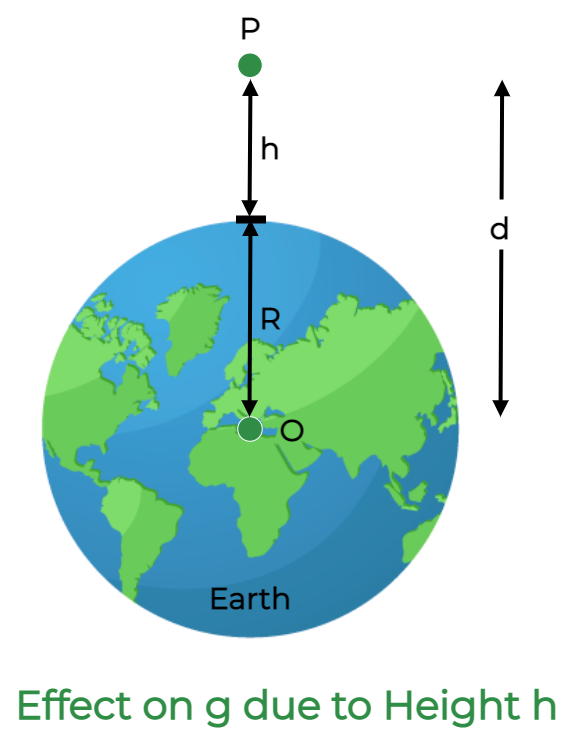
Consider an object (of mass m) P at a height h from the surface of the earth, R be the radius of the earth as shown in the figure below:
👁 Effects on g due to HeightThe gravitational force F acting on the mass m is,
F = GMm/ (R+h)2
where, M is the mass of the Earth.
Since, F = mgh, where gh is the acceleration due to gravity at height h. Then the above equation becomes:
mgh = GMm/(R+h)2
gh = GM/r2 (1+h/r)2
= (GM/r2)/(1+h/r)2
Since, g = GM/r2
Therefore,
gh = g / (1+h/r)2
Now, if h is much lesser than the radius of the earth, the value of g at height h is given by:
gh = g/(1 – 2h/r)
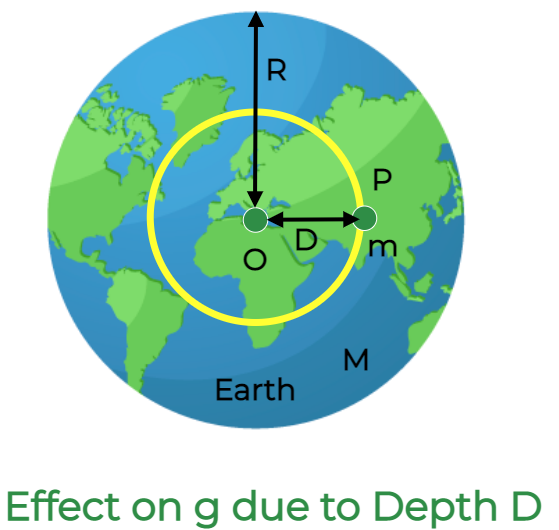
Consider an object (of mass m) P at a depth D from the surface of the earth, R be the radius of the earth as shown in the figure below:
👁 Effects on g due to Depth (d)The acceleration due to gravity at the surface of Earth in terms of density is:
g = 4/3 x πρ x RG
At depth D,
gD = 4/3 x πρ x (R-D)G
On dividing both equations we get,
gd = g x πρ x (R-D)
Now two cases can be possible:
Case 1: If depth D is equal to the radius of the earth i.e. D = R, then:
gd = 0
Case 2: If depth D = 0, i.e. the object is at the surface of earth, then
gd = g
The radius of the earth, an oblate spheroid, is greater towards the equator than it is farther from the poles. The acceleration caused by gravity changes with latitude due to the shape of the earth since it is inversely proportional to the square of the earth's radius for a given mass.
where,
- Re and Rp are the radii of Earth at the equator and the poles, and
- ge and gp are the acceleration due to gravity at the equator and poles, respectively.
Hence, from the above-mentioned equation, it is obvious that the equator experiences less, and the poles have more gravitational acceleration. Therefore, when g lowers, a person's weight falls as they move from the equator to the poles.
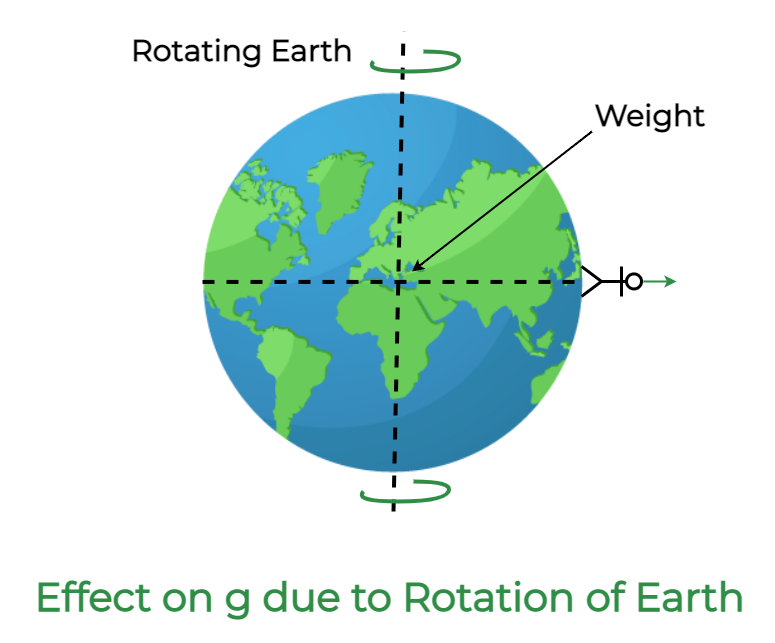
The variation in g is due to the centrifugal force acting on the rotation of the earth. When the earth is rotating, all the objects tend to experience a centrifugal force that won’t act in the direction of gravity.
👁 Effects on g due to the Rotation