|
VOOZH | about |
|
VOOZH | about |
The force of attraction is defined as a force that causes two or more objects to come together, even if they are not near to or touching one another. It is a force that attracts the bodies closer together. According to Newton's universal law of gravity, every mass that exists in the cosmos attracts another mass, and everything that is thrown upwards is bound to fall back on the ground. Magnetic force, electric force, electrostatic force, and gravitational force are some attractive forces.
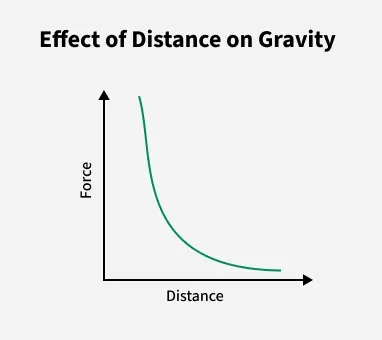
The force of attraction between any two bodies is directly proportional to their masses and inversely proportional to the distance between them. It is denoted by the symbol Fg . Its unit of measurement is Newton (N), and the dimensional formula is given by [M1L1T-2]. Its formula is equal to the product of the gravitational constant and the ratio of the product of masses of the bodies to the square of the distance between them.
Fg = Gm1m2/r2
Where,
- Fg is the force of attraction,
- G is the gravitational constant with the value of 6.67 ×10⁻¹¹ Nm2/kg2,
- m1 is the mass of a body,
- m2 is the mass of other body,
- r is the distance between the two bodies.
Consider a system of two bodies of masses m1 and m2 such that they are separated by a distance r. It is known that the force of attraction between these two bodies is directly proportional to the product of the masses of the bodies.
F ∝ m1m2 ⇢ (1)
Also, the force is indirectly proportional to the square of the distance between the two bodies. So we get,
F ∝ 1/r2 ⇢ (2)
From (1) and (2),
F ∝ m1m2/r2
Replacing the proportionality sign with a constant, we get,
Fg = Gm1m2/r2
Here, G is known as the gravitational constant.
This derives the formula for force of attraction between two bodies.
Solution:
m1 = 50
m2 = 100
r = 20
Using the formula we get,
F = Gm1m2/r2
= (6.67 ×10−11 × 50 × 100)/(20)2
= 8.3375 × 10⁻¹⁰ N
Solution:
m1 = 100
m2 = 150
r = 80
Using the formula we get,
F = Gm1m2/r2
= (6.67 ×10−11 × 100 × 150)/(80)2
= 1.5625× 10⁻¹⁰ N
Solution:
m1 = 200
m2 = 170
r = 1000
Using the formula we get,
F = Gm1m2/r2
= (6.67 ×10−11 × 200 × 170)/(1000)2
= 2.2678 × 10⁻¹² N
Solution:
F = 2.8 × 10⁻¹²
r = 120
Using the formula we get,
F = Gm2/r2
=> m2 = Fr2/G
=> m2 = (2.8 × 10-12 × 120 × 120)/(6.67 ×10−11)
First, calculate 1202=14400
Substitute that in:
m= √ (2.8×10−12)×14400/ 6.67×10⁻¹¹
m= √6.05×10²
m=√605≈24.6kg
Solution:
F = 1.89 × 10⁻¹¹
r = 60
Using the formula we get,
F = Gm2/r2
=> m2 = Fr2/G
=> m2 = (1.89 × 10-11 × 60 × 60)/(6.67 ×10−11)
=m=√1.02×103
=m=√1020≈31.95kg
Solution:
F = 4.2 × 10⁻¹²
m1 = 16
m2 = 32
Using the formula we get,
F = Gm1m2/r2
=> r2 = Gm1m2/F
=> r2 = (6.67 ×10−11 × 16 × 32)/(4.2 × 10-12)
=> r2 = 3.4144×10⁻⁸ / 4.2× 10⁻¹²
r2=8.13×10³
r= √8.13×10³≈90.2m
Solution:
We have,
F = 2.6 × 10⁻¹¹
m1 = 40
m2 = 34
Using the formula we get,
F = Gm1m2/r2
=> r2 = Gm1m2/F
=> r2 = (6.67 ×10−11 × 40 × 34)/(2.6 × 10-11)
=> r2 = 9.0792×10⁻⁸/ 2.6× 10⁻¹¹
r2=3492
r=√3492≈59.1m