|
VOOZH | about |
|
VOOZH | about |
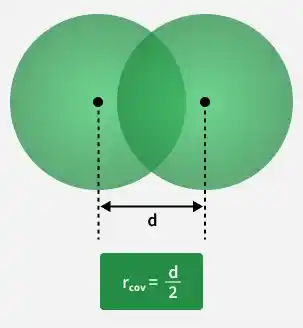
Atomic radius refers to the size of an atom. It is generally defined as the distance from the centre of the nucleus to the outermost shell of electrons. Since atoms are extremely small and the position of electrons is not fixed, it is difficult to measure the exact boundary of an atom. Therefore, atomic radius is usually determined by measuring the distance between the nuclei of two atoms that are bonded together.
It helps us understand how the size of atoms changes in the periodic table and how atoms interact with each other during chemical bonding. Atomic radii vary for different elements depending on factors such as the number of electron shells, nuclear charge, and shielding effect.
Atomic Radius = Distance between the two nuclei / 2
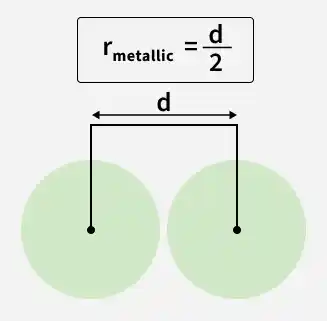
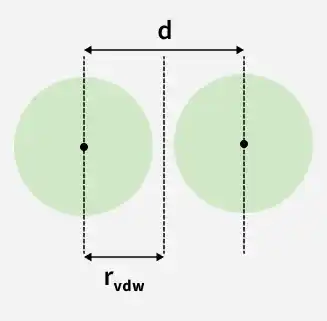
Based on how atoms are bonded or arranged, atomic radii are classified into the following types:
Example:
In a hydrogen molecule (H2), the distance between the two hydrogen nuclei is about 74 pm, so the covalent radius of hydrogen is 37 pm.
Example:
- Na⁺ (sodium ion) is smaller than a neutral sodium atom because it loses one electron.
- Cl⁻ (chloride ion) is larger than a neutral chlorine atom because it gains one electron.
Example:
Metals such as sodium (Na) and copper (Cu) have metallic radii measured from the distance between neighbouring atoms in their metallic lattice.
Example:
Noble gases such as neon (Ne) and argon (Ar) do not form covalent bonds, so their size is measured using the van der Waals radius.
The values are given in picometers (pm), where 1 picometer is equal to 1×10-12 meters.
Element | Atomic Number | Atomic Radius |
|---|---|---|
Hydrogen | 1 | 53 |
Helium | 2 | 31 |
Carbon | 6 | 67 |
Nitrogen | 7 | 56 |
Oxygen | 8 | 48 |
Fluorine | 9 | 42 |
Neon | 10 | 38 |
Sodium | 11 | 186 |
Magnesium | 12 | 160 |
Aluminum | 13 | 143 |
Silicon | 14 | 118 |
Phosphorus | 15 | 98 |
Xenon | 54 | 140 |
Bromine | 35 | 94 |
Zinc | 30 | 142 |
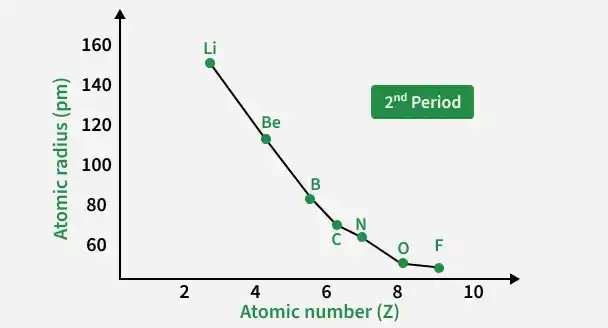
In the periodic table, the atomic radius shows a regular pattern when moving across a period or down a group. These patterns are known as periodic trends of atomic radii.
Example:
The atomic radius gradually decreases from sodium (Na) to chlorine (Cl) in the same period.
👁 2nd_periodExample:
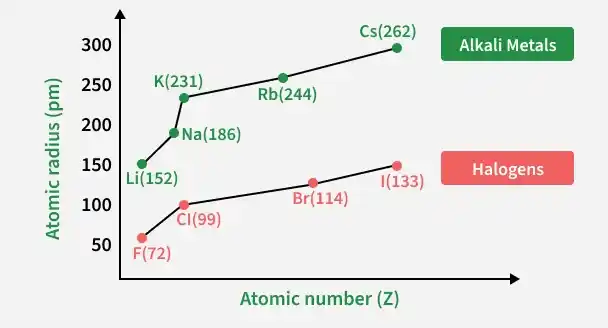
The atomic radius increases from lithium (Li) to sodium (Na) to potassium (K) in the same group.
Example:
The atomic size increases from lithium (Li) to sodium (Na) to potassium (K) because each element has an additional electron shell.
Example:
Across a period, the atomic radius decreases from sodium (Na) to chlorine (Cl) because the nuclear charge increases.
Example:
In heavier atoms like potassium (K), inner electrons shield the outer electron from the nucleus, making the atom larger.