|
VOOZH | about |
|
VOOZH | about |
Electric field lines are a representation used to visualize the electric field surrounding charged objects.
The concept of an electric field line is used to define an electric field near charged particles. They were first used by Michael Faraday to define an electric field due to an electron and a proton. They are also called electric lines of force.
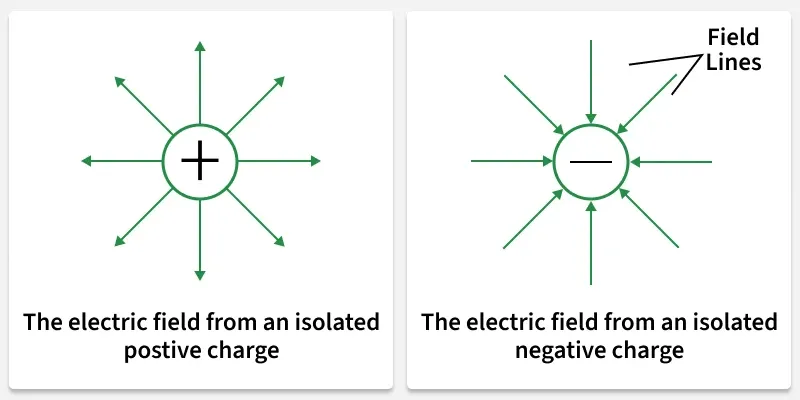
They are regular lines without any breaks and are curved in nature. In the case of a positive charge, the direction of the electric field lines is radially outwards, and in the case of a negative charge, the direction of the electric field lines is radially inwards. Also, the density of the electric field lines shows the strength of the electric field, i.e., the more electric field lines in an area, the stronger the electric field there.
The rules used for drawing electric field lines are discussed below:
Using the above rules, we can draw electric field lines for different configurations of electric charges.
In the case of an individual positive charge, the direction of the electric field line is radially outwards, and in the case of an individual negative charge, the direction of the electric field line is radially inwards.
For two equal and unlike charges, the electric field will originate from the positive charge and enter into the negative charge, forming a closed loop.
In the case of two equal and like charges, both will exert a repulsive force on each other, and the arrangement of electric field lines will be on either side of each charge.
Example 1: At any time, a force of 10 N is operating on the charge of 18 μC. Determine the intensity of the electric field at that location.
Solution: Given:
F = 10 N, q = 18 μCE = F/q
E = 10 / 18 × 10-6
E = 5.5 × 10⁵ N/C
Example 2: Calculate the strength of the electric field at a distance of 12 cm with a voltage of 68 V.
Solution: Given:
V = 68 V, r = 12 cmE = V/r
E = 68/12
E = 5.66 V/cm
Example 3: A force of 12 N is acting on the charge of 27 μC. Find Electric Field.
Solution: Given:
F = 12 N, q = 27 μCE = F/q
E = 12 / 27 × 10-6
E= 4.44 × 10⁵ N/C
Example 4: If The electric field is 6.4 N/C at a distance of 6 cm, then find the voltage.
Solution: Given:
E = 6.4 N/C, r = 6 cmV = E × r
V = 6.4 × 6
V = 38.4 V