|
VOOZH | about |
|
VOOZH | about |
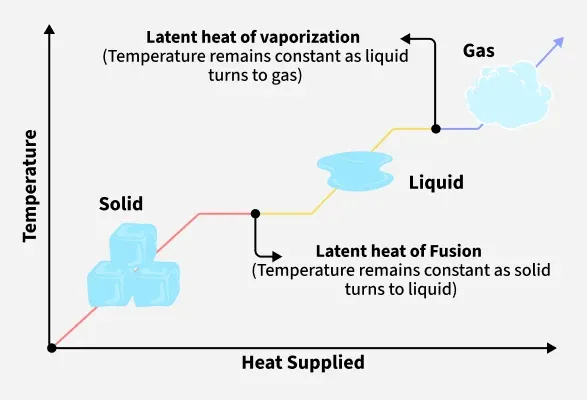
Latent heat of fusion is defined as the amount of heat received by a solid body to transform it into a liquid without raising the temperature of the substance. When a substance is changing its phase from liquid to solid or solid to a gas or a gas to a liquid, this latent heat comes in handy to find the energy of the reaction. Latent Heat of Fusion is related to the solid-to-liquid phase change.
We can calculate the Latent Heat of Fusion using the following formula:
Q = mL + mcΔT
Where,
- Q is the latent heat of fusion,
- m is the mass of the body,
- L is the specific latent heat of fusion,
- c is the specific heat of the body,
- ΔT is the temperature change during heat absorption.
If there is no change in temperature(ΔT = 0) and the energy provided to the matter is only used for the transition of phase, then
Q = mL
Where,
- Q is the latent heat of fusion,
- m is the mass of the body,
- L is the specific latent heat of fusion,
The specific heat of fusion is the amount of energy required to change the phase of a unit mass of a substance from solid to liquid, without changing its temperature. As there is a phase change happening in this transfer of energy, the substance should be at the melting point in temperature already. As specific heat of fusion varies for different substances. Some commonly known values are:
These values represent the amount of heat energy required to change 1 gram of the substance from solid to liquid at its melting point.
Similar to the specific heat of fusion, molar heat of fusion is defined as the amount of energy required to change the phase of a unit mass of a substance from solid to liquid, without changing its temperature. As phase change only happens when a substance is heated to the melting point, the substance under consideration for molar heat of fusion is already at the melting point.
The SI unit of latent heat of fusion is joules per kilogram (J/kg). Other units of latent heat of fusion are calorie/kilogram, joule/gram, calorie/gram, erg/gram, kilojoule/kilogram, etc. For example, the latent heat of fusion for water in the form of ice is 334 kJ/kg. This means that it takes 334 kJ of heat to melt 1 kg of ice at 0 degrees Celsius.
Note: Dimensional formula for the latent heat of fusion is given by [M0L2T−2].
There are various examples of the latent heat of fusion.
The latent heat of fusion of ice is the heat required to change the state of ice, i.e. it is the amount of heat required to change the ice into water without changing its temperature. The latent heat of Ice is 334 kJ/kg.
👁 Latent Heat of Fusion of IceThe latent heat of Fusion for various elements and compounds can be calculated using the formula. The latent heat of fusion for some common elements is given in the following table:
Elements | Latent Heat of Fusion (J/g) | Latent Heat of Fusion (Cal/g) |
|---|---|---|
Aluminium (Al) | 397 | 94.89 |
Chlorine (Cl2) | 181 | 43.26 |
Copper (Cu) | 209 | 49.95 |
Gold (Au) | 63.7 | 15.22 |
Hydrogen (H2) | 59.5 | 14.22 |
Iron (Fe) | 247 | 59.03 |
Lead (Pb) | 23 | 5.5 |
Mercury (Hg) | 11.4 | 2.72 |
Nitrogen (N2) | 25.3 | 6.05 |
Oxygen (O2) | 13.7 | 3.27 |
Silver (Ag) | 105 | 25.1 |
Sodium (Na) | 113 | 27.01 |
Tungsten (W) | 285 | 68.12 |
Zinc (Zn) | 112 | 26.77 |
For some common compounds, the latent heat of fusion is given in the following table:
Compounds | Latent Heat of Fusion (J/g) | Latent Heat of Fusion (cal/g) |
|---|---|---|
Water (H2O) | 334 | 79.83 |
Methane (CH4) | 58.4 | 13.96 |
Ethane (C2H6) | 95.1 | 22.73 |
Propane (C3H8) | 80.1 | 19.14 |
Butane (C4H10) | 80.2 | 19.17 |
Carbon Dioxide (CO2) | 195 | 46.61 |
Ammonia (NH3) | 334 | 79.83 |
Ethanol (C2H5OH) | 109 | 26.05 |
Methanol (CH3OH) | 352 | 84.13 |
Benzene (C6H6) | 102 | 24.38 |
Chloroform (CHCl3) | 78.4 | 18.74 |
Acetone (CH3COCH3) | 92 | 21.99 |
Problem 1: Calculate the latent heat of fusion for a body of mass 40 g at 20°C if it absorbs heat at 80°C. It is given that the specific latent heat of steam is 540 cal/g and the specific heat of the body is 0.5 cal/g °C.
Solution:
We have,
m = 40, ΔT = 80 - 20 = 60, L = 540 and c = 0.5
Using the formula, we get,
Q = mL + mcΔt
⇒ Q = (40 × 540) + (40 × 0.5 × 60)
⇒ Q = 21600 + 1200
⇒ Q = 22800 Cal
Problem 2: Calculate the latent heat of fusion for a body of mass 20 g at 40°C if it absorbs heat at 100°C. It is given that the specific latent heat of steam is 540 cal/g and the specific heat of the body is 0.1 cal/g °C.
Solution:
We have,
m = 20, ΔT = 100 - 40 = 60, L = 540, and c = 0.1
Using the formula we get,
Q = mL + mcΔt
⇒ Q = (20 × 540) + (20 × 0.1 × 60)
⇒ Q = 10800 + 120
⇒ Q = 10920 Cal
Problem 3: Calculate the latent heat of fusion for 7 g of water getting converted into ice. It is given that the specific latent heat of ice is 80 cal/g.
Solution:
We have,
m = 7, and L = 80
Using the formula we get,
Q = mL
⇒ Q = 7 (80)
⇒ Q = 560 Cal
Problem 4: Calculate the latent heat of fusion for 60 g of steam getting converted into water. It is given that the specific latent heat of water is 533 cal/g.
Solution:
We have,
m = 60
L = 533
Using the formula, we get,
Q = mL
⇒ Q = 60 (533)
⇒ Q = 31980 cal
Problem 5: Calculate the mass of water that gets converted into ice, given that the specific latent heat of ice is 80 cal/g and the latent heat of fusion is 200 cal.
Solution:
We have,
Q = 200
L = 80
Using the formula we get,
Q = mL
⇒ m = Q/L
⇒ m = 200/80
⇒ m = 2.5 g
Problem 6: Calculate the mass of steam getting converted into water, given that the specific latent heat of water is 533 cal/g and the latent heat of fusion is 700 cal.
Solution:
We have,
Q = 700
L = 533
Using the formula we get,
Q = mL
⇒ m = Q/L
⇒ m = 700/533
⇒ m = 1.31 g
Problem 7: Calculate the latent heat of fusion for a body of mass 30 g if its specific latent heat of steam is 540 cal/g and the heat absorbed by it is 200 calories.
Solution:
We have,
m = 30F
L = 540
Q' = 200
Using the formula, we get,
Q = mL + Q'
⇒ Q = (30 × 540) + 200
⇒ Q = 16200 + 200
⇒ Q = 16400 Cal