|
VOOZH | about |
|
VOOZH | about |
Mass and weight are fundamental concepts in physics that help us understand how objects behave under the influence of forces, especially gravity. In everyday life, these terms are often used interchangeably, but in physics, they have distinct meanings and significance. Mass is a measure of the amount of matter and inertia in a body, whereas weight is the force acting on it due to gravity.
To understand this difference, we must consider how forces act in nature. Any change in the speed or direction of an object requires a force. For example, when an object is dropped from a height, it falls toward the Earth; planets revolve around the Sun, and the Moon revolves around the Earth. All these motions occur due to a common force identified by Isaac Newton, known as the gravitational force. Understanding mass and weight helps explain how this force affects different objects.
Mass is defined as the amount of matter present in a body. It is also a measure of a body's inertia, which means its resistance to any change in its state of rest or motion.
Mass is an intrinsic property of an object, meaning it remains constant everywhere—whether the object is on Earth, the Moon, or in outer space.
Formula of Mass (when density is known):
Weight is defined as the force with which a body is attracted towards the Earth or any other celestial body due to gravity. Unlike mass, weight is not constant and varies depending on the gravitational field.
Formula of Weight:
Whenever an object falls freely under the influence of gravity, it experiences an acceleration called acceleration due to gravity, denoted by (g).
where:
On Earth, the value of (g) is approximately 9.8 m/s².
From Newton’s second law of motion:
F = ma
For gravitational force:
W = mg
This shows that weight is directly proportional to mass, but it also depends on gravity. Hence, if gravity changes, weight changes, but mass remains constant.
| Mass | Weight |
|---|---|
| Amount of matter in a body | Force of gravity acting on a body |
| Scalar quantity | Vector quantity |
| Constant everywhere | Varies with location |
| Measured in kilograms (kg) | Measured in newtons (N) |
| Measured using a beam balance | Measured using a spring balance |
| Cannot be zero | Can be zero in space |
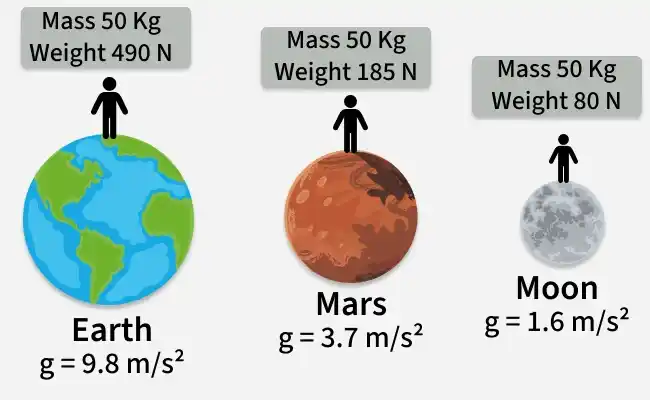
The value of gravity differs from planet to planet, so weight also changes accordingly.
This is why astronauts feel lighter on the Moon, even though their mass remains the same.
Weightlessness is the condition in which a body appears to have zero weight. This occurs when there is no normal reaction force acting on the body, such as during free fall.
Examples:
In these cases, even though gravity is present, the body does not feel its weight because everything is falling together.
This clearly shows how weight changes but mass remains constant.
Problem 1: The mass of an object is 10 kg. What is its weight on the earth?
Solution: Given that,
Mass (m) = 10 kg
Acceleration due to gravity (g) = 9.8 m s–2
Expression of the weight is
W = m × g
Substitute the values in the above equation.
W = 10 kg × 9.8 m s-2 = 98 N
Thus, the weight of the object is 98 N.
Problem 2: An object weighs 10 N when measured on the surface of the earth. What would be its weight when measured on the surface of the moon?
Solution: Given,
Weight of an object on Earth is 10 N
Relation between the weight of an object on Earth (We) and weight of an object on Moon (Wm)
Wm = (1⁄6)×We
Substitute the value in the above expression.
Wm = (1⁄6)×10 N
Wm = 1.67 N
Thus, the weight of the object on the surface of the moon would be 1.67 N.
Problem 3: What is the relation between the weight of an object on the Earth and the weight of an object on the moon?
Solution: Given,
- Mass of the Earth is 5.98 ×1024 kg.
- Mass of the Moon is 7.36×10²² kg.
- Radius of the Earth is 6.37×10⁶ m.
- Radius of the Moon is 1.74×10⁶ m.
Let the mass of an object be m, the weight on the moon be Wm, the mass of the moon be Mm and its radius be Rm.
From the universal law of gravitation,
Wm = (G Mm m)/(R)2
Substitute the values in the above expression.
Wm = (G 7.36×10²² kg m)/(1.74×106 m)2 . . .(1)
Let the weight of the same object on the earth be We, the mass of Earth is M and its radius is R then the expression for the weight of the object on Earth is
We = (G M m)/(R)2
Substitute the values in the above expression
We = (5.98 ×1024 kg m)/(6.37×106 m)2. . .(2)
Divide equation (1) and (2),
Wm/We = 2.431 1010/1.474 1011
⇒ Wm/We = 0.165
⇒ Wm/We ≈ 1/6
⇒ Wm ≈ (1⁄6)×We