|
VOOZH | about |
|
VOOZH | about |
NCERT Solutions for Class 10 Science Chapter 11 The Human Eye And The Colourful World- This article includes free NCERT Solutions for Class 10 Science Chapter 11 The Human Eye And The Colourful World, according to the latest CBSE Syllabus 2023-24, and guidelines.
These detailed solutions have been developed by the subject matter experts at GFG, to help the students of Class 10 create a solid conceptual base for Class 10 Science Chapter 11 The Human Eye And The Colourful World and do well in exams.
👁 NCERT Solutions for Class 11 Physics Chapter 10 The Human Eye And The Colourful WorldThe solutions to all the exercises in NCERT Class 10 Science Chapter 11 The Human Eye And The Colourful World have been collectively covered in NCERT Solutions for Class 10.
To learn about the topics discussed in Chapter 11 The Human Eye And The Colourful World of Science NCERT Class 10 from scratch, head over to Human Eye.
Answer:
Accommodation of the eye is the ability of the eye to increase or decrease its focal length in order to form the image of the object on the retina.
Answer:
As the person has myopia, it can be corrected using a concave lens of focal length equal to 1.2 m.
Answer:
Near point of an eye is the distance at which the human eye can see the objects without strain. It is 25 cm for a human eye. Far point of an eye is the maximum distance at which a human eye can see clearly. It is infinity for human eye.
Answer:
As the child cannot see far away object, the child is probably suffering from myopia. It can be corrected using a concave lens of an appropriate power.
Answer:
The ability of the human eye to focus on near and distant objects by adjusting its focal length is termed as accommodation. Hence, option (b) accommodation is the correct answer.
Answer:
Human eye has a layer at its end which is connected to the brain through nerve cells. Retina acts as a screen and forms the image of the object by receiving the light coming from the object. The nerve cells behind the retina convert the light to electrical signals and thus we are able to see. Hence, option (d) retina is the correct answer.
Answer:
The least distance of distinct vision for a young adult with normal vision is about 25 cm. Hence, option (c) 25 cm is the correct answer.
Answer:
Human eye has the ability to change its focal length by adjusting the size of pupil. The adjustment of the size of the pupil is done with the help of ciliary muscles. Thus, option (c) ciliary muscles is the correct answer.
Answer:
We know that power of lens (P) = 1/focal length of lens (f)
(i) Given P = -5.5 D
Using P = 1/f
-5.5 = 1/f
f = -0.181 m
Thus, a lens of focal length -0.181m is required for correcting distant vision.
(i) Given P = 1.5 D
Using P = 1/f
1.5 = 1/f
f = 0.66 m
Thus, a lens of focal length 0.66 m is required for correcting near vision.
Answer:
Myopia is a condition in which a person cannot see far away objects as the image of object is formed in front of the retina. Myopia can be corrected by using a concave lens of appropriate power. Power of lens is calculated as follows:
Given f = -80 cm = -0.8 m( we use negative sign as image is formed in front of the retina)
We know that P = 1/f
P = 1/(-0.8) = -1.25 D
Answer:
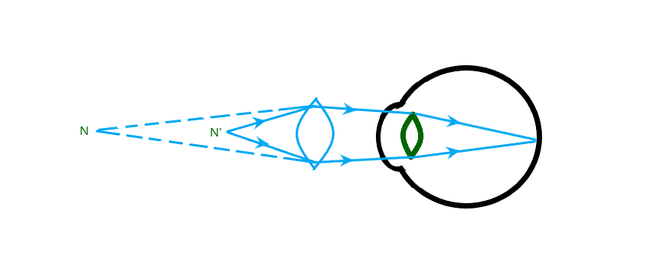
Hypermetropia is a condition in which a person is not able to see near objects clearly as the image of the object is formed behind the retina. It can be corrected using convex lens. The image for correction of hypermetropia using convex lens is shown below:
👁 Correction of Hypermetropic EyeThe convex lens used in the above diagram forms a virtual image at the point N (new near point of the eye) of the object which is placed at the point N'. Thus the image of the virtual image so formed by the convex lens is now formed on the retina.
Given u = -25 cm (negative sign is used as we move towards left from retina)
v = -100
We know that 1/v - 1/u = 1/f
⇒ -1/100 - (-1/25) = 1/f
⇒ 1/f = -1/100 + 1/25 = 3/100
⇒ f = 100/3 cm = 1/3 m
Also P = 1/f
⇒ P = 1/(1/3) = 3D
Thus a lens of power 3D is required to correct this defect.
Answer:
Ability of eye to alter its focal length is upto a certain limit only and it cannot be decreased or increased below or above that limit. Thus the human eye cannot see the objects placed closer than 25 cm as 25 cm is the near point of the eye and focal length of eye cannot be decreases beyond 25 cm.
Answer:
The image distance does not change in the eye when we increase the distance of an object from the eye and the image is still formed on the retina. This is due to accommodation of eye through which it can change the focal length of lens in eye. Thus increasing the distance of object from eye does not affect the image distance in eye but the eye lens increases its focal length by becoming thinner.
Answer:
The twinkling of stars is due to the refraction of light coming from the stars. Stars are very far away from us and are equivalent to point sources of light. As the light from the stars pass through the Earth's atmosphere which has different refractive index at different points, multiple refractions occur and the light coming from the stars flickers due to refraction which make the stars twinkle.
Answer:
Planets are closer to the Earth than the stars and thus appear bigger in size due to which they act as a collection of a large amount of point sources of light. Though the light coming from planets also undergo refraction but the net effect of the refraction gets neutralized due to presence of multiple point sources and the flickering is not visible to the human eye due to which planets do not twinkle.
Answer:
Visible Light is composed of seven colors. Each color has a different wavelength. In morning the sun rays have to travel a greater distance to reach the Earth due to which the colors of the spectrum with shorter wavelengths are scattered and not able to reach us. As blue light has the least wavelength, it gets scattered the most and the red light has highest wavelength and gets scattered the least and is able to reach us. This leads to sun appearing reddish in the early morning.
Answer:
When the light enters Earth' s atmosphere, it is scattered by the various particles present in our atmosphere. Blue color is scattered the most and hence sky appears blue to us but in case of an astronaut, he is above the atmosphere of the Earth and no scattering of light takes place due to which the sky appears dark to an astronaut.
In NCERT Class 10 Science Chapter 11 The Human Eye And The Colourful World, we have to study the following topics:
- The Human Eye
- Power of Accommodation
- Defects of Vision and Their Correction
- Myopia
- Hypermetropia
- Presbyopia
- Refraction of Light Through a Prism
- Dispersion of White Light
- Atmospheric Refraction
- Twinkling of Stars
- Advance Sunrise and Delayed Sunset
- Scattering of Light
- Tyndal Effect
- Colour of Sky
Also, Check: