|
VOOZH | about |
|
VOOZH | about |
When plane waves encounter a boundary between two media, they may undergo reflection or refraction. Reflection causes the waves to return into the same medium, while refraction results in a change of direction as the waves enter a different medium.
The behavior of these plane waves at the boundary can be explained using Huygens’ Principle, which provides a geometric interpretation of wavefront propagation.
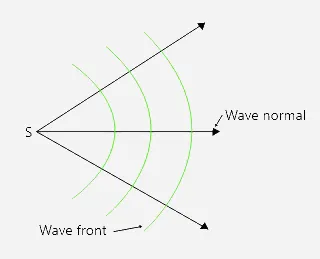
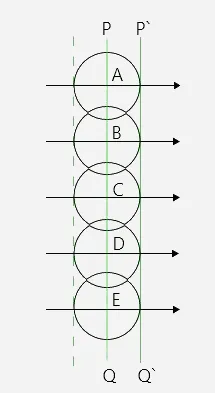
Huygens' principle, named after Dutch physicist Christiaan Huygens, is a fundamental concept in wave theory. It says that every point on a wavefront can be considered as a source of secondary wavelets. These wavelets propagate outward in all directions at the speed of the wave itself. The new wavefront at any later time is then the envelope tangent to these secondary wavelets.
This principle helps explain phenomena like diffraction, reflection, and refraction of waves. It forms the basis for understanding how waves propagate and interact with obstacles and boundaries.
In optics, for example, Huygens' principle can be used to understand the behavior of light waves as they pass through small apertures or diffract around obstacles. It provides a conceptual framework for explaining phenomena such as interference and the formation of wave patterns.
There are three types of wavefronts:
Now, let's apply Huygens' principle to understand both reflection and refraction of light waves:
When a light wave encounters a reflecting surface, such as a mirror, the incident wavefront strikes the surface. According to Huygens' principle, each point wavefront behaves as a source of secondary wavelets.
These secondary wavelets spread out spherically from each point. The reflected wavefront is formed by the tangent points of the secondary wavelets. This new wavefront is perpendicular to the reflecting surface at each point.
Thus, Huygens' principle helps to explain the laws of reflection: the angle of incidence is equal to the angle of reflection, and the incident ray, the normal, and the reflected ray all lie in the same plane.
According to the law of reflection:
The laws of reflection using Huygens' principle is proved below:
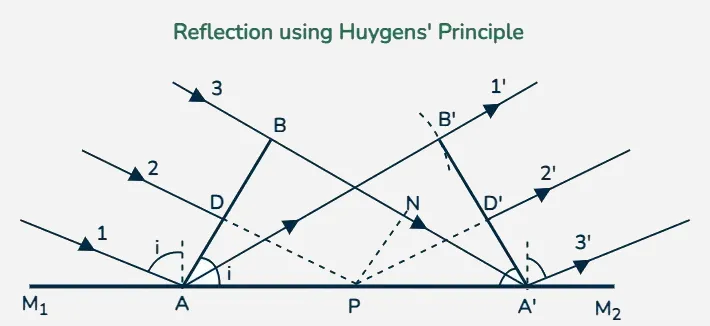
Assume that AB is the plane wavefront incident on the plane mirror M1 M2 .
Let ∠BAA’ = ∠i be the incident angle. The incident rays to wavefront AB are 1, 2 and 3.
According to Huygens' Principle, every point along the wavefront AB acts as a source of secondary wavelets.
Let's assume that the secondary wavelets from point B reach point A' in time t.
BA’ = c × t ……………………..(1)
where, c = velocity of light in vacuum
Let secondary wavelets from point A goes at point B’ in time interval t .
AB’ = c × t ………………………(2)
If you join A’ and B’, the reflected wavefront will be A’B’.
The reflected rays perpendicular to A’B’ are 1′, 2′ and 3′. Also, let B’A’A is equal to r( the reflection angle ).
We use similar triangles AA’B and AA’B’.
BA’ = AB’ (From (1) and (2))
∠B = ∠B’ (Both are 90)
AA’ = AA’ (Common Base)
Hence, triangles AA’B and AA’B’ are congruent.
∠i = ∠r
Thus law of reflection using Huygens' law is proved.
Refraction occurs when a light wave passes from one medium to another with a different optical density, causing a change in its speed and direction.
According to Huygens' principle, when a light wave passes through the boundary between two different media, each point on the incident wavefront becomes a source of secondary wavelets in the new medium. These secondary wavelets propagate forward at the speed of light in the new medium, which may be different from the speed in the previous medium.
The new wavefront is formed by the tangent points of these secondary wavelets. The change in the wavefront's direction is what we observe as the bending of light when it enters a different medium.
The degree of bending is described by Snell's law, which establishes that the ratio of the sines of the angles of incidence and refraction equals the ratio of the speeds of light in the two media.
The law of refraction using Huygens' Principle is discussed below:
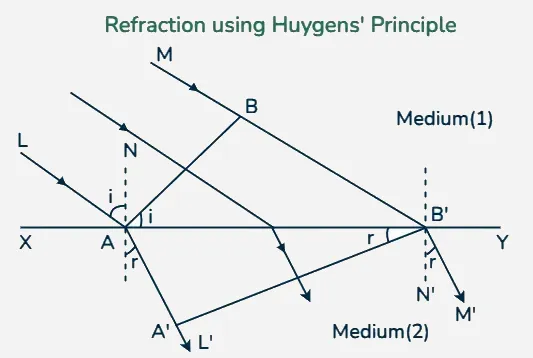
Let us take a parallel beam of light which is incident on refracting plane surface XY at glass surface . The incident wavefront AB is in rarer medium 1 and the refracted wavefront AB is in denser medium 2.
These wave fronts are perpendicular to the incident rays L, M and refracted says L', M' respectively. By the time point A of the incident wave fronts touches the refracting surface , point B is to travel a distance BB' to touch the refracting surface B'.
When point B hits the refracting surface at B', point A would have moved to A' in the other medium.
The time taken t for the ray to travel from B to B' is same as the time taken for the ray to travel A to A' .
t = BB'/v1 = AA'/v2
t = BB'/AA' = v1/v2
Now, Angle of incidence, i = ∠NAL = 90° -∠NAB = ∠ BAB'
Angle of refraction, r = ∠ N'B'M' = 90° - ∠A'B'A
For the two right angle triangle ABB' and B'A'A,
sin i/sin r = (BB'/AB')/(AA'/AB') = BB'/AA' = v1/v2 = c/v2 /c/v1
Here , c is the speed of light in vacuum . The ratio c/v is the constant, called refractive index of medium .
sin i/ sin r = n2/n1
In product form, n1 sin i = n2 sin r
Hence, the law of refractions are proved .