|
VOOZH | about |
|
VOOZH | about |
The Box-Cox transformation, introduced by statisticians George Box and David Cox, offers a systematic way to address this problem. It transforms non-normal data into a form that better approximates normality, stabilizes variance and enhances the applicability of methods that rely on normality assumptions.
The Box-Cox transformation belongs to a family of power transformations that adjust the shape of a dataset's distribution. It is particularly useful for positively skewed data such as financial metrics, biological measurements or time-to-event data.
The transformation is mathematically defined as:
Where:
For = 0, the transformation is equivalent to the natural logarithm. For other values of λ, it performs a power transformation scaled by λ.
The objective is to find the value that best normalizes the data by maximizing the log-likelihood function. This process is automated using computational tools.
Python's scipy.stats module provides the boxcox function, which:
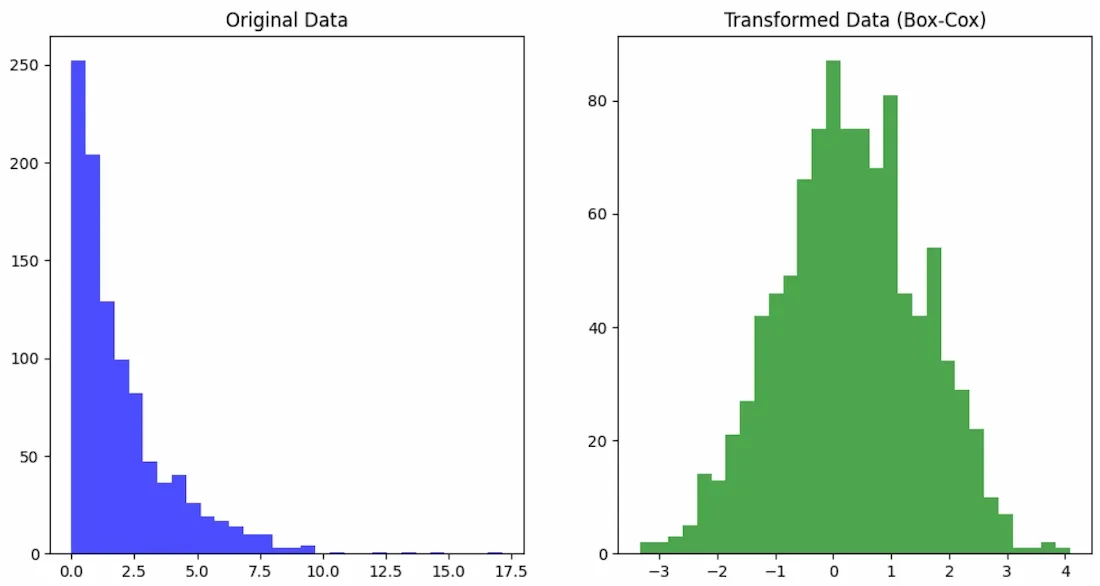
We will use a sample dataset from an exponential distribution (which is right-skewed) to demonstrate the process.
Here we will import the required python libraries:
Displays the value of that best normalizes the dataset.
Output:
Optimal lambda: 0.24201319421740217
Output: